_画板-1.png)
Tired of the mud, grass clippings, and constant upkeep around your pool? A beautiful poolside is great, but the maintenance can be a real headache. It often feels like a losing battle.
Yes, you can absolutely lay artificial turf in swimming pool areas. It is not for use inside the pool itself. For the surrounding areas, it creates a clean, low-maintenance, and beautiful landscape. The key is to choose the right materials and ensure it is installed correctly.
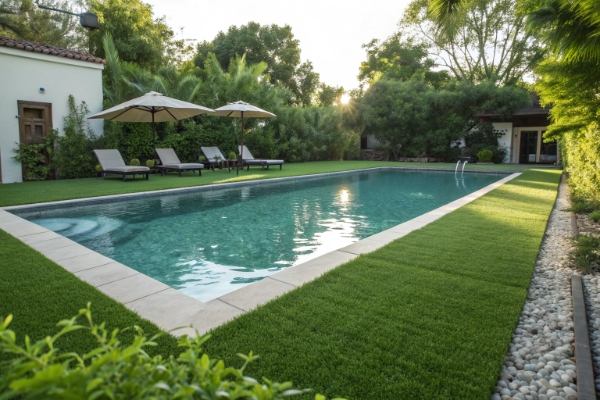
Many of my clients, from homeowners to hotel managers, ask me about using artificial turf around their pools. It’s a fantastic idea, but there are some very important things you need to know to do it right. If you miss these details, you could end up with problems down the road. I want to walk you through the most common questions I get. This will help you make the best decision for your project and ensure your poolside area looks great for years to come. Let’s get into the details.
Can you put fake grass around a pool?
Do you dream of a perfect green lawn right up to the edge of your pool, but hate the thought of mud? Real grass gets waterlogged and often dies from chemical splashes.
Yes, putting fake grass around a pool is an excellent choice. It provides a lush, green look all year without the mess of mud or grass clippings. It creates a comfortable, clean, and slip-resistant surface for everyone to enjoy, making your poolside safer and more beautiful.
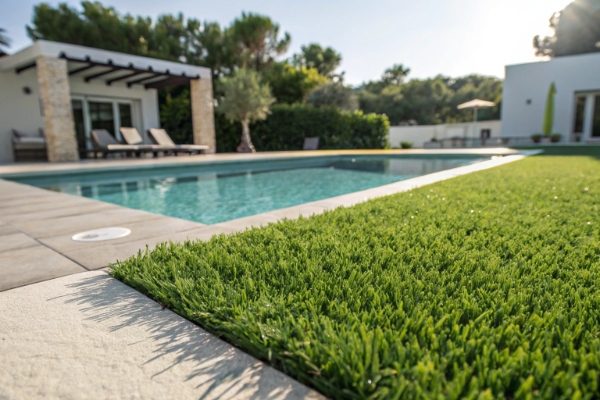
I remember a client of mine, James from Australia, who was so frustrated. His kids and their friends were constantly running in and out of the pool. They would track wet grass and mud all through the house. He felt like he was always either mowing the lawn, cleaning the pool filter, or cleaning the floors. He wanted a solution that was clean, safe, and looked good. We decided on artificial turf for his pool surround, and it completely changed his experience.
The benefits go far beyond just looking good. Let’s break it down further.
Benefits of Poolside Artificial Turf
When you compare artificial turf to other common poolside surfaces, you can see why it’s such a popular choice for my clients. It solves many common problems.
| Surface Type | Safety (Slip) | Maintenance | Comfort |
|---|---|---|---|
| Artificial Turf | Excellent grip | Very low | Soft, not hot |
| Concrete | Can be slippery | Low | Hard, gets very hot |
| Wood Decking | Splinters, slippery | High (staining) | Gets hot, splinters |
| Natural Grass | Muddy, slippery | Very high | Soft, but messy |
As you can see, artificial turf hits the mark on all the important points. It stays green, doesn’t need mowing or watering, and provides a soft surface for walking and playing. Plus, no more mud! It’s important to remember that we are talking about the area around the pool. I never recommend putting it inside the pool. Just like in a fish tank, it would become a breeding ground for microorganisms and be impossible to keep clean.
Does pool water damage artificial turf?
You’re ready to invest in a beautiful new turf lawn. But you worry that the splashing from the pool will ruin it. Chlorine and constant water can destroy many materials, after all.
Generally, pool water does not damage high-quality artificial turf. The fibers are non-porous and UV-stabilized. However, you must choose a turf with a polyurethane (PU) backing, as a latex backing can degrade with constant moisture. Highly concentrated chlorine1 can also cause some fading over time.
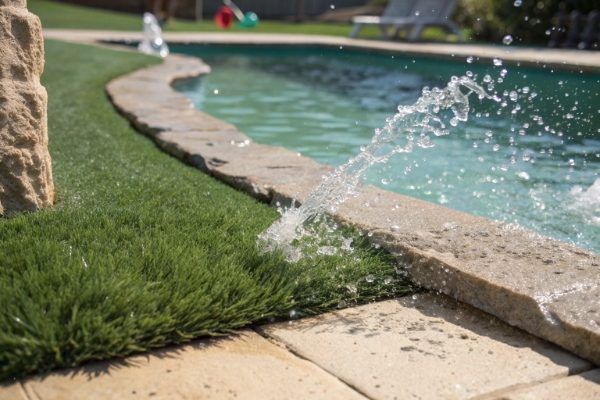
This is one of the most technical, but most important, questions my customers ask. When I worked in the factory, I saw firsthand how these products are made. The quality of the materials makes all the difference, especially in a demanding environment like a poolside. A client like Michael, a property developer, needs to know his investment will last. He can’t afford to have the turf failing after just a couple of years. So, we need to look at two key parts: the backing and the chemicals.
The Role of Backing: PU vs. SBR Latex
The backing is the material on the underside of the turf that holds the grass blades in place. For a pool area, this is not a detail you can ignore.
- SBR Latex Backing2: This is a common backing for standard landscaping projects. It’s effective, but it can act like a sponge. If it’s constantly wet, it can hold water, which leads to mold, mildew, and eventually, the material will break down. I never recommend this for pool surrounds.
- Polyurethane (PU) Backing3: This is what you need. A PU backing is fully waterproof. It does not absorb water at all. This means it will not rot or grow mold, even with daily splashes from the pool. It costs a little more, but for a poolside project, it is the only choice for long-term success.
Chlorine and Your Turf
Pools need to be clean, and that usually means disinfectants. The most common one is chlorine.
Normal, diluted chlorine splashing from the pool is perfectly fine for the turf fibers. They are designed to be tough. The real risk comes from spills of concentrated chlorine. If you accidentally spill a bottle of pure or highly concentrated chlorine on the turf, it can cause discoloration. It’s like spilling bleach on a carpet.
My advice is simple. If possible, use a neutral disinfectant for your pool. If you must use chlorine, be careful when handling the concentrated chemicals. Mix them away from the turf area to avoid spills.
How to install artificial grass around a pool?
So you’ve chosen the perfect turf. Now you need to install it. But a poolside job has unique challenges. A poor installation can lead to big problems like poor drainage and lifting edges.
A successful poolside installation starts with an excellent drainage base. After preparing the base, you must use turf with a PU backing, seam it carefully, and secure the edges firmly, especially the edge against the pool coping. This prevents lifting and ensures water drains away properly.
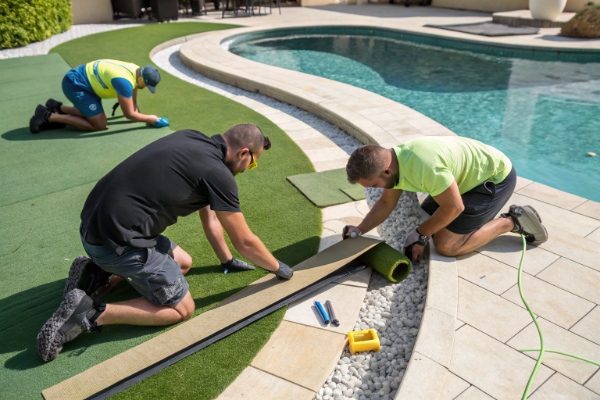
A proper installation is everything. I’ve seen projects fail not because of the product, but because of shortcuts taken during this stage. A purchasing manager like Carlos in Mexico needs his projects to be durable and safe. For him, the installation process is just as critical as the turf quality. Let’s walk through the key steps and special considerations for a pool.
Step 1: Base Preparation is Everything
You can’t just lay turf on top of soil. For a pool, you need a solid base that drains water away fast.
This usually involves excavating 3-4 inches of the existing ground. Then, we put down a layer of crushed rock or stone. This is compacted to create a firm, level, and very permeable base. Any water that gets on the turf will go right through the backing and drain away through the stone base, preventing any puddles.
Step 2: Laying, Cutting, and Seaming
Once the base is perfect, we roll out the turf. We always make sure the grass blades (the pile) all point in the same direction for a uniform look. Cutting the turf to fit the exact curves of a pool requires skill and patience. We then seam the pieces together using a special tape and strong adhesive. You should not be able to see the seams when it’s done.
Special Considerations for Pools
Installing around a pool is not a standard job. There are two more things I always emphasize with my clients.
- Securing the Edges: The edge of the turf that meets the pool deck or coping is a high-traffic area. We secure this edge very thoroughly with nails or adhesive to ensure it never lifts up. A lifted edge is a trip hazard.
- Preventing Static: Sometimes, in very dry climates, artificial turf can build up a little static electricity. When you add water, it can sometimes give a tiny, harmless shock. To prevent this, I recommend using anti-static yarns in the turf or ensuring the installation includes extra grounding nails that penetrate deep into the base. This grounds the turf and eliminates any static buildup.
Conclusion
So, can you use artificial turf around a pool? Yes. It’s a fantastic, low-maintenance solution that creates a beautiful and clean space. Just remember to choose PU backing and ensure a professional installation.
-
Discover the impact of chlorine on turf and how to protect your investment from potential damage. ↩
-
Learn why SBR latex backing may not be suitable for pool areas and how it can affect your investment. ↩
-
Understanding PU backing is crucial for ensuring your turf withstands poolside conditions without degrading. ↩
_画板-1.png)