_画板-1.png)
Contractors often struggle with establishing natural grass in high-traffic municipal or commercial zones. When seeds fail to take root under heavy trampling, the project handover gets delayed. You might wonder if hybrid turf can actually help grass grow and solve this problem.
Hybrid turf does not act as a fertilizer to make grass grow faster. Instead, woven hybrid turf features an open-mesh structure that acts as physical armor. It allows natural grass to grow through the mesh while protecting the vulnerable roots and crown from severe mechanical damage and heavy trampling.
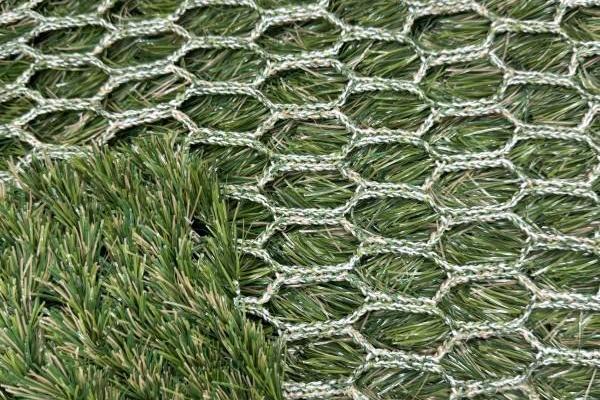
To understand how this system performs in real-world engineering projects, we need to look beyond agronomy. Let us explore the mechanical and structural ways this material interacts with natural grass.
How Does Woven Hybrid Turf Support Natural Grass?
Traditional artificial grass completely suffocates the soil beneath it. This creates a major issue for landscape developers who want the ecological benefits of real grass. How exactly does a hybrid system solve this permeability problem?
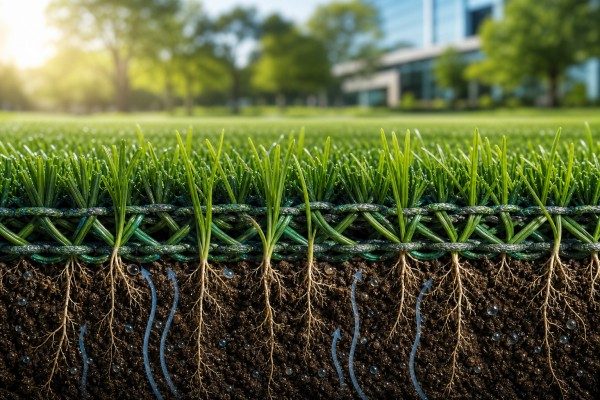
Woven hybrid turf supports natural grass by regulating the surface micro-climate and preventing soil erosion. The open-mesh backing retains essential moisture and moderates soil temperature for seeds, providing a stable, protective environment where natural grass can safely germinate and coexist with synthetic fibers.
As a manufacturer, I constantly speak with landscape contractors who misunderstand how synthetic materials interact with living plants. We must shatter the "impermeable backing" myth. Standard artificial turf uses solid polyurethane or latex backings equipped with small, sparse drainage holes. These standard backings block root growth and choke out natural vegetation.
Woven hybrid turf, also known as grow-through turf, is engineered entirely differently. The backing is an open-mesh grid. When you roll this out over a prepared, seeded soil base, you are essentially installing a structural grid over the earth.
Here is how the physical structure actively supports the natural grass during its critical growth phases:
- Moisture Retention: The synthetic fibers cast micro-shadows over the topsoil. This slight shading reduces rapid water evaporation from the sun, keeping the seedbed moist.
- Temperature Moderation: The mesh layer acts as a mild insulating blanket, protecting fragile seeds from extreme temperature fluctuations1 during early spring or late autumn installations.
- Erosion Control: In municipal roadside green belts or sloped park areas, heavy rainfall routinely washes away topsoil and expensive seeds. The woven grid locks the soil surface in place2, securing the seeds until they sprout.
We are not dealing with agricultural magic here. The turf provides a stable, highly engineered matrix that eliminates the environmental volatility that usually kills young grass.
Why Is the Open-Mesh Structure Critical for Root Protection?
High-intensity trampling destroys natural grass faster than it can regenerate.3 For sports field developers and park contractors, continuous maintenance is a costly nightmare. Why is the open-mesh design the ultimate defense against this damage?
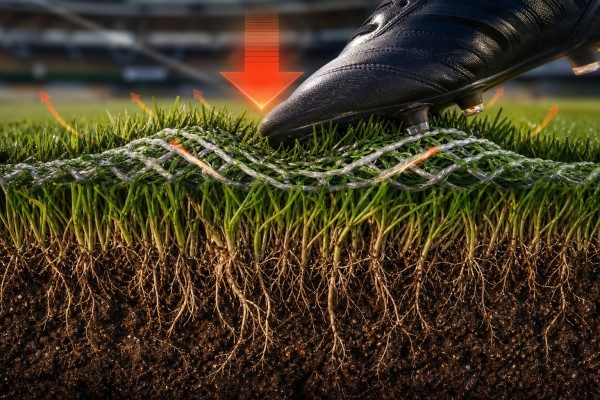
The open-mesh structure is critical because it shields the natural grass crown from direct impact. While foot traffic may crush the upper blades of the natural grass, the woven hybrid turf absorbs the mechanical stress, ensuring the roots remain completely intact and capable of fast regeneration.
When B2B buyers ask me about grass growth, I always reframe the question. Instead of asking if the product helps grass grow, I ask: "What is the trampling intensity and usage frequency of your project, and does your natural grass need structural armor?"
Mechanical Armor for the Grass Crown
The survival of natural grass depends entirely on the crown—the critical junction where the shoots meet the roots at the soil surface. If heavy foot traffic, athletic cleats, or maintenance machinery crushes the crown, the plant dies.
When you install woven hybrid turf, the synthetic fibers stand slightly above or flush with the natural grass crown. As pedestrians walk across the park or athletes run across the field, the durable synthetic fibers take the brunt of the compressive force. The natural grass blades might get clipped or bent, but the vital crown and root system remain safely protected beneath the mesh grid. Because the roots are healthy, the natural grass recovers and regrows incredibly fast.
Comparing Turf Systems
To make informed procurement decisions, buyers must understand the physical differences between surfacing options.
| Feature | Standard Artificial Grass | Pure Natural Grass | Woven Hybrid Turf |
|---|---|---|---|
| Root Protection | N/A (Blocks roots) | None (Vulnerable to trampling) | Excellent (Physical mesh armor) |
| Permeability | Low (Punched holes only) | High | High (Open-mesh design) |
| Wear Resistance | High | Low | Extremely High (Shared load) |
Do not confuse this open-mesh woven system with stitched or injected hybrid systems. Stitched systems require massive machinery to sew fibers deep into a sand profile. Our woven hybrid turf is a roll-out product, making it highly efficient for contractors to install across large municipal and commercial landscapes.
Does Hybrid Turf Provide Immediate Commercial Value?
Waiting for natural grass to grow from seed takes weeks4, leaving construction sites looking like barren dirt patches. Clients hate waiting for visual results. Does hybrid turf offer a faster return on investment for contractors?
Hybrid turf provides immense commercial value by delivering instant green coverage the moment it is installed. Even while the natural grass is still in its vulnerable seed or germination phase, the project immediately looks finished, solving the waiting-period pain point for quick handovers.
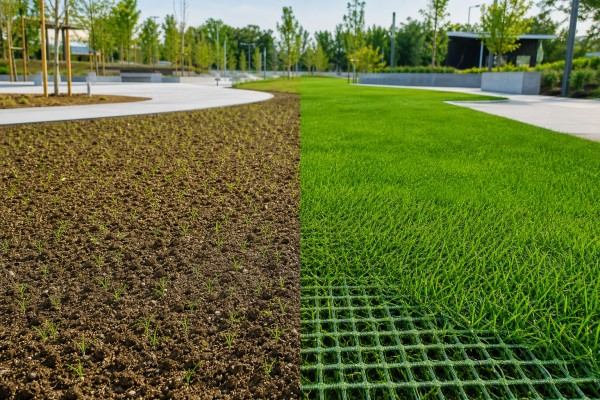
In the commercial landscaping and construction industry, time is money. When a landscape contractor is building a luxury hotel courtyard, a public park, or a school campus, the general contractor demands rapid visual results. Handing over a project that is just a muddy field covered in straw and seeds is often unacceptable, and it can delay final payments.
This is where hybrid turf becomes a massive commercial asset.
The Phases of Visual Greening
- Instant Delivery: On day one of installation, the site is instantly transformed by the green synthetic fibers. It looks clean, professional, and ready for inspection.
- The Growth Phase: Over the next few weeks, the natural grass safely germinates beneath the mesh and grows upward.
- Full Integration: Once fully grown, the natural grass blends perfectly with the artificial fibers, creating a dense, lush appearance.
- Dormancy Protection: During winter months or unexpected droughts, natural grass naturally turns brown or thins out.5 The synthetic fibers remain vibrant, ensuring the landscape maintains a high aesthetic standard year-round.
Furthermore, modern woven hybrid turf is manufactured using eco-friendly, recyclable materials. For government project suppliers and engineering companies bidding on municipal contracts, utilizing materials that meet modern green building standards is a significant competitive advantage. The ability to offer instant aesthetic results while promoting natural ecology makes this a highly profitable product for B2B distributors.
How to Choose the Right Hybrid Turf for Engineering Projects?
Selecting the wrong landscape material can lead to massive project failures and rejected container shipments. With various hybrid systems on the market, how do importers and engineers evaluate the right product?
To choose the right hybrid turf, contractors must evaluate the project’s traffic intensity, required permeability, and the specific open-mesh woven structure. B2B buyers should request physical samples and verify factory certifications to ensure the material can provide adequate structural armor for natural grass.
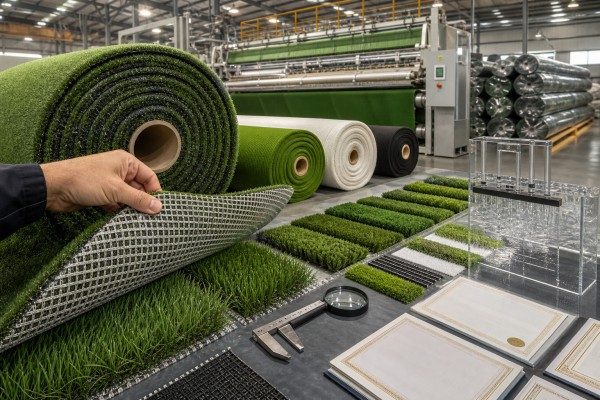
As an exporter handling wholesale and full-container orders daily, I see many sourcing agents make the mistake of buying based on price alone. You cannot treat hybrid artificial grass like a cheap, generic rug. It is a highly engineered landscaping material meant for heavy-duty applications.
Key B2B Evaluation Metrics
When evaluating a manufacturer for a commercial project, you must verify the technical specifications and the supplier’s production capacity.
- Confirm the Open-Mesh Backing: Ensure the factory is actually producing a woven, open-mesh backing. Some suppliers attempt to pass off standard artificial grass with extra drainage holes as "hybrid." That will not work; the natural grass will fail to grow through.
- Pile Height and Density: The specifications must match the application. A roadside green belt might require a different fiber height than a heavy-use football training area.
- Wholesale Logistics: Professional buyers need reliable lead times. For example, a standard 1x40HQ container order typically takes 15–20 days to produce, while customized specifications take 25–30 days.
- Minimum Order Quantities (MOQ): Because this is a specialized manufacturing process, factories require volume. Expect a custom MOQ of around 3,000 square meters per specification to ensure cost-effective production and shipping.
- Certifications: Always treat certifications as documents you must verify. Look for CE, RoHS, ISO9001, and strictly ask for specific test reports if your project requires strict environmental compliance.
Partnering with a direct manufacturer ensures you get accurate technical data, strict quality control, and the production capacity needed to keep your large-scale engineering projects on schedule.
Frequently Asked Questions
Does hybrid turf require soil preparation before installation?
Yes. Just like planting pure natural grass, the sub-base must be properly graded and prepared. You must lay down suitable nutrient-rich topsoil and seeds before rolling out the open-mesh turf on top.
Can I mow natural grass that grows through hybrid turf?
Yes, you can use standard mowing equipment. The key is to set the mower blade height slightly above the synthetic fibers. This ensures you only cut the natural grass blades while avoiding damage to the artificial turf.
Is woven hybrid turf the same as stitched hybrid grass?
No. Stitched systems inject synthetic fibers deep into a sand rootzone using specialized heavy machinery. Woven hybrid turf is a highly permeable, roll-out product with an open-mesh backing that allows natural grass to grow upwards through it.
What is the MOQ for wholesale hybrid turf orders?
For custom engineering specifications, a standard minimum order quantity is typically 3,000 square meters. This volume is designed specifically for B2B importers, landscape contractors, and full-container shipments.
Conclusion
So, can hybrid turf help grass grow? It does not provide agronomic nutrients, but its open-mesh woven structure acts as vital physical armor. It regulates soil moisture, prevents erosion, and completely shields the natural grass crown from high-intensity trampling. For contractors, it solves the waiting-period pain point by delivering instant green coverage for rapid project handovers.
If you are a distributor, landscape contractor, or sourcing agent looking to import premium woven hybrid turf for your next commercial project, we are ready to support your supply chain. Contact Alice Chen at QH Grass today to discuss custom specifications and full-container wholesale pricing.
-
"[PDF] Geotextiles and Mats", https://www.escondido.gov/DocumentCenter/View/2774/Geotextiles-and-Mats-PDF. Research on turfgrass establishment shows that permeable synthetic covers and geotextiles buffer the soil against extreme diurnal temperature shifts, creating a more stable thermal environment for seed germination. Evidence role: mechanism; source type: paper. Supports: The insulating properties of permeable synthetic covers on soil temperature.. Scope note: The insulating effect of an open-mesh structure is generally lower than that of solid germination blankets. ↩
-
"[PDF] Geosynthetics for Erosion Control of Slopes", https://mdl.mndot.gov/_flysystem/fedora/2023-04/ris-08.pdf. Environmental protection guidelines and civil engineering standards widely recognize the use of woven geosynthetics and geogrids to anchor topsoil, significantly reducing erosion and seed displacement caused by surface runoff. Evidence role: general_support; source type: government. Supports: The use of woven geosynthetic grids to stabilize topsoil and prevent erosion during precipitation events.. ↩
-
"Foot traffic on turf primarily shaped the endophytic bacteriome of the soil …", https://pmc.ncbi.nlm.nih.gov/articles/PMC12014648/. Sports turf research demonstrates that continuous mechanical stress from high-intensity trampling exceeds the cellular regeneration capacity of natural turfgrass, leading to inevitable thinning and bare patches. Evidence role: general_support; source type: research. Supports: The biological limits of natural turfgrass recovery when subjected to continuous, high-intensity mechanical wear.. ↩
-
"Lawn Establishment", https://extension.psu.edu/lawn-establishment/. Agricultural extension services note that depending on the species and environmental conditions, natural turfgrass typically requires 7 to 21 days to germinate and several additional weeks to establish a root system capable of withstanding traffic. Evidence role: statistic; source type: education. Supports: The standard timeline required for turfgrass seeds to germinate and establish a mature, usable surface.. ↩
-
"Summer Dormancy in Perennial Temperate Grasses – PMC – NIH", https://pmc.ncbi.nlm.nih.gov/articles/PMC2803600/. Turfgrass enters a state of physiological dormancy during periods of extreme cold or prolonged drought, a survival mechanism that results in the cessation of chlorophyll production and the visible browning of the leaf blades. Evidence role: mechanism; source type: education. Supports: The physiological process of turfgrass dormancy in response to cold temperatures and water scarcity.. ↩