_画板-1.png)
My carpet used to trap stains and smells, and I felt like I cleaned it every day. I wanted a floor that looked fun, but also stayed easy.
Yes, artificial turf can work like a carpet when I treat it as an indoor floor covering, choose soft yarn, add a pad, and plan the seams. It cleans faster than many carpets, but it can feel cooler and less “plush,” so the room matters.
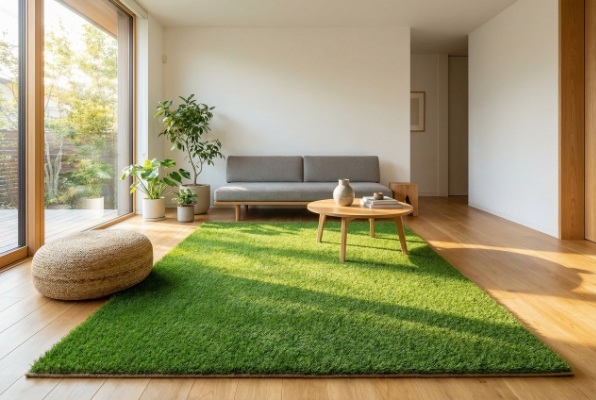
I often tell people that “turf as carpet” is not a joke idea, but it is also not a one-size idea. I want you to keep reading because one small choice, like yarn feel or backing, can decide if you love it or hate it.
Can You Use Artificial Grass as a Carpet Indoors?
Indoor floors get dirty fast, and indoor cleaning feels endless when kids and pets run all day. I saw many people give up because carpet cleaning costs time and money.
Yes, I can use artificial grass indoors as a carpet if I pick an indoor-friendly product and install it like flooring, not like a loose rug. Many turf styles are sold for indoor and outdoor multi-use, so I can place them in home decor areas, schools, pet areas, and even gyms.
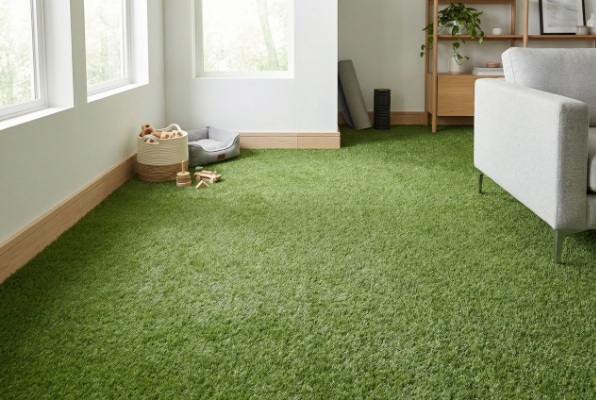
I treat indoor turf like a system. I look at the turf, the base, and the edge details. I also think about what “indoor” really means. Many catalog items list a pile height range from 20mm to 45mm, and they list DTEX ranges from about 5500d up to 14000d or even 17000d, with density ranges shown around 12560 to 23100 turfs/m², and a common gauge like 3/8 inch. Those numbers are not decoration. They decide how the turf feels under socks, how it stands up after foot traffic, and how it hides crumbs.
I also plan installation steps in a simple order: I clean and flatten the subfloor, I add an underlay if I need softness, I seam with tape and glue, and I finish edges so nobody trips. I do not rely on “drainage” indoors the same way I do outdoors, so I focus more on spill control and fast cleanup. I also ask for customization when the feel is wrong, because a supplier can offer custom dtex1, pile heights, density, and backing options when the order size fits their rules.
| Indoor area I build | What I choose | Why I choose it |
|---|---|---|
| Kids play area | Softer yarn feel, medium pile height, pad under | I want knees and elbows to feel safe |
| Pet activity zone | Shorter pile, tighter build, easy seam layout | I want faster pickup and less trapped hair |
| Home gym corner | Firmer feel, stable backing, clean edges | I want stable footing and easy wipe-down |
I learned one lesson the hard way: when I rush seams, I see seams every day. When I slow down on seams, I stop thinking about the floor.
Is Artificial Turf Better Than Carpet for Indoor Use?
People often ask me if turf is “better” because they want one clear winner. I understand that, because nobody wants to buy the wrong floor twice.
Artificial turf can be better than carpet in indoor zones that get heavy traffic, dirt, or spills because it holds up well and it cleans fast, while carpet can be better in living spaces because it feels warmer, softer, and quieter. I choose based on the room’s job.
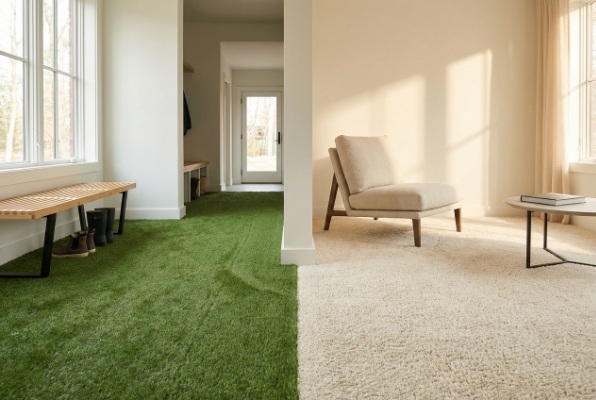
I compare turf and carpet by daily life, not by marketing. A turf product is made from synthetic materials and is positioned as durable and elastic, and many designs try to look and feel close to real grass with straight blades and curled yarn. That durability matters when people walk through with shoes, or when kids drag toys. I also like that many turf products are promoted for multi-use spaces, including patios, schools, pet areas, and gyms, so I know the maker expects wear.
But I do not pretend turf feels like a thick living-room carpet. Carpet usually wins on warmth and sound control. Carpet can also feel “cleaner” to sensitive users if a turf product is low quality, because low quality materials can smell, and buyers worry about chemicals. I reduce that risk by checking supplier claims and tests. I also ask direct questions about heavy metals. Some suppliers state they use lead-free and heavy metal-free materials, and they also say their products follow environmental standards. Those statements do not replace third-party testing, but they tell me what the supplier is trying to meet.
| Factor I care about | Artificial turf indoors | Traditional carpet indoors |
|---|---|---|
| Cleaning time | I can shake, vacuum, or spot rinse fast | I often need deeper cleaning for stains |
| Durability | I usually get strong wear in traffic zones | I often see flattening in paths |
| Feel underfoot | I can tune it with yarn + pad, but it can feel cool | I get soft and warm comfort |
| Smell risk | I must control pet urine cleanup | I must control spills and mold risk |
| Chemical concerns | I choose lead-free, heavy metal-free claims and verify | I still check adhesives and treatments |
I do not chase a perfect answer. I match the floor to the room. I use turf where function matters. I use carpet where comfort matters.
What Are the Pros and Cons of Using Artificial Turf as Indoor Carpet?
When I see a buyer excited about turf as carpet, I also see them ignore the downsides. That is when projects fail, and that is when refunds start.
The main pros are easy cleanup, strong wear, and a unique look for play, pets, or gyms. The main cons are possible scratchy feel if I pick the wrong yarn, odor if I do not clean pet accidents fully, and higher risk if I buy low quality materials without safety checks like lead-free and heavy metal-free claims.
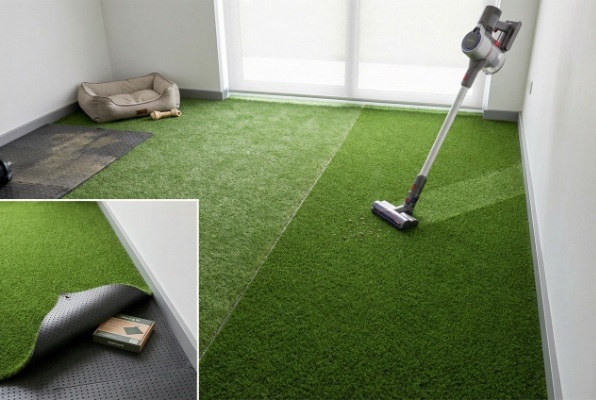
I break the decision into two lists that I can act on. I like turf indoors because it changes the mood of a room fast. I used it in a small gym corner once, and the space looked like a “zone” right away. That idea matches how many turf products are marketed for multi-use places like home decor setups and gyms. I also like the maintenance pattern. I can vacuum it like a carpet, and I can also wipe and spot clean it in ways that carpet does not enjoy.
But the cons are real. I can make turf feel rough if I pick higher dtex with a harder yarn shape, or if I pick a build that is made for outdoor landscapes, not for barefoot indoor use. I can also trap smells if a pet accident soaks through and I do not clean the base layer well. I also worry about unsafe materials when buyers chase the lowest price, so I ask for proof, I ask for samples, and I compare the product to stated claims like lead-free and heavy metal-free materials. I also use customization when a client wants “carpet soft,” because some suppliers offer custom colors, dtex, pile height, density, and backing options for larger orders.
| Issue I see indoors | What causes it | What I do to fix it |
|---|---|---|
| Turf feels prickly | Wrong yarn feel, wrong product type | I choose softer yarn and add an underlay |
| Odor stays after pet urine | Incomplete cleaning under the turf | I lift a corner, clean the base, and use odor treatment2 |
| Seams look ugly | Poor seam tape work or direction mismatch | I align grain direction and use better seam steps |
| Slipping or edge trips | Loose edges, no proper finish | I use edge trims and solid perimeter bonding |
| Health worries | Unknown material quality | I ask for safety docs and check lead/heavy metal claims |
I do not sell turf as “better than everything.” I sell it as a tool. When I use the right tool in the right room, the project feels smart.
Conclusion
Artificial turf can work like indoor carpet, but I win only when I match softness, safety, and installation to the room’s real daily use.
_画板-1.png)