_画板-1.png)
Switching from natural grass to artificial turf confuses many players. You miss passes and hurt your knees. I will explain exactly how to adjust your technique for success.
Yes, artificial turf changes the game significantly. The ball moves faster and bounces higher, requiring sharper ball control and shorter, quicker steps. Players must adapt their passing power and body positioning to manage increased traction and prevent impact injuries.
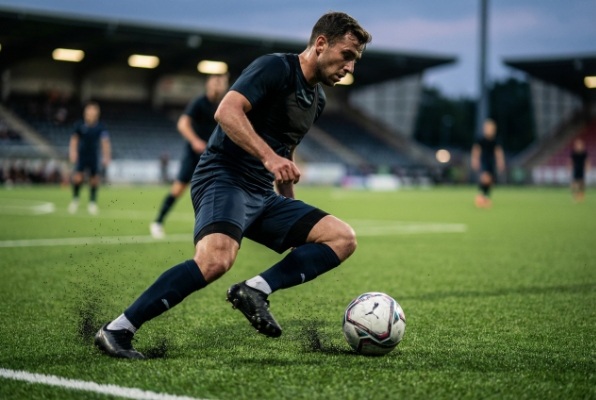
Many football lovers think a pitch is just a pitch, but that mistake leads to bad performance. Let me break down the specific challenges you will face next.
What are the disadvantages of playing on turf?
Playing on synthetic surfaces can leave you with nasty scrapes and exhausted from the heat. Ignoring these risks ruins the fun. Here are the specific downsides you face.
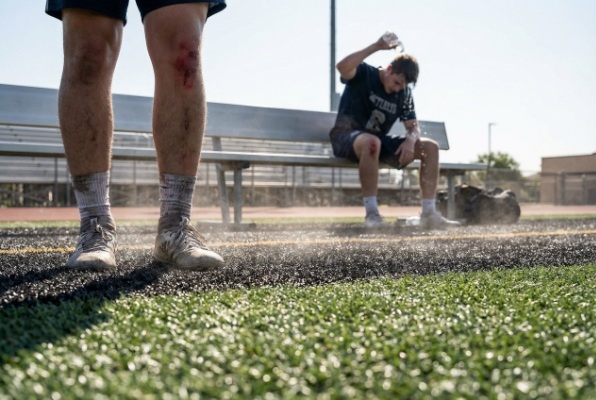
Disadvantages include "turf burn1" from abrasive friction, higher surface temperatures causing heat stress, and potential exposure to chemical odors from rubber infill. The surface is harder than soil, increasing stress on joints and changing how the ball reacts during play.
I started my career in the technical department of a workshop, so I look at the materials to understand playability. The biggest disadvantage is the heat. Natural grass cools the air, but artificial turf traps solar energy. We use black rubber particles for performance filling, usually 4 to 7 kilograms per square meter. These black crumbs absorb sunlight and can reach temperatures high enough to melt plastic soles or cause heatstroke.
Another issue is the "feel" of the ground. The surface is often harder than natural soil. If the installation team does not use a shock pad, the ground returns more energy to your legs. This causes joint pain. Also, the friction is different. When you slide on grass, the mud gives way. When you slide on plastic fibers, they burn your skin. This is the dreaded "turf burn."
There are also environmental and health worries. The rubber filling, often made from old tires, can smell bad in the heat. People worry about chemicals like polycyclic aromatic hydrocarbons. As an engineer, I also see the issue of microplastics. Older fields shed fibers that end up in the water. We try to solve this with better materials, but it remains a disadvantage for older fields.
Here is a breakdown of how the field composition affects your game:
| Feature | Cause | Effect on Player |
|---|---|---|
| Ball Bounces | High density fibers (10,500+ needles/sqm) | The ball bounces higher and faster. You have less time to react. |
| Surface Heat | Black rubber infill | Causes faster fatigue and dehydration. |
| Friction | Plastic polyethylene fibers | leads to skin abrasions during tackles. |
| Hardness | Compressed quartz sand base | Increases impact shock on ankles and knees. |
Do ACL tears happen more on turf or grass?
Every player fears the "pop" in their knee during a turn. Many blame the fake grass for these career-ending injuries. Let us look at what the data actually says.
Research suggests ACL injuries occur more frequently on artificial turf due to higher rotational resistance. Cleats grip the synthetic fibers too tightly, fixing the foot in place while the knee twists. Lack of shock absorption2 in older fields also contributes to this risk.
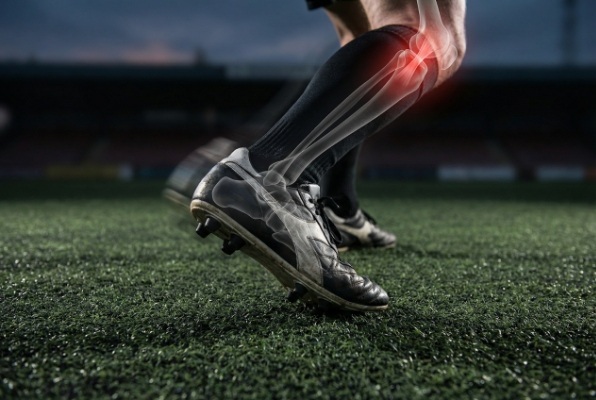
I always tell my customers that safety comes from the interaction between the shoe and the surface. In the industry, we call this "Rotational Resistance3." This measures how hard it is to twist your foot when it is planted on the ground.
On natural grass, if you turn sharply, the dirt breaks and your foot slides a little. This releases the pressure. On artificial turf, the fibers are very strong. We test this rigorously. A FIFA Quality field has a rotational resistance between 27Nm and 48Nm. If the resistance is too high, your cleats get "stuck." Your body rotates, but your foot does not. This torque snaps the ACL.
I also look at shock absorption. A good field systems include a shock pad or E-layer to lower impact. If a field is just carpet over concrete or hard stone, there is zero "give." This shocks your joints with every step.
Maintenance plays a huge role here too. If a field is not brushed, the fibers lay flat. We recommend using special equipment to comb the lawn so the filling settles. If the infill is uneven, your foot lands on unstable ground. This unpredictability causes injuries.
To stay safe, you must change your movement. Do not make large lunges. Keep your steps short. This creates less force if your foot gets stuck. You also need to build stronger leg muscles to handle the harder impact.
Conclusion
Adapting to artificial turf requires quicker skills and physical strength. While injury risks exist due to high traction and hardness, proper field maintenance and shock pads significantly improve safety.
-
Understanding turf burn is crucial for athletes to prevent injuries and ensure safe play on synthetic surfaces. ↩
-
Exploring shock absorption can reveal how different surfaces impact player safety and performance. ↩
-
Understanding Rotational Resistance can help you grasp how footwear and surface interaction affects injury risk. ↩
_画板-1.png)