_画板-1.png)
Your beautiful artificial lawn is starting to look flat. This can make a big investment look tired and worn out. But you can easily fix this and prevent it from happening.
Yes, artificial turf can mat down, especially in high-traffic areas. This happens when the grass blades flatten due to pressure. Key factors include the quality of the turf, heavy use, and insufficient infill. Regular brushing and proper infill levels are essential to prevent and fix matting.
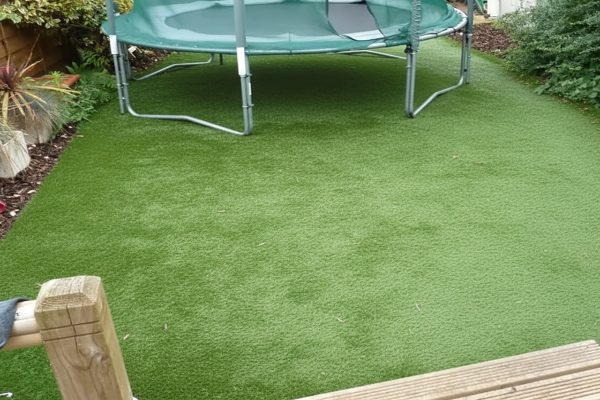
This is one of the most common questions I get from customers. They invest in a beautiful, green lawn and then, over time, see some areas start to look a little tired. It’s a normal concern, but the good news is that it’s usually not a sign of a defective product. Matting is often a maintenance issue or an installation detail that was overlooked. Understanding why it happens is the first step to keeping your turf looking upright and fresh for its entire lifespan. Let’s dive into how you can protect your investment and keep it looking perfect.
How does artificial turf stay down?
You worry about your new turf installation lifting or shifting. This not only looks messy but can also be a serious tripping hazard. Let’s look at what holds it down.
Artificial turf is held down by several key things. The weight of the turf itself, the infill material1 like sand spread between the fibers, and fasteners like nails or glue at the edges all work together. A properly prepared base is the foundation for everything.
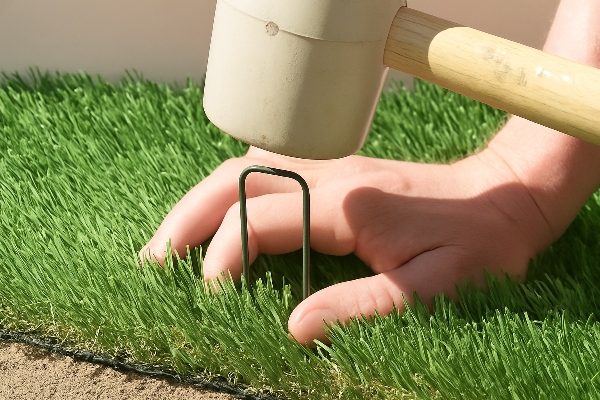
When I visit installation sites, I always stress that a secure lawn isn’t just about the grass itself. It’s a complete system. If any part of this system is weak, you will have problems later. The goal is to make the turf feel like a permanent part of the landscape, not just a carpet laid on top of the ground. It all starts from the bottom up.
The Foundation and Infill
The most critical part is the sub-base, which is the layer of compacted aggregate material under the turf. This provides a stable, flat surface that drains well. Once the turf is rolled out, the infill does a lot of the work. This is usually sand or a mix of sand and rubber granules. The infill serves two main purposes. First, its weight helps hold the entire surface down. Second, it gets between the grass fibers to help them stand up straight, which prevents matting.
Securing the Perimeter
Even with a solid base and heavy infill, you need to secure the edges and any seams. This is where you physically attach the turf to the ground. If you don’t secure the edges, they can curl up over time, which looks bad and can be unsafe.
| Component | Function | Why It’s Important |
|---|---|---|
| Sub-base | Creates a stable and level foundation. | Prevents sinking, bumps, and poor drainage. |
| Infill | Adds weight and supports grass fibers. | Keeps turf in place and prevents matting. |
| Fasteners | Secure the edges and seams to the ground. | Prevents lifting, curling, and trip hazards. |
How to fix matted down artificial turf?
Your once-perfect lawn now looks flat in some spots. You might worry that it’s ruined and needs replacement. But you can often bring it back to life with a simple fix.
To fix matted turf, you just need to brush it. Use a power broom2 or a stiff-bristled broom and brush against the direction of the grass fibers. This lifts them back up. Adding a bit more infill can also help support the blades.
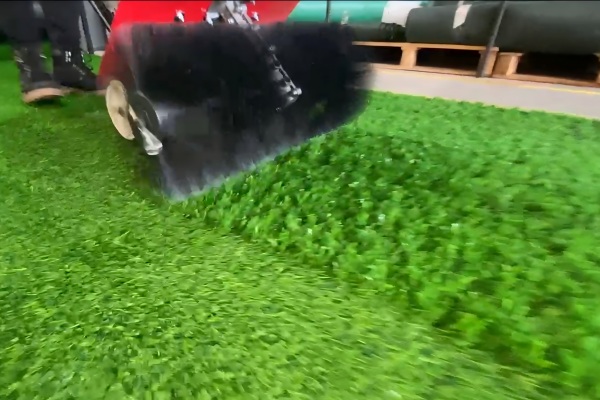
I have seen clients who thought their turf was at the end of its life. But after a few hours of maintenance, it looked almost new again. This process is often called "blooming" the turf. It’s like fluffing a pillow. The key is using the right tools and the right technique. Don’t be afraid to put some effort into it. You are not just cleaning the turf; you are actively reviving it and helping the fibers stand tall again.
The Brushing Technique
The most important rule is to always brush against the grain. If you look closely, you will see that all the turf fibers lean slightly in one direction. You need to brush in the opposite direction to lift them up. Using a broom with stiff, synthetic bristles is best. Metal bristles can damage the turf fibers, so I always tell people to avoid them. For larger areas or heavily matted spots, a power broom is a fantastic tool that saves a lot of time and energy.
Checking Your Infill Levels
After brushing, check your infill. Over time, infill can get compacted or washed away in small amounts. You should be able to see the base of the infill but not the turf’s backing material. If it looks low, you can add a little more and brush it in. This gives the grass blades the support they need to stay upright.
| Brushing Method | Effort Level | Best For | Tip |
|---|---|---|---|
| Manual Broom | High | Small areas, light matting. | Use a broom with stiff, non-metal bristles. |
| Power Broom | Low | Large areas, heavy matting. | Walk slowly and let the machine do the work. |
Does all artificial turf have rubber matting?
You might hear people talk about rubber under artificial turf. This can be confusing. You wonder if this is a standard part of every installation or an optional extra you missed.
No, not all artificial turf installations include a separate rubber mat. Most turf has its own built-in backing. A separate rubber mat, often called a shock pad, is an optional underlayment. It is mostly used for playgrounds or sports fields to add cushioning and safety.
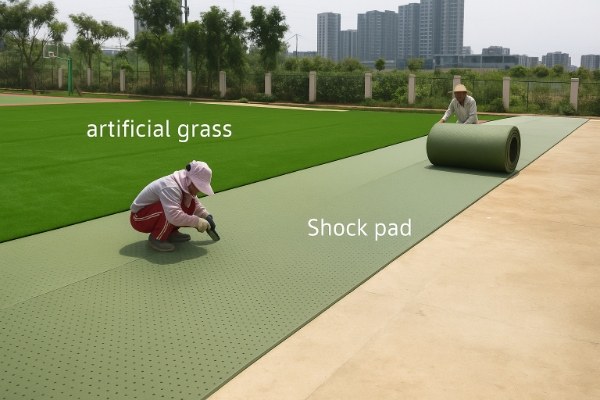
Let me clear this up, because the terminology can be tricky. Every piece of artificial turf has a "backing." This is the material that the grass fibers are tufted into. It’s usually made of coated polypropylene or urethane. This is not the same as a "rubber mat" or "shock pad." A shock pad is a completely separate layer that is installed underneath the turf. I always advise my clients that for a typical backyard lawn, a shock pad is usually not necessary if you buy good-quality turf.
Understanding Turf Backing
The built-in backing is essential. It has two parts. The primary backing is what the fibers are sewn into. The secondary backing is a coating applied to the back that locks the fibers in place and adds dimensional stability. A high-quality backing is crucial for the turf’s durability. It prevents the fibers from being pulled out easily.
When is a Shock Pad Necessary?
A shock pad is basically a foam or rubber cushion that goes between the sub-base and the turf. We recommend these for specific applications. For playgrounds, they are often required to meet safety standards for fall height. For sports fields, they provide shock absorption to reduce player injuries. They can also add a softer feel underfoot for any lawn, but it is an added cost.
| Installation Type | Key Layers (Bottom to Top) | Main Purpose |
|---|---|---|
| Standard Landscape | Compacted Base -> Artificial Turf with Infill | Aesthetics and durability |
| Playground/Sport | Compacted Base -> Shock Pad -> Artificial Turf with Infill | Safety, performance, and comfort |
Conclusion
Matting is a common issue, but it is not a major problem. With the right amount of infill and regular brushing, your artificial turf will continue to look fresh and new for years.
_画板-1.png)