_画板-1.png)
When landscape contractors and municipal engineers ask me how hybrid turf systems work, they are usually trying to solve a specific problem. Natural grass fails under heavy foot traffic, turning into mud pits1, while standard artificial turf often looks too synthetic for high-end parks. Finding a solution that combines the best of both worlds can feel overwhelming.
Hybrid turf systems work by integrating synthetic fibers with natural grass roots. In an open-mesh woven system, the artificial grass features a glue-free, grid-like backing. This allows natural grass seeds to germinate and grow right through the mesh, intertwining their roots with the synthetic matrix to create an ultra-durable, trample-resistant anchor.
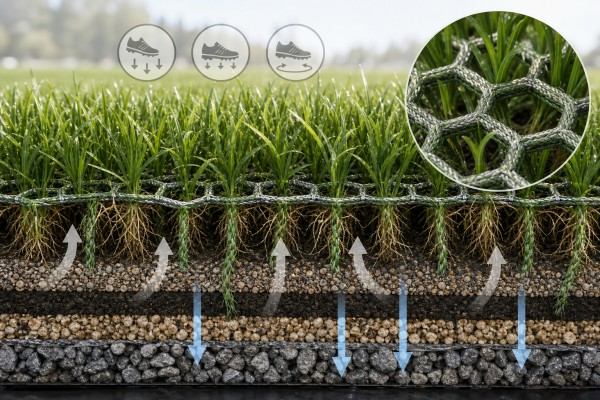
Understanding this structural mechanism is not just a botany lesson—it is a critical project selection decision. Let’s break down how this root-intertwining technology translates into easier installation, reduced machinery costs, and guaranteed instant greening for your commercial landscaping projects.
What are the different types of hybrid turf systems?
Buyers often miscalculate their project costs because they misunderstand the terminology in their bidding documents. They bid on a municipal project specifying a hybrid setup, only to realize later that the system they priced requires millions of dollars in specialized installation equipment.
There are three main types of hybrid turf systems: stitched, injected, and open-mesh woven.2 Stitched and injected systems require heavy, specialized machinery to implant synthetic fibers directly into a natural sand profile. Open-mesh woven systems come in pre-manufactured rolls laid over topsoil, offering contractors a much lower barrier to entry.
When a client comes to me looking for wholesale hybrid turf, my first question is always: "Is this for a professional tier-one stadium, or a municipal landscape project?"
For professional stadiums hosting major televised tournaments, contractors often use stitched or injected systems. These are incredibly expensive and require massive tractors to literally sew synthetic yarn into an existing natural grass pitch.3 They are fantastic for their specific niche, but they are completely unviable for standard commercial projects.
For municipal landscaping, roadside green belts, school campuses, and standard sports fields, open-mesh woven hybrid turf is the standard. I manufacture this exact open-mesh product at our factory, and it is specifically designed to eliminate the need for heavy installation machinery.
It is also vital to establish strict definitional boundaries. Standard artificial turf with oversized punched drainage holes is not a true hybrid system. True grow-through turf requires a woven, open-grid structure.
Here is a breakdown of how the systems compare for B2B procurement evaluation:
| System Type | Mechanism | Machinery Required | Primary Application | Cost Profile |
|---|---|---|---|---|
| Stitched | Sewing fibers into soil | Specialized giant stitching rigs | Professional stadiums | Extremely High |
| Injected | Injecting fibers into soil | Heavy injection machinery | Professional sports | Extremely High |
| Open-Mesh | Rolling out woven mesh | Standard landscape tools | Municipal & Landscape | Moderate / Accessible |
For sourcing agents, landscape contractors, and government project suppliers, selecting the open-mesh system is the safest way to manage risk. It keeps the initial procurement costs predictable and ensures your local crews can actually execute the build without sub-contracting specialized equipment operators.
How do roots intertwine with hybrid turf systems?
A common misconception I hear from importers is that artificial backings suffocate natural soil. They worry the mesh will act as a barrier, stunting growth and causing the natural grass to die off completely after the first dry season.
Roots intertwine with hybrid turf systems through a specialized, glue-free woven backing. Unlike traditional artificial grass coated in polyurethane or latex, open-mesh hybrid turf leaves the physical spaces between the yarn completely open. Natural grass roots actively grow through these gaps, wrapping around the synthetic base to form an unbreakable anchor layer.
The "aha" moment for most buyers happens when they realize that the natural roots do not just pass through the backing—they actively integrate with it.
The Problem with Standard Drainage Holes
Standard landscape grass is manufactured by punching artificial yarns through a primary cloth, and then coating the entire back with a heavy layer of SBR latex or Polyurethane (PU) glue to lock the tufts in place. To allow rain to pass, small drainage holes are punched into the back every few inches.
Sometimes, suppliers will sell this standard turf with slightly larger punched holes and call it "hybrid." This is a massive risk for contractors. The glued backing still blocks over 90% of the soil surface. Roots cannot penetrate the solid latex, resulting in shallow, weak natural grass that dies quickly under pressure.
The Woven Mesh Advantage
A true open-mesh hybrid turf system works entirely differently. The backing is woven in a grid, and the synthetic yarns are locked into place mechanically during the weaving process—meaning there is zero glue on the back.
This creates a 100% open physical growth space. When natural grass seeds germinate, the roots push down through the mesh grid into the soil profile below. As the root system matures and expands, it thickens and wraps around the rigid woven fibers of the artificial backing.
This intertwining creates a fortified anchor layer that is exponentially stronger than pure natural grass. When pedestrians walk on it, or athletes run on it, the pulling force that would normally rip natural grass completely out of the soil is instead absorbed by the synthetic woven matrix. The artificial blades also act as a physical shield, taking the brunt of the foot traffic and protecting the sensitive crown of the natural grass plant from being crushed.
How do contractors install open-mesh hybrid turf systems?
Theory is great for procurement, but contractors ultimately care about execution. If a product requires a steep learning curve or completely different site preparation than standard landscaping, crew supervisors will aggressively push back against using it.
Contractors install open-mesh hybrid turf systems using standard landscaping equipment. The process involves preparing a flat, nutrient-rich topsoil base, rolling out the hybrid turf, applying a specialized sand and seed mixture directly into the artificial fibers, and watering. No complex stitching machines or specialized injection tractors are required.
Bridging the gap between "how it works" and "how it’s built" is crucial for eliminating execution anxiety. From my experience consulting with landscape contractors and municipal engineers, the installation of woven hybrid grass is remarkably straightforward if you follow a logical sequence.
Step 1: Base Preparation
Unlike standard artificial grass—which requires a compacted, dead base of crushed rock and stone dust—grow-through turf needs a living base. Contractors prepare a leveled, well-draining rootzone profile. This is typically a custom blend of sand and organic topsoil designed to promote rapid seed germination while preventing water-logging.4
Step 2: Turf Deployment
Once the soil base is perfectly level, the crew rolls out the hybrid turf directly over the soil. The rolls are stretched tight and secured at the perimeters using standard landscape pins or staples. Because the backing is a flexible woven mesh, it contours easily to gentle slopes or rolling landscape designs in parks and commercial courtyards. Seams are joined together securely, ensuring the grid remains consistent across the entire project area.
Step 3: Sand and Seed Infill
This is where the magic happens. A mixture of specialized sports sand and natural grass seed is spread over the top of the synthetic turf. Using mechanical rotary brushes or stiff push brooms, contractors brush this mixture down into the synthetic fibers until it settles right at the woven mesh level.
Step 4: Instant Greening and Germination
The immediate result is a site that looks instantly green because the synthetic blades stand proudly above the sand line. The site is then watered aggressively according to standard agronomic schedules. Over the next three to six weeks, the natural grass seeds germinate in the protected micro-climate created by the synthetic blades, pushing their roots down through the mesh to complete the system.
Do hybrid turf systems require special maintenance?
Once the project is handed over, maintenance teams need to know exactly what they are dealing with. Property developers, hotel resorts, and municipal buyers are highly sensitive to long-term ROI and fear unpredictable upkeep costs.
Hybrid turf systems do not require complex, specialized maintenance compared to pure natural grass. Because the synthetic fibers protect the grass crown and the mesh anchors the root zone, standard landscaping tasks like mowing, aerating, and fertilizing are completely safe. The hybrid structure actually reduces overall repair costs from heavy wear and tear.
When buyers evaluate long-term costs, they are often surprised to learn that a mature grow-through turf installation is treated almost exactly like a high-quality natural lawn.
Mowing Mechanics
The most common question I receive about maintenance is: "Will my lawnmower chop up the artificial plastic blades?" The answer comes down to blade height configuration. When we manufacture open-mesh turf at QH, we design the synthetic pile height with mowing in mind.
The maintenance crew simply sets the blades of their rotary or cylinder mowers a few millimeters above the height of the synthetic yarn.5 The mower smoothly cuts the fast-growing natural grass down to a uniform level while completely missing the durable synthetic fibers below. This ensures a pristine, manicured look without damaging the artificial matrix.
Protection from Washout and Trampling
The true return on investment for commercial buyers lies in damage prevention. In pure natural grass setups, heavy rain followed by foot traffic results in severe soil displacement, rutting, and root destruction. Municipalities spend thousands of dollars annually re-sodding bare patches in parks and school campuses.
With woven hybrid turf systems, the synthetic mesh holds the soil profile in place, preventing washout.6 Even if a harsh winter causes the natural grass to temporarily go dormant and brown, the ever-green synthetic blades continue to provide a lush, vibrant appearance. Come spring, the natural grass safely regenerates from the protected crown nestled safely inside the artificial matrix. You get the environmental and cooling benefits of real plants, alongside the heavy-duty resilience of industrial synthetics.
Frequently Asked Questions
Can I use standard artificial turf as a hybrid system?
No. Standard artificial turf uses a heavy latex or polyurethane glued backing to lock the fibers in place. This glue blocks the soil, preventing natural grass roots from penetrating the base. True hybrid grow-through systems use a specialized, glue-free woven mesh backing.
Are hybrid turf systems environmentally friendly?
Yes, open-mesh woven hybrid turf is highly eco-friendly. Because it uses a glue-free manufacturing process and is constructed entirely from compatible PE/PP polymers, it is 100% recyclable at the end of its lifespan. It also promotes natural plant growth and water permeability.
Does open-mesh hybrid turf work for professional FIFA stadiums?
Generally, no. Professional tier-one soccer stadiums utilize complex stitched or injected systems that cost millions of dollars. Open-mesh woven hybrid turf is specifically designed for municipal landscaping, roadside green belts, parks, and standard community sports fields.
How long does it take for natural grass to grow through the mesh?
Depending on your local climate, watering schedule, and the specific natural grass seed blend used, noticeable germination usually begins within 7 to 14 days.7 A fully integrated and intertwined root system typically takes 4 to 6 weeks to mature.
Conclusion
Understanding how hybrid turf systems work is the first step in making profitable, low-risk B2B procurement decisions. By choosing an open-mesh, woven grow-through system, landscape contractors and municipal engineers avoid the prohibitive costs of heavy machinery required by stitched systems. Instead, they gain an easy-to-install product that allows natural grass roots to intertwine completely with a synthetic anchor, resulting in instant greening, heavy-duty trample resistance, and simplified long-term maintenance.
If your company is sourcing high-quality woven hybrid turf for municipal, commercial, or landscape projects, Hebei Qinghong Artificial Grass Co., Ltd. (QH) is your ideal factory partner. We supply directly to B2B importers and wholesale contractors, offering custom manufacturing with a minimum order quantity of 3,000 sqm for full-container shipments. Contact me at [email protected] or reach out via WhatsApp at +86 185 7566 0746 to discuss your project specifications.
-
"9. Traffic Stress & Turf Cultivation", https://www.umass.edu/agriculture-food-environment/turf/best-management-practices-bmps-for-lawn-landscape-turf/9-traffic-stress-turf-cultivation. University extension programs note that excessive foot traffic on natural turfgrass leads to soil compaction, reducing pore space and causing the grass to thin and eventually fail. Evidence role: mechanism; source type: education. Supports: The mechanism by which heavy foot traffic causes soil compaction and turfgrass degradation.. Scope note: Does not specifically mention ‘mud pits’, but confirms the degradation of turf under heavy traffic. ↩
-
"Hybrid grass – Wikipedia", https://en.wikipedia.org/wiki/Hybrid_grass. Sports turf research classifies hybrid grass systems into three primary categories: stitched fibers, injected fibers, and carpet-based systems where grass grows through a synthetic mat. Evidence role: definition; source type: research. Supports: The classification of hybrid turf systems into stitched, injected, and carpet-based (woven) categories.. ↩
-
"Stitching – Natural Grass", https://naturalgrass.com/en/stitching/. Sports governing bodies describe stitched hybrid systems as being installed by specialized machines that sew synthetic fibers deep into the rootzone of a prepared pitch. Evidence role: mechanism; source type: institution. Supports: The installation process of stitched hybrid turf using specialized machinery.. ↩
-
"Best management practices for construction of sand-based …", https://extension.oregonstate.edu/catalog/pnw-675-best-management-practices-construction-sand-based-athletic-fields-football-soccer. Guidelines from sports turf management associations recommend sand-dominated rootzone mixtures amended with organic matter to balance drainage requirements with nutrient retention for optimal turfgrass growth. Evidence role: general_support; source type: institution. Supports: The standard composition of rootzones for sports turf, emphasizing sand-based blends for drainage.. Scope note: Rootzone specifications can vary based on local climate and specific athletic field standards. ↩
-
"Mowing Lawn Turf – MSU Extension", https://www.canr.msu.edu/resources/mowing-lawn-turf. Turfgrass management programs advise that mowing equipment on hybrid fields must be calibrated to cut above the synthetic fiber height to prevent damage to both the machinery and the artificial matrix. Evidence role: general_support; source type: education. Supports: The recommended mowing height practices for hybrid turf systems to prevent damage to synthetic fibers.. ↩
-
"Using Vegetation for Erosion Control on Construction Sites", https://extension.okstate.edu/fact-sheets/using-vegetation-for-erosion-control-on-construction-sites. Geotechnical studies confirm that three-dimensional synthetic meshes and reinforced turf systems significantly increase soil shear strength and reduce surface erosion during heavy precipitation. Evidence role: mechanism; source type: paper. Supports: The role of synthetic geosynthetics and turf meshes in soil stabilization and erosion control.. ↩
-
"Healthy Lawns—Grass development: Seed germination rates", https://ipm.ucanr.edu/TOOLS/TURF/ESTABLISH/germin.html. University agricultural extensions state that most common cool-season and warm-season turfgrass seeds typically germinate within a 7 to 14 day window under optimal moisture and temperature conditions. Evidence role: statistic; source type: education. Supports: The standard germination timeframe for common turfgrass species.. Scope note: Germination times can vary significantly based on the specific grass species and environmental factors. ↩