_画板-1.png)
You worry that weird weather might ruin your landscape investment. Acid rain sounds scary, but do you know exactly how it ruins synthetic fibers?
Acid rain affects artificial turf by accelerating chemical degradation in the fibers and backing. Prolonged exposure causes colors to fade faster, makes fibers brittle, and significantly reduces the product’s lifespan. While high-quality turf resists weather, acidic environments require more frequent maintenance and earlier replacement.
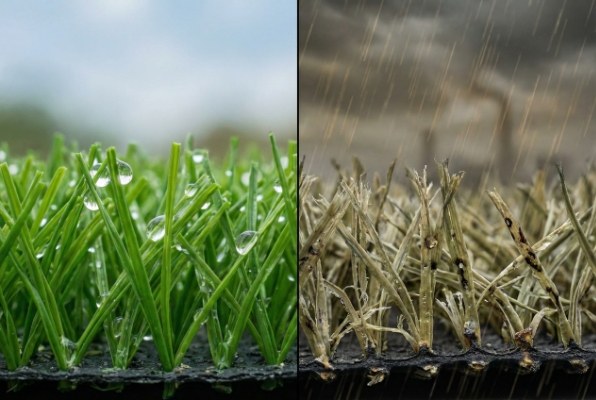
I remember a client in a heavy industrial zone who ignored local weather patterns. His field looked old in just three years, despite buying a top-tier product. While standard rain usually helps clean your lawn, acidic precipitation is a silent killer that eats away at your investment from the inside out. Understanding this risk is the only way you can plan your budget and maintenance effectively.
How Does Acid Rain Chemically Damage Artificial Turf Over Time?
Plastic seems indestructible from the outside, but chemistry proves otherwise. If you ignore the science of pH levels, your green lawn will turn ugly fast.
The acid breaks down the polymer chains in polyethylene and polypropylene fibers1. It attacks the UV stabilizers2 mixed into the plastic, leading to micro-cracks. Over time, this chemical reaction weakens the structural integrity of the grass blades, causing them to snap easily under foot traffic.
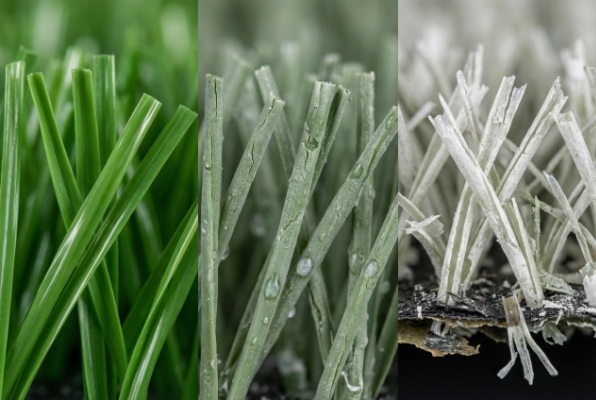
I have spent many years in the factory technical department, and I can tell you that plastic is not as invincible as it looks. Artificial turf is mostly made of Polyethylene (PE) or Polypropylene (PP). When we manufacture these fibers, we add stabilizers to stop the sun from burning them. Acid rain, which often contains dilute sulfuric or nitric acid, attacks these stabilizers.
Think of it like rust on metal, but for plastic. The acid sits on the blade surface and slowly eats into the molecular chain. This process is called hydrolysis3. In the early stages, you will not see anything wrong. However, after months of exposure, the surface of the fiber gets rough. It loses its shine.
Eventually, the plastic becomes "chalky." This is a sign that the degradation has reached a critical point. Once the fiber becomes brittle, normal walking or running on the field causes the grass blades to snap off. We call this unexpected wear. The damage is not just on top; the acid can also seep into the backing glue. If the glue fails, the tufts come loose.
| Damage Stage | Visual Sign | Chemical Process |
|---|---|---|
| Stage 1 (Early) | Loss of shine, slight dullness | Acid attacks surface coating |
| Stage 2 (Mid) | Color fading, rough texture | UV stabilizers begin to fail |
| Stage 3 (Late) | Cracking, fibers snapping off | Polymer chains break down |
Does Acid Rain Shorten the Lifespan of Artificial Turf and Its Infill?
You expect your turf to last a decade based on the warranty. However, environmental factors often silently steal years of use from your sports field or garden.
Yes, acid rain significantly shortens the lifespan of artificial turf. A product designed for 8-10 years of use may fail in just 4-5 years under acidic conditions. It also degrades rubber infill, causing it to harden and lose shock absorption properties, which increases injury risks.
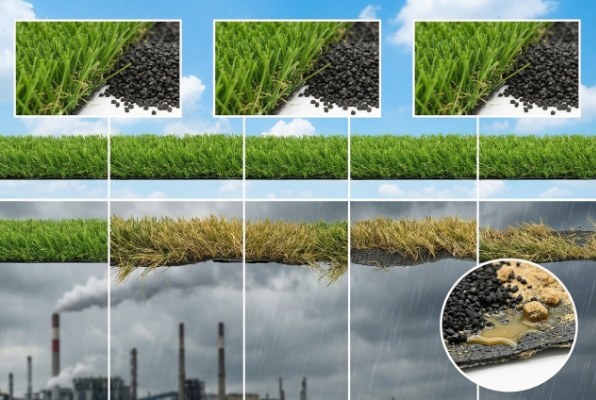
When we talk about lifespan, we usually give ranges like 8-10 years for residential use or 5-12 years for sports applications. However, these numbers assume "normal" weather. Acid rain changes the game completely. My insights show that in areas with heavy acid rain, you might lose half of your expected lifespan.
It is not just the green grass blades that suffer. The infill system is equally at risk. Most sports fields use SBR rubber granules (black crumbs) and quartz sand.
- Rubber Infill: Acidic water makes rubber hard. When rubber loses its elasticity, the field becomes hard like concrete. This is dangerous for athletes.
- Quartz Sand: While sand is durable, the acid can affect the binders used in coated sand, causing clumps.
- The Backing: This is the foundation. If the acidic water pools at the bottom because of poor drainage, it eats the latex or PU backing.
If you are a business owner buying turf for resale or projects, you must adjust your expectations. If your customer lives near a volcano or a factory district, you cannot promise them the max lifespan.
Impact on ROI (Return on Investment4):
- Standard Scenario: Buy turf for $10,000 -> Lasts 10 years -> Cost is $1,000/year.
- Acid Rain Scenario: Buy turf for $10,000 -> Lasts 5 years -> Cost is $2,000/year.
The cost of ownership doubles because you simply have to replace it sooner.
How Can You Protect Artificial Turf from Acid Rain and Pollution?
Replacing your lawn every few years is too expensive for anyone. You need practical ways to extend the life of your turf against harsh pollutants.
Protecting turf involves regular rinsing with fresh water to neutralize pH levels immediately after rainfall. You should also brush fibers frequently to remove particulate matter. In extreme cases, avoid installing standard turf in heavy industrial zones, or budget for a 2-5 year replacement cycle.
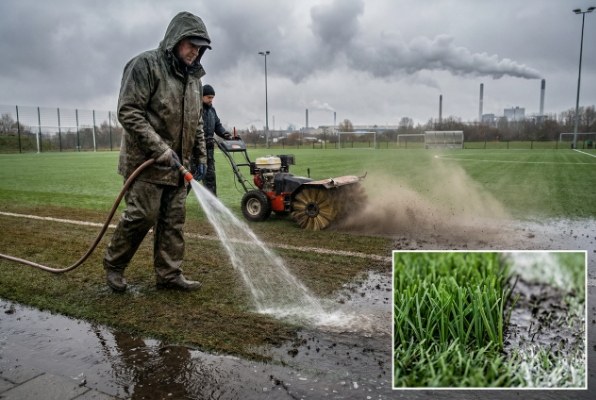
Since we cannot stop the rain from falling, we have to change how we maintain the ground. In my experience helping customers in polluted regions, proactive cleaning is the only solution.
1. The Rinse Technique
After a storm, you might think, "Great, the rain cleaned the grass." In acid rain areas, this is wrong. You need to rinse the field with clean tap water as soon as possible. This dilutes the acid sitting on the fibers and washes it into the drainage system.
2. Physical Cleaning
Acid rain often comes with "dry deposition"—dust and chemicals that settle before the rain. You must brush the fibers. Our maintenance guide suggests using special equipment to comb the lawn. This stops chemical particles from sticking to the grass blades.
3. Site Selection and Product Choice
If you are planning a project in a high-risk area (near heavy industry or volcanic activity), you have two choices:
- Don’t install it: Sometimes, natural grass or hardscape is a better engineering choice.
- Budget for replacement: Be honest with yourself. Prepare to replace the surface every 2-5 years.
4. Check the Specs
When purchasing, ask your supplier about the "UV resistance" and "Chemical resistance" of the fiber. Although our products are designed to be UV-resistant and weather-resistant, knowing the exact specs helps you predict performance.
| Protection Method | Frequency | Benefit |
|---|---|---|
| Fresh Water Rinse | After every acid rainfall | Neutralizes pH on surface |
| Deep Brushing | Bi-weekly | Removes chemical dust buildup |
| Infill Top-up | Annually | Maintains protective layer over backing |
Conclusion
Acid rain creates a harsh chemical environment that fades fibers and weakens backing, cutting turf lifespan by half. You must rinse regularly to neutralize acidity, or simply budget for faster replacement cycles.
-
Understanding these fibers helps in grasping their vulnerabilities and applications in artificial turf. ↩
-
Discover the role of UV stabilizers in protecting materials from sun damage and their significance in turf longevity. ↩
-
Learn about hydrolysis to understand the chemical processes that degrade plastics over time. ↩
-
Discover how environmental factors like acid rain can affect your ROI when investing in artificial turf. ↩
_画板-1.png)