_画板-1.png)
Buying artificial turf can feel risky when you see technical terms you do not understand. If you ignore the Dtex value, you might purchase grass that looks good now but flattens quickly.
Dtex stands for Decitex, which measures the weight in grams of a 10,000-meter long yarn bundle. It is the standard unit for fiber density. Generally, a higher Dtex value indicates a heavier, more durable product, but the thickness of the individual fibers is what truly determines long-term wear resistance.
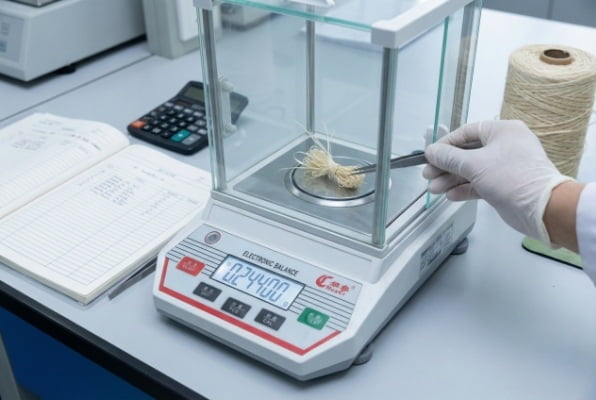
I often see clients focus entirely on pile height or density, but they forget to ask about the weight of the fiber itself. Let me explain why Dtex is actually the secret to finding a product that lasts.
What Exactly Is Dtex and Why Is It Critical in Turf Fibers?
Many buyers assume all green plastic fibers are the same, risking their investment on weak materials. Understanding Dtex is the first step to avoiding thin products that fail after one season.
Dtex ranges from 1,400 to 21,000 and defines the total mass of the yarn bundle used in the grass. It determines if the turf feels lush and substantial. A correct Dtex ensures the turf mimics natural grass in both appearance and physical substance.
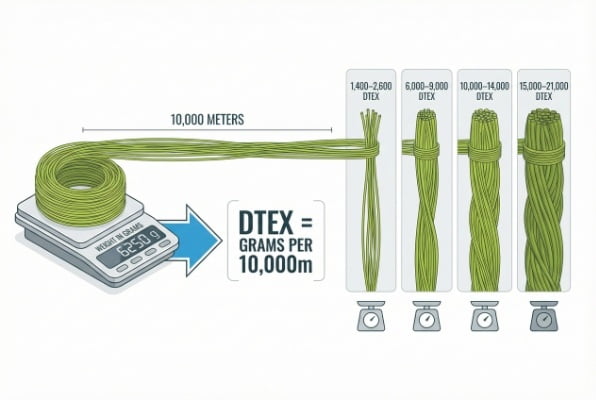
I have spent years in this industry, first in the workshop and now helping business owners like you. I treat Dtex as the "meat" of the sandwich. You can have a tall pile height, which is the bread, but if the Dtex is low, there is no substance inside.
Technically, Dtex refers to the weight of a bundle of yarn that is 10,000 meters long. If that bundle weighs 10,000 grams, the turf is 10,000 Dtex. It is that simple. In the market, you will see a wide range of values.
Here is a quick breakdown of common ranges I work with:
| Range (Dtex) | Common Feel | Material Weight |
|---|---|---|
| 1,400 – 2,600 | Very light, thin paper-like | Low |
| 6,000 – 9,000 | Soft, flexible similar to standard lawn | Medium |
| 10,000 – 14,000 | Thick, robust, heavy duty | High |
| 15,000 – 21,000 | Extremely dense, professional sports grade | Very High |
With the same number of yarns in a bundle, a higher number means thicker fibers. A lower number means finer fibers. We used to see cheap imports with very low Dtex values claiming to be high quality. They felt soft at first, but they had no durability. Knowing this number protects your profit because you know exactly how much raw material you are paying for.
How Does Dtex Impact Pile Strength, Resilience, and Wear in Synthetic Turf?
You surely worry about grass flattening or splitting after just a few months of heavy use. This common issue usually stems from misunderstanding how fiber weight relates to actual strength.
A higher total Dtex usually implies more material, but individual filament thickness matters most for wear. Thicker individual yarns resist splitting and stay upright better than thinner yarns, even if both bundles have a similar total weight.
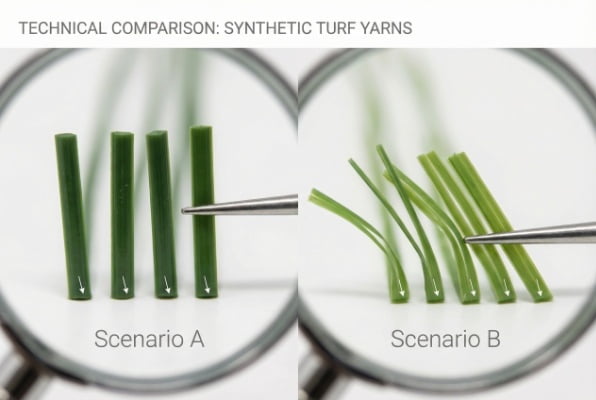
This is where things get interesting, and where I use my engineering background to save my clients money. You cannot just look at the total Dtex number. You must look at how the bundle is made. The total thickness is not just the Dtex value; it depends on the Dtex of each single yarn inside that bundle.
Let me give you a specific example from a production comparison I did recently.
Scenario A: You have a 10,000 Dtex turf. It uses a bundle of 4 single filaments.
Scenario B: You have a 12,000 Dtex turf. It uses a bundle of 6 single filaments.
Most people think Scenario B is stronger because 12,000 is bigger than 10,000. This is wrong.
Let’s do the math:
- Scenario A: 10,000 divided by 4 filaments = 2,500 Dtex per filament.
- Scenario B: 12,000 divided by 6 filaments = 2,000 Dtex per filament.
The single strand in Scenario A is thicker (2,500 > 2,000). Therefore, the 10,000 Dtex yarn is stronger and more durable. It will stand up better to footprints and ball rolls. The 12,000 Dtex yarn might cover the ground better because it has more strands, but those strands are thinner and will split or crush faster.
So, the higher the Dtex of a single yarn, the more wear-resistant it is. If you want durability, check the single yarn thickness, not just the total number.
Which Dtex Value Should You Choose for Sports Fields, Landscaping, or Pets?
Selecting the wrong specification for your specific application ruins your profit margin and damages your reputation. You need to match the Dtex value to the traffic level of the installation site.
For heavy-duty sports, choose 9,500-21,000 Dtex monofilament for maximum resilience. For tennis or padel, use 4,500-9,500 Dtex curled fibers. Landscape and pet areas work best with a dense mix of 6,000-14,000 Dtex to balance softness with durability.
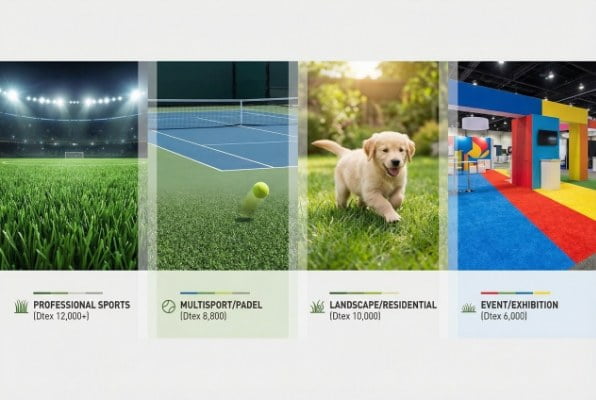
I always tell my customers to think about the end user. A dog running in a yard puts different stress on the grass than a professional soccer player. Through my experience at QH Grass, I have categorized the best Dtex ranges for different projects.
1. Large Sports Fields (Soccer, Football, Baseball)
These fields need strength. We typically use 9,500 to 21,000 Dtex. The fiber is usually monofilament1 (single strand) with 4 to 8 yarns per bundle. This thickness prevents the grass from snapping under cleats.
2. Small Sports Venues (Tennis, Padel, Golf)
Here, ball roll is key. We use curled grass fibers (texturized). The Dtex is lower, usually 4,500 to 9,500, with about 8 yarns per bundle. This creates a flat, consistent surface.
3. Landscaping and Pets
This is the most complex category. We need it to look real but also stand up. We use a "hybrid" mix.
- Type: Monofilament (straight) + Curled (root zone).
- Dtex: 6,000 to 14,000.
- Structure: A cluster usually contains 6-12 straight fibers and 6-12 curled fibers2.
The curled fibers hold the straight ones up, while the straight ones look like real grass.
4. Decorative or Budget Options
For events or temporary displays, we use split film yarn. The Dtex is low, 1,400 to 2,600. It is cheap, covers well, but is essentially disposable.
Here is a quick reference table for your next order:
| Application | Recommended Dtex | Yarn Type |
|---|---|---|
| Professional Sports | 12,000+ | Monofilament |
| School Sports | 9,500 – 11,000 | Monofilament |
| Padel / Tennis | 6,600 – 8,800 | Curled / Texturized |
| Premium Garden | 10,000 – 14,000 | Shape Memory + Curled |
| Standard Garden | 7,000 – 9,000 | Flat + Curled |
What Customized Dtex Solutions Does QHGRASS Provide for Different Applications?
Finding a supplier who adjusts specs to your local climate is frustratingly hard, leading to inventory that does not sell. Standard products often fail in extreme heat or rain, leaving you with angry customers.
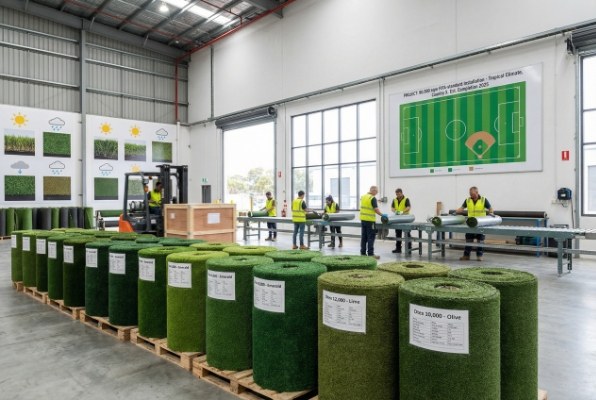
QH Grass offers full customization for orders over 3,000 sqm. We adjust Dtex, density, and backing to suit your market. Our recent 80,000 sqm project in Honduras proves our ability to deliver FIFA-standard, climate-resilient turf.
Make no mistake, quality control is my obsession. At QH Grass, we do not just sell what is in the warehouse; we build what you need. I know that customers like you in Brazil, the US, or Saudi Arabia have very specific needs.
We offer "Tailor-made" production. If you have an order of a 40HC container (or at least 3,000 sqm), we can create a specific yarn recipe for you.
- Dtex Range: We can extrude anything from 1,400d to 21,000d.
- Color Matching: We customize yarn colors to match local natural grass varieties.
- Price: Custom orders often get better pricing because we optimize the material usage for your budget.
I want to share a success story that makes me proud. Recently, we handled a large project in Honduras. The client needed turf for huge soccer and baseball fields. The total area was nearly 80,000 square meters.
They were worried about the intense South American sun and heavy rainfall. Standard grass would fade or rot.
We worked with them to engineer a 14,000 Dtex artificial turf. We adjusted the UV stabilizers and the backing drainage system. This turf met FIFA quality standards.
This is our modular design solution. We do not just guess. We adjust the Dtex value and density based on your climate. If you are in a hot place like Saudi Arabia, we change the formula. If you are in a rainy place like parts of Indonesia, we change the drainage. Buying from QH Grass means buying a solution, not just plastic rolls.
Conclusion
Dtex measures yarn weight, but individual fiber thickness defines durability. Choosing the right Dtex ensures longevity. QH Grass customizes these specs to help your business succeed.
_画板-1.png)