_画板-1.png)
If you are a landscape contractor or a sports field builder, you might wonder how does hybrid turf allow grass to grow through it without choking the roots. Many project managers face failing green belts because they completely misunderstand the mechanics of natural grass integration. The secret to success lies entirely in the engineering of the backing and strict adherence to installation protocols.
Hybrid turf allows natural grass to grow through it by utilizing a 100% open woven mesh backing rather than standard black-glued backings. This uncoated grid structure provides completely unobstructed pathways for real grass shoots to emerge upward and roots to grow downward, ensuring optimal air circulation, drainage, and symbiotic root protection.
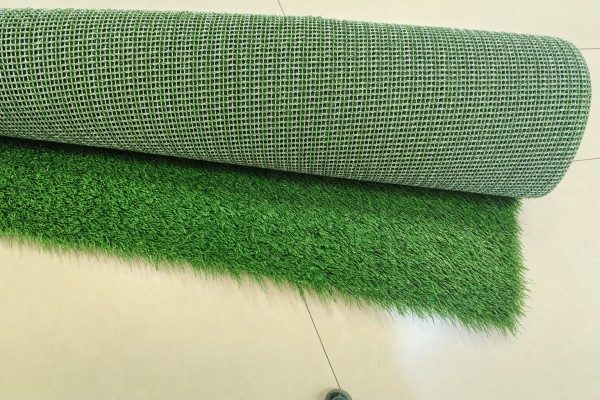
Understanding this growth mechanism is not a botanical mystery; it is a straightforward engineering and construction process. Let us break down the physical backing structure, the critical site installation steps, and why this grow-through turf system guarantees long-term durability for demanding municipal and commercial projects.
Why do standard backings fail for hybrid turf systems?
Selecting the wrong turf backing is the fastest way to ruin a large-scale landscape project. Contractors often try to use conventional landscape grass for hybrid applications to cut material costs, only to watch the natural grass rot and die underneath. You need the correct physical structure to support a living, breathing ecosystem.
Standard PU or SBR latex backings fail because they are fully sealed, utilizing only small, punched holes for drainage. This restricts root expansion and traps moisture. True hybrid turf uses an uncoated, open woven mesh backing that provides infinite pathways for unobstructed grass growth and maximum permeability.
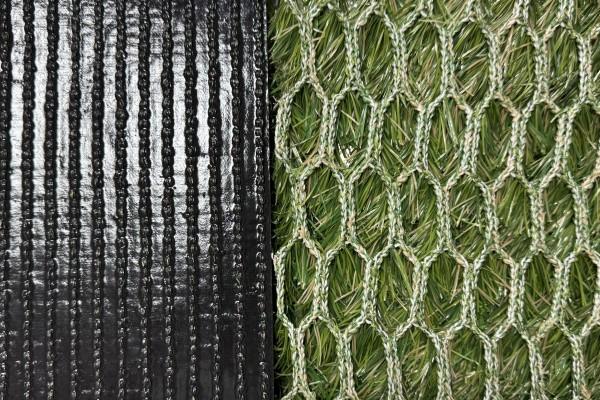
To fully grasp how does hybrid turf allow grass to grow through it, we must first debunk the biggest myth in B2B procurement: standard artificial grass with drainage holes is not hybrid grass.
In my years of supplying large-scale engineering contractors, I have seen countless procurement teams make this fatal error. Standard artificial turf is manufactured by tufting yarn into a primary cloth, which is then coated with a thick layer of SBR latex or Polyurethane (PU) glue to lock the tufts in place. To allow rain to pass through, factories punch small holes every few inches. While this works fine for a static synthetic lawn, it is a death sentence for living plants.
Real grass roots require vast amounts of oxygen and rapid water drainage to prevent fungal diseases.1 A glued backing suffocates the soil. Even if a few blades of grass manage to squeeze through the punched holes, the root system remains trapped and restricted, eventually leading to plant death during hot or overly wet seasons.
By contrast, an open woven mesh backing is a structural prerequisite for hybrid synthetic turf. At QH, our hybrid grass is manufactured using a specialized weaving technique. The synthetic grass fibers are physically knotted into a grid-like mesh. Because the fibers are structurally locked by the weave, there is absolutely no need for a secondary glue coating.
This results in a backing that is practically transparent to natural elements. Water flows through it instantly. Oxygen reaches the soil unimpeded. Most importantly, when the grass seeds germinate, the young shoots encounter no physical barriers. They grow straight up through the open squares of the woven mesh, while their root systems expand deeply into the subsoil below.
Material Comparison Breakdown
| Feature | Standard Glued Artificial Turf | Woven Hybrid Turf (Uncoated) |
|---|---|---|
| Backing Material | PP cloth + SBR Latex or PU glue | 100% Woven PE/PP Mesh |
| Permeability Method | Mechanical punched holes (spaced) | Fully open grid structure |
| Root Growth Space | Severely restricted (<5% open area) | Completely unobstructed (>50% open area) |
| Water Drainage | Moderate (prone to pooling over time) | Maximum (instantaneous drainage) |
| Primary Application | Fully synthetic fields, decorative lawns | Municipal green belts, hybrid sports fields |
When you evaluate suppliers for your next municipal or commercial landscaping bid, always demand an uncoated woven hybrid turf. Anything less will result in project failure.
What is the exact installation sequence for woven hybrid turf?
Even with the perfect woven mesh turf, improper installation guarantees failure. The most common site disaster I see is contractors laying the artificial grass first and then aggressively scattering seeds on top of the synthetic fibers. This fatal mistake wastes time, money, and labor, leaving seeds exposed and unable to root.
The exact installation sequence for hybrid turf requires placing the seeds below the turf, not on top. The correct standard operating procedure is to tamp the ground, scatter loose topsoil, plant the grass seeds, lay the hybrid turf directly over the seeded soil, secure it with U-pins, and initiate routine watering.
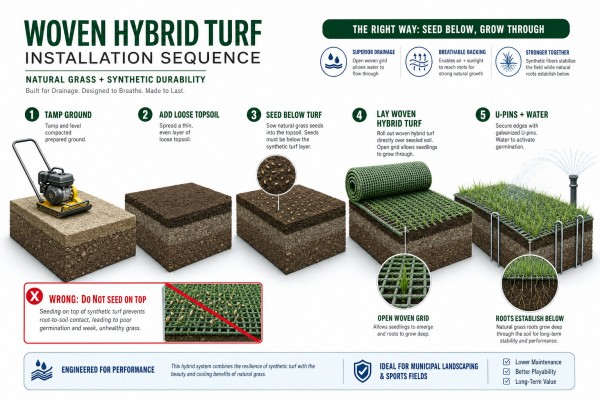
If you want to know how does hybrid turf allow grass to grow through it successfully, you must view the synthetic turf purely as a protective carrier during the installation phase.
Contractors often assume that because it is a "grow-through" turf, they can simply lay the rolls down and broadcast seeds over the top, expecting the seeds to wash down through the mesh. This is structurally incorrect. When seeds are scattered on top of the artificial fibers, they become trapped in the synthetic yarn. They fall prey to birds, get washed away by heavy rain, or germinate suspended in the plastic fibers where they quickly dry out and die2 because their fragile roots cannot penetrate downward into the tough soil.
The Correct Standard Operating Procedure (SOP)
To guarantee a lush, integrated green space for high-end estates, schools, or roadside green belts, your site construction teams must strictly follow this "soil-seed-turf" sequence:
- Site Preparation: Clear the area of debris and lightly tamp the native ground to create a stable, level base. Do not compact it to the density of concrete; the soil must remain porous.
- Nutrient Layering: Spread a layer of high-quality, nutrient-rich topsoil or a specific sand-soil mixture designed for the local climate.
- Seeding: Broadcast the natural grass seeds evenly across the prepared topsoil. Use a seed variety suitable for the specific region and expected foot traffic.
- Laying the Hybrid Turf: Unroll the woven hybrid turf directly over the freshly seeded soil. The turf must sit flat and snug against the earth.
- Securing the Edges: Pin the turf firmly into the ground using green PE U-pins or galvanized steel staples. This prevents the turf from shifting under heavy winds or initial foot traffic.
- Watering and Germination: Begin a routine watering and fertilization schedule.
During the critical germination phase, the woven hybrid turf acts as a protective microclimate canopy. It shields the vulnerable seeds from birds, heavy downpours, and intense UV rays, keeping the topsoil moist and warm.3 Within a few weeks, the natural grass blades simply push their way up through the open mesh grid, seamlessly blending with the synthetic fibers.
How does artificial turf protect real grass roots from trampling?
Heavy foot traffic destroys natural green belts, turning beautiful municipal parks and public green areas into muddy, barren patches. Facility managers constantly struggle to maintain natural grass under high-volume use. A hybrid grass system solves this massive maintenance headache by physically shielding the biological components from mechanical wear.
Artificial turf protects real grass roots by acting as a heavy-duty physical armor. The synthetic fibers bear the downward pressure of intense foot traffic, preventing severe soil compaction. Meanwhile, the woven mesh base shields the delicate grass crowns, allowing natural grass to regenerate rapidly in high-traffic areas.
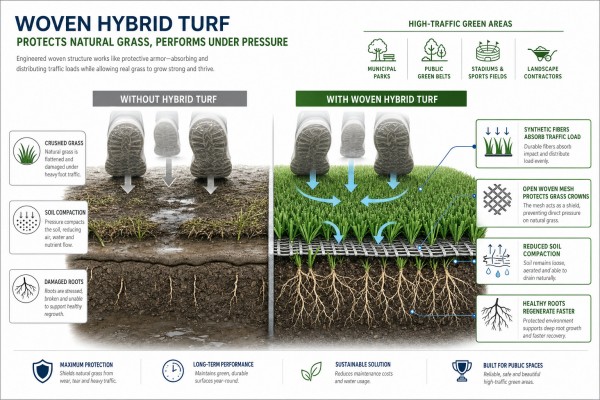
How does hybrid turf allow grass to grow through it while surviving constant use? It comes down to a symbiotic protection mechanism. In a standard natural lawn, the most vulnerable part of the grass plant is the crown—the point where the root system meets the shoot, located just at or below the soil surface. When natural grass is subjected to continuous trampling in public parks, festival grounds, or sports field sidelines, the soil compacts. Compacted soil starves the roots of oxygen, and the physical friction crushes the grass crowns, killing the plant entirely.4
Woven hybrid turf essentially functions as a load-bearing skeleton for the landscape.
When a pedestrian walks across a mature hybrid lawn, their shoe does not grind directly into the soil. Instead, the resilient synthetic PE (polyethylene) fibers take the brunt of the mechanical friction. The physical weight is distributed across the synthetic matrix. Because the artificial fibers are manufactured to sit slightly taller than or equal to the natural grass cut level, they act as permanent shock absorbers.
Furthermore, the open woven backing stabilizes the topsoil. It prevents the soil from churning into mud during heavy rains, which is a major reason why municipal and landscape contractors heavily favor this system for roadside green belts and commercial landscaping.
Real-World Engineering Benefits
- Anti-Compaction: The physical grid prevents soil from becoming densely packed under pedestrian weight.
- Crown Shielding: Even if the natural grass blades are worn down or cut short, the vital crown remains safely tucked beneath the synthetic mesh line, ready to shoot new growth.
- Erosion Control: The synthetic mesh acts as a permanent geogrid, anchoring the topsoil and preventing washouts on sloped landscapes.
This structural synergy drastically extends the lifespan of the green space, ensuring the area remains visually pristine 365 days a year, significantly reducing long-term maintenance costs for governments and developers.
Why does 100% recyclable hybrid turf help contractors win bids?
Municipalities and government developers are implementing increasingly strict environmental standards for large-scale construction projects.5 If your landscaping materials contain toxic glues or cannot be recycled at the end of their lifecycle, your bid will likely be rejected. Upgrading your material selection is essential to staying competitive in public procurement.
Woven hybrid turf helps contractors win bids because its uncoated, no-glue design makes it 100% recyclable. By eliminating traditional SBR latex or polyurethane coatings, the turf aligns with strict municipal environmental regulations, providing an eco-friendly solution that scores highly in government project evaluations.
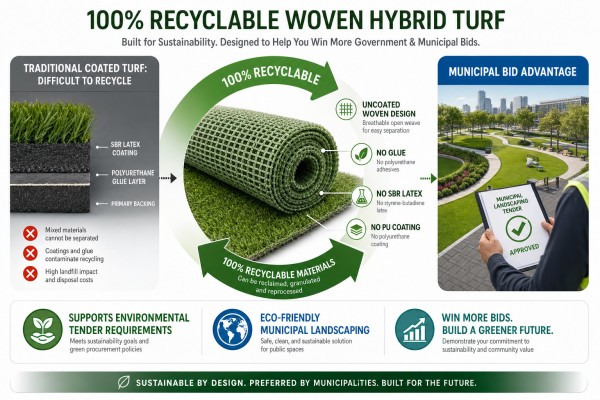
In the B2B landscaping industry, functionality is only half the battle; compliance is the other half. When pitching to municipal planners or high-end commercial developers, explaining how does hybrid turf allow grass to grow through it is a great technical start, but explaining how it meets ESG (Environmental, Social, and Governance) goals is what actually closes the deal.
Traditional artificial grass is notoriously difficult and expensive to recycle. Because the plastic fibers (PE/PP) are permanently bonded to a heavy rubber (SBR) or Polyurethane (PU) backing, recycling facilities must use energy-intensive processes to separate the vastly different chemical compounds.6 As a result, millions of square meters of old artificial turf end up in landfills every year. Government entities are actively clamping down on this waste.
The QH Woven Hybrid Artificial Grass completely bypasses this problem through its manufacturing architecture.
Because we utilize an advanced open weaving technique, there is zero glue applied to the backing. The entire product—from the synthetic blades to the woven base—is composed of materials from the same polyolefin family (Polyethylene and Polypropylene). At the end of its impressive lifespan, the entire hybrid turf system can be pulled up, melted down together, and repurposed into new plastic products without any complex chemical separation.7
Advantages for Municipal and Commercial Contractors
- Regulatory Compliance: Easily meets the strict environmental criteria required for public park and campus tenders.
- Instant Greening: The moment the artificial mesh is laid down, the site looks vibrantly green. This fulfills developers’ requirements for immediate aesthetic improvement while waiting for the natural grass to establish itself.
- CE and RoHS Alignment: Opting for products manufactured in facilities with robust quality control (ISO9001) and safe material certifications (RoHS) protects your firm from liability.
By supplying 100% recyclable hybrid turf, you elevate your company from a simple landscape contractor to a provider of advanced, sustainable engineering solutions.
Frequently Asked Questions
How long does it take for natural grass to grow through hybrid turf?
Typically, it takes 2 to 4 weeks for natural grass to grow through the open mesh, depending on the local climate, the specific seed variety used, and the watering schedule. The woven hybrid turf acts as a microclimate canopy, which often accelerates initial seed germination.
Can I use standard artificial turf for a grow-through system?
No, you cannot. Standard artificial turf uses a sealed, glued backing (PU or SBR) with limited drainage holes. This structure will completely suffocate natural grass roots, trap moisture, and ultimately kill any living plants beneath it. You must use an uncoated woven mesh backing.
What maintenance is required for a hybrid grass system?
A hybrid turf system requires the exact same basic maintenance as a standard natural lawn, including routine mowing, watering, and fertilizing. The synthetic fibers are highly durable and will not be damaged by standard lawnmower blades, provided the mowing height is set correctly.
Do you sell hybrid turf to individual residential buyers?
No, we do not. Hebei Qinghong Artificial Grass Co., Ltd. strictly specializes in B2B wholesale and full-container orders for engineering contractors, landscape distributors, and municipal project suppliers. Our minimum order quantity (MOQ) for custom specifications is 3,000 square meters.
Conclusion
Understanding how does hybrid turf allow grass to grow through it requires looking past botanical guesswork and focusing on physical engineering. The success of any hybrid green space relies entirely on two factors: selecting a 100% open woven mesh backing (with zero glue) and strictly following the "soil-seed-turf" installation sequence. By utilizing this system, contractors provide a symbiotic physical armor that protects natural grass roots from severe trampling while offering a 100% recyclable solution that wins lucrative municipal bids.
If you are a landscaping contractor, distributor, or municipal supplier looking to source premium, eco-friendly woven hybrid turf directly from the manufacturer, we are ready to support your large-scale projects. Contact Alice at Hebei Qinghong Artificial Grass Co., Ltd. today for wholesale pricing and full-container B2B orders.
-
"SSPLP14/LH040: Turfgrass Disease Management – Ask IFAS", https://ask.ifas.ufl.edu/publication/LH040. Agronomic research demonstrates that prolonged soil saturation depletes root zone oxygen, stressing turfgrass and creating ideal environmental conditions for root-rotting fungal pathogens such as Pythium. Evidence role: mechanism; source type: education. Supports: The relationship between poor soil drainage, root hypoxia, and the proliferation of fungal pathogens in turfgrass.. ↩
-
"Seeding strategies | Sports field management", https://safesportsfields.cals.cornell.edu/grasses/seeding-strategies/. Horticultural extension guidelines emphasize that adequate seed-to-soil contact is critical for capillary water movement to the seed; seeds germinating in surface debris or thatch are highly susceptible to rapid desiccation. Evidence role: mechanism; source type: education. Supports: The necessity of seed-to-soil contact for successful turfgrass germination and survival.. ↩
-
"Microclimatic variation regulates seed germination phenology in alpine …", https://besjournals.onlinelibrary.wiley.com/doi/10.1111/1365-2745.14461. Research on turf blankets and permeable geotextiles confirms that these materials moderate extreme soil temperature fluctuations and reduce evaporative moisture loss, thereby accelerating seed germination rates. Evidence role: general_support; source type: research. Supports: The use of synthetic permeable covers to enhance seed germination microclimates.. Scope note: Research primarily evaluates temporary turf blankets rather than permanent hybrid turf meshes, though the thermodynamic effects on the soil surface are comparable. ↩
-
"Assessing the impact of human trampling on vegetation – PMC", https://pmc.ncbi.nlm.nih.gov/articles/PMC4017817/. Turfgrass science literature establishes that mechanical wear directly damages the meristematic tissue (crown) of the plant, while the resulting soil compaction reduces macroporosity, severely limiting root oxygen uptake. Evidence role: mechanism; source type: education. Supports: The physiological mechanisms by which trampling and soil compaction damage turfgrass.. ↩
-
"Construction Sector (NAICS 23) | US EPA", https://www.epa.gov/regulatory-information-sector/construction-sector-naics-23. Recent frameworks for Green Public Procurement (GPP) published by international environmental agencies mandate that municipal construction projects prioritize materials with low environmental impact and high end-of-life recyclability. Evidence role: historical_context; source type: government. Supports: The increasing adoption of strict environmental and ESG standards in public procurement.. ↩
-
"From Waste to Styrene–Butadiene (SBR) Reuse: Developing PP/SBR …", https://pmc.ncbi.nlm.nih.gov/articles/PMC11398230/. Waste management analyses indicate that recycling conventional synthetic turf is highly energy-intensive, as it requires complex mechanical and chemical separation of the polyolefin face yarns from the thermoset polyurethane or styrene-butadiene rubber backings. Evidence role: mechanism; source type: paper. Supports: The technical challenges of recycling traditional artificial turf due to mixed material composition.. ↩
-
"Recycling polyolefin-based multilayer plastic packaging", https://etd.auburn.edu/handle/10415/10164. Materials science research confirms that polyethylene and polypropylene, both belonging to the polyolefin family, can be mechanically co-recycled and melt-blended to produce secondary plastic composites without the need for chemical depolymerization. Evidence role: mechanism; source type: research. Supports: The feasibility of co-recycling mixed polyolefins (PE and PP) without chemical separation.. Scope note: While they can be melted together, the resulting polymer blend may have different mechanical properties than virgin single-stream plastics, limiting its use to specific secondary applications. ↩