_画板-1.png)
Are you a landscape engineering contractor struggling with budget overruns when evaluating how hybrid grass used on golf courses impacts your bottom line? Traditional stitched or injected hybrid systems provide excellent turf reinforcement but consume massive chunks of project budgets. I see contractors constantly looking for smarter material allocations to protect their margins without sacrificing landscape integrity.
Hybrid grass is used on golf courses strategically to reinforce high-traffic zones and prevent soil erosion.1 Instead of deploying expensive stitched systems everywhere, contractors use open-weave mesh-backed hybrid turf on walkways, cart paths, and bunker edges. This tiered procurement approach stabilizes vulnerable areas while significantly lowering material and installation costs.
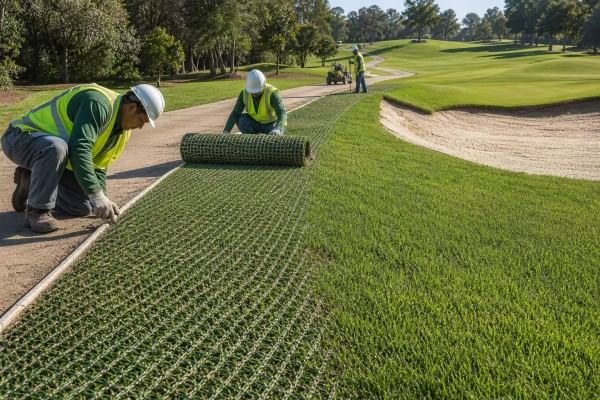
Let us look at how smart material selection directly solves bald spots and mud issues. By understanding the structural differences in hybrid turf varieties, you can optimize your procurement strategy for your next large-scale golf course construction project.
Why Do Contractors Misunderstand What Hybrid Grass Is?
Buyers often face sticker shock when sourcing hybrid turf because they assume every system requires heavy machinery. This narrow view traps procurement managers into overspending on over-engineered materials for standard landscaping zones.
Contractors frequently confuse all hybrid turf with expensive stitched or injected systems used in professional stadiums. However, open-weave mesh-backed hybrid turf offers a laydown alternative. Natural grass grows directly through this woven matrix, providing a highly durable, cost-effective reinforcement solution without requiring specialized injection machinery.
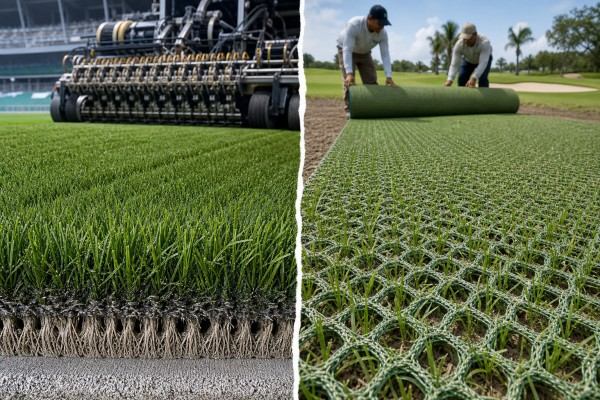
When I speak with sourcing agents and landscape engineering companies, I frequently encounter a massive misconception about hybrid grass systems. Many buyers believe that "hybrid grass" strictly means bringing in massive, specialized rigs to sew synthetic fibers deep into a prepared sand base. While those injected and stitched systems are incredible engineering feats for high-impact professional football pitches, they are entirely overkill for golf course pathways.
You do not need stadium-grade injection machinery to stop a cart path from turning into a mud pit.
Open-weave hybrid artificial grass—also known as grow-through turf or a mesh-backed hybrid grass system—utilizes a completely different installation logic. We manufacture this product with an open grid structure. Instead of a solid polyurethane or latex backing found on conventional artificial grass, the backing resembles a strong, permeable net. You simply prepare the soil, lay down the mesh-backed turf, and allow the natural grass seed to germinate. The natural blades and roots grow right through the open gaps.
This structural difference drastically shifts the procurement conversation. Let us compare the systems side-by-side:
| Feature | Stitched / Injected Hybrid Systems | Mesh-Backed Hybrid Turf (Laydown) |
|---|---|---|
| Installation Machinery | Requires specialized heavy injection machines. | Standard laydown tools; no heavy rigs needed. |
| Primary Structure | Fibers sewn directly into the root zone. | Woven, open-grid backing placed over soil/seed. |
| Procurement Cost Tier | Very high; specialized contractor required. | Cost-effective; accessible for general contractors. |
| Best Golf Course Use | High-impact tee boxes (if budget allows). | Cart paths, walkways, and bunker faces. |
The natural grass eventually overtakes the synthetic fibers aesthetically. However, the synthetic blades remain just below the canopy to absorb the mechanical wear of foot traffic and golf cart tires. The synthetic roots (the woven backing) stabilize the soil matrix. This synergy gives you the visual appeal of a natural golf course with the structural resilience of synthetic materials. By understanding this distinction, you immediately unlock a more efficient way to allocate your material budget.
Where Should Open-Weave Hybrid Turf Be Installed on a Golf Course?
Golf courses experience highly localized wear and tear based on player movement and water runoff. Pouring expensive materials into areas that do not require professional-grade reinforcement wastes your client’s budget and ruins your profit margin.
Open-weave hybrid turf should be installed on a golf course in high-traffic and erosion-prone zones. Prime applications include heavy-use walkways, cart path perimeters, and steep bunker edges. Contractors must strictly avoid using mesh-backed hybrid grass on putting greens, as it disrupts fine ball-roll performance.
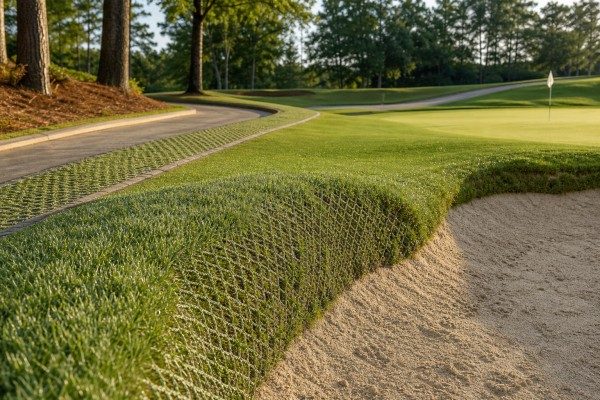
To maximize your return on investment, you must apply specific materials to specific problems. Mesh-backed hybrid synthetic turf excels at structural stabilization. It solves distinct mechanical failures on a golf course layout.
First, consider your high-traffic transition zones. Walkways between holes and the edges of paved cart paths constantly suffer from soil compaction. Golfers walk the same narrow routes repeatedly. Carts occasionally veer off the concrete, crushing the natural grass. This concentrated friction kills natural grass, creating ugly bald spots and muddy trenches. When you install an open-weave hybrid grass system in these transition zones, the synthetic fibers act as a protective cage. The synthetic blades bear the brunt of the shoe spikes and tire treads, allowing the natural grass crown to survive and recover quickly.
Second, bunker edges and faces represent a massive maintenance headache for golf course operators. Rainwater runoff and regular sand raking cause the steep soil slopes around bunkers to erode. Soil sheer failure destroys the sharp, aesthetic lines of the bunker. The woven grid of our hybrid turf locks the soil matrix together. Because the material boasts high tensile strength, it physically holds the slope in place while the natural grass roots entangle with the mesh. This creates an armored soil layer that resists erosion remarkably well.
However, as a professional B2B supplier, I always establish strict boundaries for my products. You must know what a product cannot do to maintain your credibility.
Here is where you should never install mesh-backed hybrid turf:
- Putting Greens: The open-weave structure and the integration of synthetic fibers will interfere with the highly precise ball-roll dynamics required for golf greens.
- Deep Water Hazards: Prolonged, complete submersion requires different ecological stabilization methods.
Instead, focus your procurement on these high-ROI application zones:
- Walkways connecting tee boxes and greens.
- Perimeters lining concrete or gravel cart paths.
- Steep bunker faces requiring immediate erosion control.
- Spectator zones prone to heavy foot traffic during tournaments.
By restricting this material to utility and transition zones, you solve the most common aesthetic failures on the course without compromising the professional gameplay experience.
How Does Tiered Procurement Improve Contractor Margins?
Bidding on golf course construction requires tight financial control and risk management. Relying on a single, expensive hybrid grass supplier for an entire 18-hole project leaves contractors vulnerable to supply chain delays and inflated costs.
Tiered procurement improves margins by matching the specific technical grade of hybrid grass to the distinct needs of each golf course zone. Sourcing cost-effective mesh-backed hybrid turf in full containers directly from a manufacturer reduces material costs, allowing contractors to reserve expensive injected systems only where necessary.
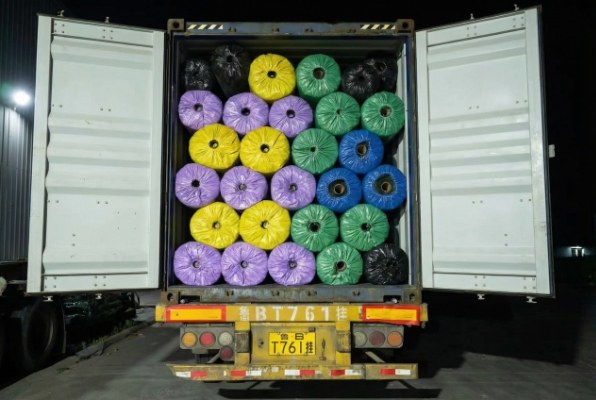
I advise contractors to adopt a "tiered procurement" strategy. You do not buy diamond-tipped drill bits to cut standard drywall. Similarly, you should not buy premium injected hybrid grass for a spectator walkway.
Tiered procurement means you classify the physical demands of every zone on the golf course and match the material cost accordingly. You reserve your highest budget for the tees or specialized greens infrastructure. For the thousands of square meters comprising cart paths, walkways, and bunker edges, you deploy factory-direct open-weave hybrid turf.
When you bypass local distributors and source open-weave hybrid turf directly from a manufacturer, your project profitability jumps significantly. For instance, my factory operates 10 production lines and outputs over 1.5 million square meters monthly. We focus exclusively on wholesale and full-container orders. When you buy in bulk, the unit economics shift heavily in your favor.
Consider the logistical predictability this provides. A standard 1x40HQ container of our CE and RoHS-certified hybrid turf takes only 15 to 20 days to produce. Custom specifications require 25 to 30 days. Because we sit just 150 km from Tianjin Port, the transit from factory floor to export vessel is highly efficient. This predictable lead time protects your project schedule from expensive delays.
Furthermore, mesh-backed hybrid turf inherently lowers your secondary project costs through its material properties:
- Exceptional Water Permeability: The open woven grid does not block water. Rain drains naturally into the soil, preventing surface pooling and reducing the need for complex, supplementary subsurface drainage pipes in walkways.
- Reduced Skilled Labor Threshold: Because installation does not require specialized injection machines, your standard landscape crews can roll out and secure the mesh-backed turf. You save massive amounts of money on specialized subcontractor day rates.
- Immediate Aesthetic Value: The green synthetic fibers provide immediate visual coverage for the client while the natural grass takes time to germinate and grow through the backing.
- Long-Term Durability: Utilizing environmentally friendly, recyclable materials that meet ISO9001 standards ensures the turf withstands UV degradation and mechanical wear. This durability drastically reduces warranty callbacks for soil erosion repair.
When you combine factory-direct pricing, reduced labor costs, and long-term erosion prevention, the mesh-backed hybrid turf becomes a massive profit driver for golf course contractors.
Frequently Asked Questions
Is open-weave hybrid grass suitable for putting greens?
No. Open-weave hybrid turf is not designed for putting greens. The woven structure and synthetic blades interfere with the precise golf ball rolling dynamics required for greens. It is best used for high-traffic transition zones, cart paths, and bunker edges.
How does natural grass grow through mesh-backed hybrid turf?
The turf features an open-weave grid backing instead of a solid coating. You lay the turf over prepared soil and seed. The natural grass blades and roots simply grow through the open holes, intertwining directly with the synthetic fibers for maximum stability.
What are the minimum order quantities for factory-direct hybrid turf?
Manufacturers typically supply B2B wholesale buyers. For example, our custom production runs require a minimum order quantity (MOQ) of 3,000 square meters per specification. This volume is designed specifically for full-container shipments to commercial landscaping contractors.
Do I need specialized machinery to install mesh-backed hybrid grass?
No. Unlike stitched or injected hybrid systems, mesh-backed hybrid turf utilizes a simple laydown method. Standard landscape engineering crews can cut, place, and pin the rolls over the prepared soil base without leasing expensive heavy machinery.
Conclusion
Understanding how hybrid grass used on golf courses can be optimized is critical for protecting your construction budget. By implementing a tiered procurement strategy, contractors can avoid overspending on injected systems for utility zones. Open-weave mesh-backed hybrid turf provides a highly cost-effective, durable solution for preventing mud on cart paths and stopping soil erosion on steep bunker edges. Sourcing this material directly in full containers maximizes your project margins while delivering long-lasting landscape integrity.
If you are a contractor or distributor looking to secure reliable, factory-direct open-weave hybrid turf for your next major project, contact Alice at QH Grass to discuss specifications and full-container wholesale pricing.
-
"Turf Reinforcement Mats | Highway Knowledge Portal", https://kp.uky.edu/knowledge-portal/articles/turf-reinforcement-mats/. Industry guidelines from golf course management associations highlight the use of turf reinforcement matrices to stabilize high-traffic transition zones and mitigate soil erosion on slopes. Evidence role: case_reference; source type: institution. Supports: Validates the use of hybrid turf systems in golf course management for erosion control and traffic management.. ↩