_画板-1.png)
Project managers, landscape contractors, and municipal buyers often struggle with unpredictable sports field and green belt durability. When pure natural grass fails under heavy use and extreme weather, clients demand long-term, resilient solutions, leading many to ask how long does a hybrid pitch last? The answer dictates your project’s total cost of ownership, ongoing maintenance liabilities, and long-term viability.
The lifespan of a woven hybrid pitch operates on two levels: the synthetic framework and the living natural grass. The open-mesh synthetic structure, designed with high UV resistance, typically lasts around 8 years. However, the overall system’s lifespan depends entirely on professional base construction, drainage, and ongoing agronomic maintenance.
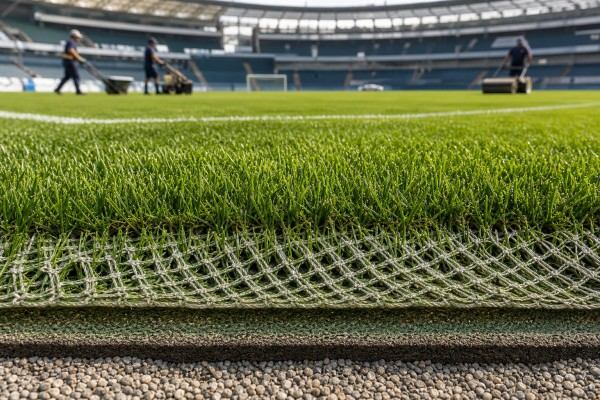
Understanding this dual-lifespan concept is a crucial step for B2B buyers evaluating material durability. Let’s break down why hybrid turf longevity is not a static warranty number, but rather a dynamic system heavily reliant on the rule of "30% material quality and 70% maintenance and base construction."
What is the dual-lifespan concept of a woven hybrid grass system?
Buyers often evaluate artificial grass warranties by looking for a single expiration date, assuming hybrid turf works the exact same way. This misconception leads to serious miscalculations in municipal and commercial project planning. Understanding the difference between the physical components and the living ecosystem is the only way to measure true durability.
A woven hybrid grass system features a dual-lifespan. The physical baseline relies on the synthetic material’s UV resistance, which provides a reliable 8-year framework. Conversely, the living system’s lifespan fluctuates based on natural grass survival, which requires strict environmental and agronomic conditions to thrive within the mesh.
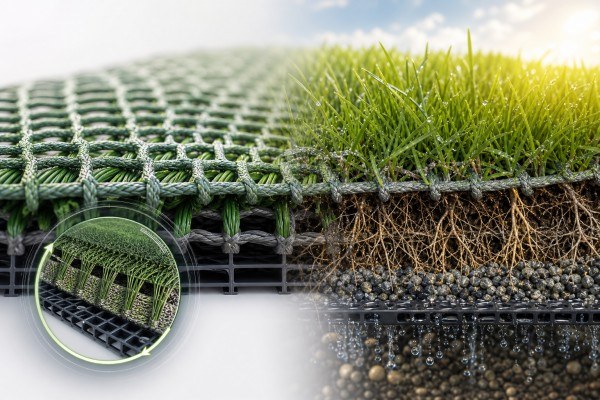
To accurately forecast how long a hybrid pitch lasts, you must evaluate the product as two distinct halves working together.
The Synthetic Framework (The Baseline)
At QH, we manufacture an open-woven mesh structure—often referred to as Grow-Through Turf. This synthetic skeleton is engineered from eco-friendly, recyclable materials designed to stabilize the soil and protect the natural grass crown. The lifespan of this synthetic component is highly predictable. High-quality synthetic yarns are treated for UV resistance. In our manufacturing process, this UV resistance is engineered to last for roughly 8 years under standard outdoor exposure.
The synthetic mesh will not simply disintegrate after 8 years, but its tensile strength and UV stability will gradually decline. As long as the natural grass canopy remains healthy, it actually shades the synthetic yarns from direct sunlight, potentially extending the plastic’s lifespan even further.
The Living System (The Variable)
The second half of the lifespan equation is entirely up to nature and human intervention. Natural grass is a living organism. Its lifespan is theoretically infinite if it is perfectly maintained, continuously seeded, and properly nourished. However, if the natural grass dies out due to disease, drought, or poor soil conditions, the hybrid pitch is compromised.
In my years of exporting open-woven hybrid turf to international contractors, I always clarify this dynamic: the factory provides the indestructible skeleton, but your local groundskeeper provides the muscle and skin.
Comparing the Two Lifespans
| System Component | Core Material | Expected Lifespan | Primary Threats to Longevity |
|---|---|---|---|
| Synthetic Framework | Open-woven polymer mesh | ~8 Years (UV Resistance) | Prolonged direct UV exposure, improper blade height during mowing |
| Living System | Natural grass roots and blades | Variable (Months to Decades) | Poor drainage, soil compaction, drought, disease, overuse |
Why is the "install-and-forget" mentality a trap for hybrid turf?
Many municipal clients, school campuses, and resort developers want the lush look of natural grass without the associated upkeep. They mistakenly view hybrid grass as a low-maintenance magic bullet that solves all landscaping problems. This dangerous assumption practically guarantees project failure within the first year.
The "install-and-forget" trap assumes hybrid turf is as low-maintenance as conventional artificial grass. In reality, an open-woven hybrid pitch requires rigorous agronomic care, including watering, mowing, aeration, and fertilizing.1 Neglecting these living grass requirements will quickly destroy the natural turf, leaving behind an exposed synthetic mesh.
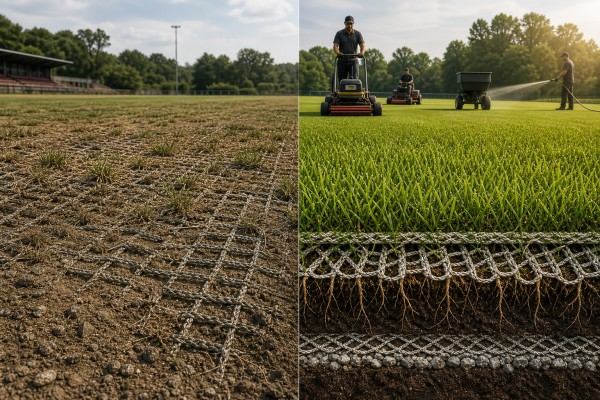
If you are sourcing materials for a high-end commercial landscaping project or a municipal green belt, you must set realistic expectations with your end-users. A hybrid pitch is absolutely not a "low-maintenance" alternative to natural grass. It is an enhanced natural pitch, designed for higher stability and traffic tolerance, but it demands the exact same—if not more—agronomic attention.
Essential Maintenance Protocols for Longevity
To maximize how long a hybrid pitch lasts, maintenance teams must adhere to a strict schedule:
- Routine Mowing: The natural grass must be mowed regularly to encourage horizontal growth (tillering) and a dense canopy.2 However, mowers must be set to the correct height so the blades do not catch and tear the synthetic mesh.
- Irrigation Management: While the open-woven structure allows for excellent drainage and breathability, the living roots still require consistent moisture.
- Nutrient Application: Fertilization is necessary to keep the natural grass vibrant and capable of recovering from heavy foot traffic.
- Aeration and Topdressing: This is arguably the most critical step. Traffic compacts the soil over time. Aeration relieves this pressure, allowing oxygen to reach the root zone through the synthetic mesh grid.
When B2B buyers treat a hybrid grass system like standard synthetic turf—assuming it needs no water, no food, and no breathing room—the natural grass rapidly dies. The remaining exposed synthetic mesh is not designed to be played on or walked on as a standalone surface, leading to rapid degradation and client dissatisfaction.
What causes a hybrid pitch to fail prematurely?
You source high-quality hybrid grass rolls, your contractors install them, and six months later, the pitch is a muddy, barren mess. Identifying the root causes of these rapid system failures is essential to protect your reputation as a supplier and your client’s financial investment.
Premature hybrid pitch failure is rarely a material manufacturing defect; it stems from poor site conditions and maintenance. The primary culprits include poor sub-base drainage leading to waterlogging and root rot, severe soil compaction from a lack of aeration, and continuous overuse without allowing natural grass recovery.
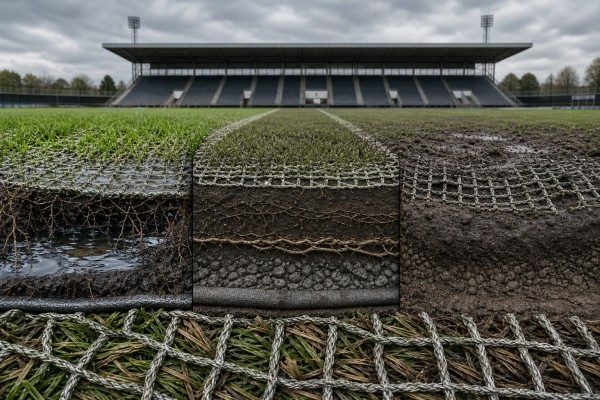
When evaluating why a hybrid grass installation failed long before its 8-year synthetic baseline, we almost always trace the issue back to the 70% rule—base construction and maintenance. Here is the anatomy of premature failure.
1. Poor Sub-Base Drainage and Root Rot
An open-woven hybrid turf system is highly permeable by design. It allows water to pass through the mesh instantly. However, if the sub-base beneath the turf (the soil, sand, and gravel layers) is improperly graded or heavily compacted, that water has nowhere to go.
When water pools beneath the mesh, the natural grass roots sit in stagnant moisture. This inevitably leads to root rot.3 Within a few weeks, the natural grass dies off, turning into sludge. The client is left with a highly visible synthetic mesh sitting on top of mud. B2B buyers must ensure their installation contractors are building proper sand-based rootzones with engineered drainage systems.
2. Severe Soil Compaction
In high-traffic areas like school campuses, municipal parks, or sports field sidelines, constant compression squeezes the air out of the soil. When soil becomes compacted, natural grass roots cannot breathe, absorb nutrients, or expand deeper into the base.4
Because the synthetic mesh stabilizes the surface, groundskeepers often fail to notice the soil compaction happening underneath until the natural grass turns yellow and dies. Skipping regular aeration and topdressing is a guaranteed way to cut the lifespan of a hybrid pitch down to just a few months.
3. Overuse Without Recovery Periods
One of the greatest benefits of pure artificial grass is that it can be used 24/7 without rest. Hybrid grass cannot be treated this way. While the synthetic woven mesh protects the root crown from being torn out by cleats or heavy foot traffic, the green blades of the natural grass are still being sheared and crushed.
If a commercial lawn or sports field is subjected to continuous daily use without designated recovery periods, the natural grass will simply wear away.5 The synthetic framework will survive, but the aesthetic and functional value of the hybrid pitch will be lost.
How can buyers spot deceptive hybrid turf lifespan claims?
The B2B landscaping and sports construction market is flooded with suppliers making outrageous longevity promises to secure contracts. When a supplier guarantees a flawless, maintenance-free pitch for decades without context, procurement managers need to know how to filter the facts from the marketing noise.
To spot deceptive hybrid turf lifespan claims, buyers must look beyond static warranty numbers. If a supplier blindly promises a 15-year lifespan, ask if this includes the natural grass survival cycle and what specific maintenance protocol it assumes. Legitimate manufacturers separate synthetic material baselines from agronomic survival.
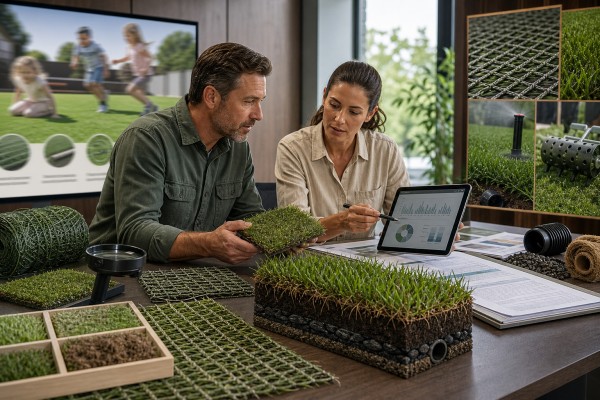
When you are importing wholesale artificial grass or supplying government projects, falling for deceptive marketing can lead to massive liability. Here is how you arm yourself against exaggerated claims.
Questions to Ask Your Hybrid Grass Supplier
When a competitor tells you their hybrid pitch lasts 15 years, you should immediately ask these qualifying questions:
- "Does your warranty cover the whole system or just the synthetic mesh?"
No honest factory can guarantee the lifespan of natural grass because we cannot control the local climate, soil quality, or the groundskeeper’s work ethic. If they claim to warranty the natural grass, they are lying. - "What is the specific UV resistance rating of the yarn?"
Look for tangible engineering specs. An 8-year UV resistance is a realistic, high-quality standard for open-woven mesh exposed to outdoor elements. - "What sub-base specifications do you require?"
If a supplier tells you that their hybrid turf can be installed on "any base" without specialized sand or soil rootzones, walk away. Proper natural grass growth requires a very specific agronomic profile.
The Reality of TCO (Total Cost of Ownership)
Understanding how long a hybrid pitch lasts is really about understanding your Total Cost of Ownership. You are investing in premium, eco-friendly materials—like QH’s 100% recyclable open-woven mesh—that carry a higher upfront cost than conventional landscaping grass.
To protect that investment, you must budget for the necessary maintenance equipment, irrigation systems, and skilled labor required to keep the living half of the system alive. Honest manufacturers will always highlight these requirements upfront rather than hiding them behind a fake 15-year guarantee.
Frequently Asked Questions
Can you install woven hybrid grass on a concrete base?
No. Open-woven hybrid grass systems require a natural soil or engineered sand base. The core function of the product is to allow living natural grass roots to grow through the open mesh into the earth below. Installing it on concrete completely defeats its purpose.
Is open-woven hybrid grass fully recyclable?
Yes, high-quality systems prioritize sustainability. At QH, our open-woven mesh is manufactured using eco-friendly, fully recyclable materials. Because it does not rely on heavy polyurethane or latex backings like traditional artificial turf, it is much easier to process at the end of its life.
How long does the natural grass take to grow through the mesh?
This depends entirely on your local climate, grass seed species, and irrigation. Typically, natural grass begins to push through the mesh within a few weeks. However, the open-woven structure immediately stabilizes the soil the moment it is installed, providing instant ground protection while the grass matures.
Do I need special equipment to maintain a hybrid pitch?
Generally, no. You will use standard natural grass maintenance equipment, including rotary or reel mowers, aerators, and topdressers. The only critical adjustment is ensuring that mower blades and aerator tines are set to appropriate depths so they do not catch and damage the synthetic mesh.
Conclusion
So, exactly how long does a hybrid pitch last? The most accurate answer is that the physical synthetic framework provides a highly durable, UV-resistant baseline of roughly 8 years, while the overall system’s lifespan relies heavily on rigorous base construction and ongoing agronomic maintenance. By avoiding the "install-and-forget" trap and ensuring proper drainage and aeration, B2B buyers can deliver long-lasting, high-performance green spaces for their clients.
If you are a contractor, importer, or municipal supplier looking for reliable, factory-direct materials, QH Grass is here to help. We specialize in B2B wholesale and full-container orders of premium open-woven hybrid turf. Contact Alice Chen at [email protected] or reach out via WhatsApp at +86 185 7566 0746 to discuss your next project’s technical specifications and container pricing.
-
"FS102: Your Lawn and Its Care (Rutgers NJAES)", https://njaes.rutgers.edu/fs102/. University extension guidelines for sports turf management confirm that hybrid grass systems require intensive agronomic inputs, including precise irrigation, fertilization, and aeration, to maintain the living grass component. Evidence role: expert_consensus; source type: education. Supports: Outlines the intensive agronomic protocols required for hybrid sports fields, confirming they demand similar or greater maintenance inputs compared to traditional natural turf.. ↩
-
"[PDF] Evaluation of the Defoliation Resistance Mechanisms Influence …", https://www.ndsu.edu/agriculture/sites/default/files/2022-10/topic1_volume1_ch3_report4.pdf. Agronomic studies show that regular, appropriate defoliation (mowing) alters the hormonal balance in turfgrass, stimulating the development of lateral shoots (tillers) and increasing overall canopy density. Evidence role: mechanism; source type: education. Supports: Explains the physiological response of turfgrass to regular defoliation, noting that proper mowing heights stimulate lateral shoot development (tillering).. ↩
-
"Turfgrass Response to Water Deficits : Turf – UMass Amherst", https://www.umass.edu/agriculture-food-environment/turf/fact-sheets/turfgrass-response-to-water-deficits. Prolonged soil saturation creates anaerobic conditions that not only suffocate turfgrass roots but also provide an ideal environment for oomycete pathogens like Pythium, leading to rapid root rot. Evidence role: mechanism; source type: education. Supports: Describes the pathogenesis of root-rotting fungi, such as Pythium species, which thrive in waterlogged, anaerobic soil conditions.. ↩
-
"Bulk Density | Soil Quality for Environmental Health", https://soilquality.nres.illinois.edu/bulk-density/. Increases in soil bulk density due to compaction mechanically impede root elongation and reduce pore space, severely limiting the root system’s ability to intercept water and absorb essential nutrients. Evidence role: mechanism; source type: paper. Supports: Analyzes the effects of high soil bulk density on root elongation, showing that compaction severely limits oxygen availability and nutrient absorption.. ↩
-
"Best management practices for maintaining sand-based, natural …", https://extension.oregonstate.edu/catalog/pnw-676-best-management-practices-maintaining-sand-based-natural-grass-athletic-fields. Sports governing bodies note that while hybrid turf systems can sustain more playing hours than pure natural grass, they still require scheduled recovery periods to prevent the complete defoliation of the living grass component. Evidence role: expert_consensus; source type: institution. Supports: Provides usage guidelines for hybrid sports pitches, emphasizing that while they offer higher wear tolerance than pure natural grass, they still require mandatory biological recovery periods.. Scope note: Exact recovery times vary based on grass species, climate, and intensity of use. ↩