_画板-1.png)
Budgeting for commercial landscaping projects is incredibly frustrating when you cannot find reliable material prices online. If you are a contractor or importer searching for the hybrid synthetic turf cost per square foot, you have likely encountered wildly varying numbers that could either blow your bid out of the water or make you miss a highly profitable opportunity. As a factory representative who quotes container orders daily, I always start by asking my clients: Is your project for municipal landscaping or a professional stadium? What is your total project area? Do you know the fundamental difference between this and standard artificial grass? Diagnosing these misunderstandings is the only way to get an accurate price.
For B2B wholesale buyers, the factory-direct hybrid synthetic turf cost per square foot ranges from $0.65 to $1.20. In international trade, this translates to roughly $7 to $13 per square meter. These prices apply specifically to open-woven mesh systems and require minimum order quantities of at least 3,000 square meters.
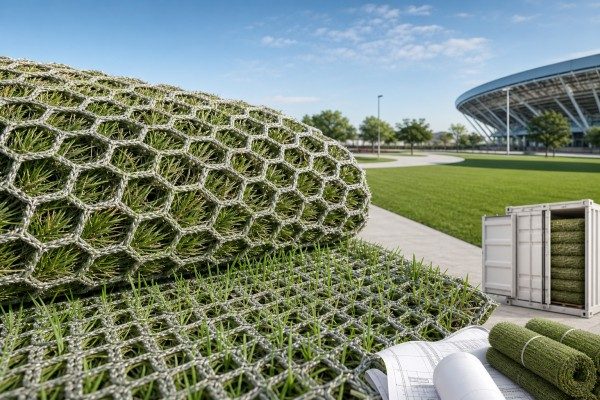
If you are a landscape contractor or municipal project bidder, securing this factory-direct pricing can make or break your proposal. However, the final landed price depends entirely on the specific hybrid grass system you evaluate and how you purchase it. Let’s break down the variables that drive these costs.
Does the hybrid synthetic turf cost per square foot change between stitched stadium systems and open-woven mesh?
Many contractors completely abandon hybrid turf because they see astronomical prices online and immediately panic. They assume the high cost will instantly ruin their municipal bids and alienate their clients. The reality is that they are usually looking at the wrong product category entirely.
The biggest pricing mistake buyers make is confusing ultra-expensive stitched or injected professional stadium systems with cost-effective open-woven hybrid turf. Stitched systems cost significantly more and require heavy installation machinery1, whereas open-woven mesh systems provide an affordable grow-through solution for commercial landscaping.
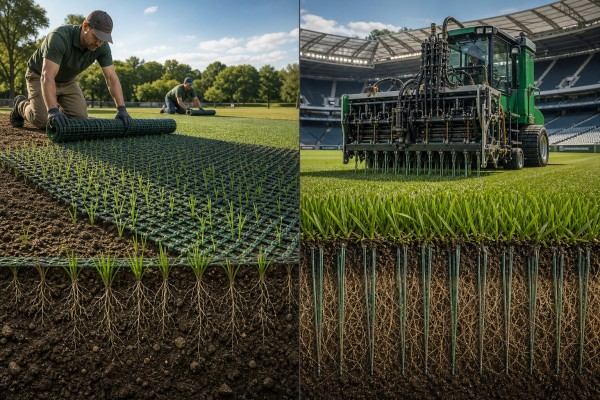
To make profitable commercial sourcing decisions, you must understand the system selection risk. When buyers hear "hybrid turf," they often picture the high-tech playing surfaces used in the World Cup or top-tier European football leagues2. Those systems involve injecting synthetic fibers deep into a prepared sand base or using massive machines to stitch fibers into existing natural grass. Because of the specialized machinery, patented technologies, and complex installation required, the cost per square foot for those stadium systems is astronomical.
Conversely, open-woven hybrid turf—also known as a grow-through turf or woven hybrid turf—is an entirely different product designed for a different market. This system features an open-woven mesh backing that is simply laid down over prepared soil. Natural grass seeds are sown, and the real grass grows directly through the synthetic mesh, allowing the two to coexist.
This open-woven design is exactly what our factory at QH manufactures. It is vastly more affordable and does not require million-dollar stitching machines to install. If you are bidding on parks, public green areas, school campuses, or roadside green belts, the open-woven mesh system is the exact product you need to keep your budget competitive.
Comparing Hybrid Turf Systems
| Feature | Stitched / Injected Systems | Open-Woven Mesh Systems (QH Hybrid) |
|---|---|---|
| Primary Application | Professional sports stadiums | Municipal landscaping, parks, commercial greening |
| Installation Method | Heavy specialized machinery | Standard roll-out over prepared soil |
| Cost Profile | Ultra-premium, extremely high cost | Cost-effective B2B pricing ($0.65–$1.20/sqft) |
| Natural Grass Interaction | Fibers reinforce the soil/roots | Natural grass grows freely through the open mesh |
Why is the hybrid synthetic turf cost per square foot 3x higher than standard artificial grass?
When reviewing wholesale quotes, purchasing managers quickly notice a steep price gap between product lines. Why does a hybrid grass system demand such a premium compared to normal fake grass? Failing to understand and justify this premium to your stakeholders makes it very difficult to win high-end greening contracts.
The hybrid synthetic turf cost per square foot is roughly three times higher than standard artificial grass due to a slow, specialized open-woven manufacturing process and the use of tough, eco-friendly materials. This premium is justified because it solves strict municipal mandates requiring real natural grass.
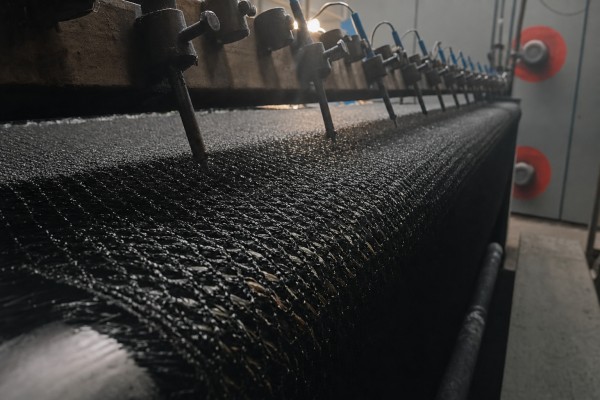
To properly evaluate this product during supplier selection, you have to look closely at the manufacturing quality control and the specific commercial hurdles this turf overcomes. The 3x price premium over conventional landscape grass is directly tied to how the product is made and what it achieves on the job site.
The Slower Manufacturing Process
Standard artificial grass is produced using a high-speed tufting process where yarn is punched through a solid backing cloth and sealed with a heavy coating of polyurethane (PU) or latex. It is fast, efficient, and cheap to produce. Open-woven hybrid turf, however, cannot be tufted. It is meticulously woven on specialized looms to create an open grid structure. This weaving process is significantly slower, which drastically limits daily production volume and increases the overhead cost per square meter.
Meeting Government Mandates for Real Greenery
The most critical reason commercial contractors accept the higher hybrid synthetic turf cost per square foot is that it solves a major regulatory hurdle. Today, many government and municipal landscaping projects have strict environmental mandates requiring a certain percentage of the project area to be living, natural greenery3. Standard artificial grass is considered a "hardscape" or artificial surface and fails these environmental quotas.
By utilizing an open-woven grow-through turf, you provide immediate green coverage upon installation, but because the natural grass grows through the mesh and takes root, the area qualifies as a natural green space. Furthermore, the materials used in our QH woven turf are highly durable, eco-friendly, and 100% recyclable, which perfectly aligns with modern sustainable construction requirements.
How do wholesale MOQs impact your final hybrid synthetic turf cost per square foot?
Finding an incredibly low factory-direct price on a manufacturer’s website is exciting, but treating that number as your final project cost is a dangerous oversight. If you ignore shipping fees, import tariffs, and minimum volume requirements, your calculated procurement budget will fall apart before the turf even leaves the port.
To secure the factory-direct $0.65 to $1.20 per square foot pricing, buyers must meet a Minimum Order Quantity (MOQ) of 3,000 square meters for full-container wholesale orders. After international freight, destination tariffs, and dealer margins, terminal retail prices are entirely different.
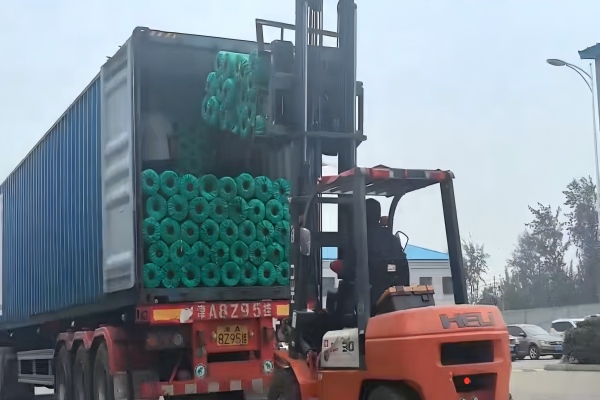
One of the most frequent challenges I face as a factory representative is explaining the realities of B2B international trade to buyers who are used to domestic retail shopping. It is crucial to understand exactly how you are buying the product and what unit of measurement is actually used in the contract.
Translating Square Feet to Square Meters
While North American contractors often search for the hybrid synthetic turf cost per square foot to estimate their local bids, international B2B factories do not quote or manufacture in square feet. In global trade, pricing is strictly calculated in square meters (sqm).4 The $0.65–$1.20/sqft price equates to roughly $7 to $13/sqm. When you evaluate quotes from our factory, all technical specifications, invoices, and shipping documents will be standardized in square meters.
Calculating the Landed Terminal Cost
The factory-direct price is essentially your FOB (Free on Board) cost. It does not represent what a final consumer pays a local dealer. When contractors ask me for the exact retail price in their country, I always clarify that terminal retail prices are estimates. Because of the costs associated with ocean freight, import duties, domestic warehousing, and local distributor profit margins, the final retail price for open-woven hybrid turf is often three to five times higher than our factory price.
This massive retail markup is exactly why mid-to-large landscape contractors, municipal project bidders, and sports field contractors come directly to QH. By meeting our custom MOQ of 3,000 sqm and purchasing in standard 1×40HQ containers, you bypass the middleman and drastically reduce your material costs. (Keep in mind, a standard 1×40HQ container takes about 15–20 days to produce, while customized specifications take 25–30 days).
Does the long-term ROI justify the initial hybrid synthetic turf cost per square foot?
Convincing developers to approve higher upfront material costs is always an uphill battle. If a purchasing committee only looks at the initial invoice, they might opt for cheaper 100% natural grass or standard synthetic turf. How do you prove that the initial premium is actually a long-term cost-saving measure?
The upfront premium of open-woven hybrid turf yields massive ROI by drastically reducing long-term landscape maintenance. By physically protecting natural grass roots from heavy commercial wear, it eliminates the frequent replanting, high-frequency watering, and expensive soil renovations associated with natural grass.
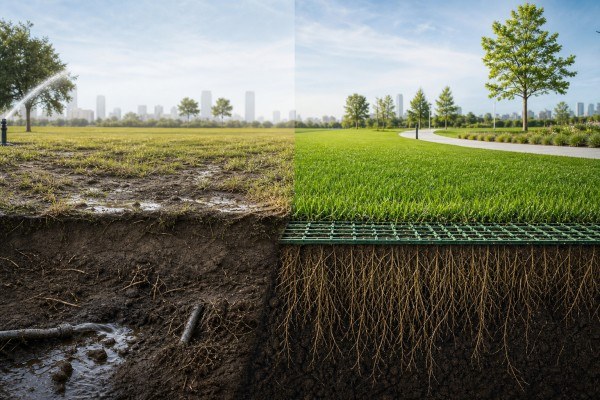
Evaluating the true cost of a landscaping product requires looking beyond the initial material purchase. When you install 100% natural grass in high-traffic municipal areas—like roadside green belts, public parks, or school courtyards—the grass gets destroyed rapidly. The soil compacts, the grass crowns are crushed, and the area turns into a muddy eyesore.5
The Hidden Costs of 100% Natural Grass
To maintain natural grass in heavy-use commercial areas, municipalities spend a fortune on:
- Continuous re-sodding and over-seeding
- High-frequency irrigation and fertilization
- Labor-intensive soil aeration and renovation
- Loss of use while the area recovers
How Grow-Through Turf Protects Your Investment
The open-woven hybrid grass system acts as an armored shield for the soil. The synthetic fibers take the brunt of the foot traffic, preventing soil compaction and protecting the vital crowns and roots of the real grass below. Even if the natural grass blades are worn away during peak use, the roots remain safe, allowing the grass to recover naturally without expensive replanting.
Additionally, the hybrid system provides an instant visual benefit. The moment our QH hybrid turf is rolled out, the site looks impeccably green and finished. You do not have to wait weeks for natural seeds to germinate and fill in. This combination of instant aesthetic appeal, long-term root protection, and massive reductions in maintenance labor makes the hybrid synthetic turf cost per square foot highly profitable for commercial developers and government project suppliers.
Frequently Asked Questions
Does open-woven hybrid turf require rubber infill?
No, unlike standard artificial sports turf, open-woven hybrid turf typically does not require rubber infill. It is designed to be filled with topsoil, sand, and natural grass seeds. The goal is to facilitate natural grass growth through the mesh, not to simulate a synthetic sports cushion.
Can I buy a small amount of hybrid turf for my residential backyard?
We are a B2B manufacturer focused strictly on wholesale and full-container orders. Our minimum order quantity (MOQ) is 3,000 square meters per specification. Individual consumers or those looking for small residential trial orders should contact their local landscaping distributors.
How does the drainage of open-woven turf compare to standard artificial grass?
The drainage is vastly superior. Standard artificial grass uses a solid PU or latex backing with small punched drainage holes. Open-woven hybrid turf is essentially a porous grid, offering 100% permeability.6 This exceptional drainage and breathability are exactly what allows the natural grass roots to thrive.
What is the lead time for a wholesale container order?
For standard specifications, manufacturing a 1×40HQ container takes about 15 to 20 days. If your project requires customized specifications, the lead time is 25 to 30 days. Each additional container adds approximately 10 extra days to the production schedule.
Conclusion
Understanding the true hybrid synthetic turf cost per square foot is the first step in winning profitable commercial and municipal landscaping bids. By recognizing that factory-direct open-woven mesh systems cost between $0.65 and $1.20 per square foot ($7–$13/sqm), you can confidently budget your projects without fearing the exorbitant costs of professional stadium systems. While the upfront material cost is higher than standard artificial grass, the open-woven design solves strict environmental mandates and delivers exceptional ROI by protecting natural grass roots and drastically reducing maintenance expenses.
If you are a B2B importer, municipal contractor, or landscape developer ready to source premium grow-through turf directly from the factory, let’s discuss your project requirements. Contact me, Alice Chen, at QH Artificial Grass ([email protected] or WhatsApp: +86 185 7566 0746) to secure your full-container wholesale pricing today.
-
"Hybrid grass – Wikipedia", https://en.wikipedia.org/wiki/Hybrid_grass. See studies on sports surface engineering detailing the use of computer-guided stitching machines to inject synthetic fibers 20cm deep into the rootzone of stadium pitches. Evidence role: mechanism; source type: paper. Supports: The mechanical process of installing stitched hybrid turf using specialized injection machines.. Scope note: Specific machinery costs and installation times vary by manufacturer and stadium size. ↩
-
"Bringing UT’s Turfgrass Expertise to FIFA World Cup 26", https://www.utk.edu/turfgrass/. FIFA and UEFA technical reports document the widespread adoption of reinforced hybrid grass systems (such as stitched turf) in World Cup and premier league stadiums to maintain pitch stability. Evidence role: case_reference; source type: institution. Supports: The adoption of stitched hybrid grass systems in major international football tournaments.. Scope note: Tournament regulations allow for various pitch types; not every single stadium uses the exact same hybrid technology. ↩
-
"The Basics of Land Use and Zoning Law", https://online.law.tulane.edu/blog/land-use-and-zoning-law. Municipal zoning codes and urban planning guidelines frequently mandate a minimum Green Space Factor (GSF) or permeable surface area, requiring a specific percentage of a lot to feature living vegetation. Evidence role: general_support; source type: government. Supports: The existence of municipal zoning laws mandating minimum percentages of living green space.. Scope note: Green space quotas and definitions vary significantly by jurisdiction and local climate. ↩
-
"Units of textile measurement – Wikipedia", https://en.wikipedia.org/wiki/Units_of_textile_measurement. The World Customs Organization and international trade standards (such as the Harmonized System) utilize the square meter (sqm) as the standard unit of measurement for the global trade of carpets, textiles, and synthetic turf. Evidence role: general_support; source type: institution. Supports: The use of the square meter as the standard metric in international textile and flooring trade.. ↩
-
"9. Traffic Stress & Turf Cultivation", https://www.umass.edu/agriculture-food-environment/turf/best-management-practices-bmps-for-lawn-landscape-turf/9-traffic-stress-turf-cultivation. University extension agronomy programs document that excessive foot traffic on natural turfgrass leads to severe soil compaction, which restricts root oxygenation, and physically crushes the meristematic crowns, leading to plant death and bare soil. Evidence role: mechanism; source type: education. Supports: The mechanism of natural turf degradation via soil compaction and crown damage from foot traffic.. ↩
-
"Porous Pavement: Low-impact development fact sheet", https://extension.oregonstate.edu/catalog/pub/em-9210-porous-pavement-low-impact-development-fact-sheet. Hydrological testing of synthetic turf backings shows that open-woven or grid-style backings provide continuous porosity, resulting in water infiltration rates that are significantly higher than those of traditional hole-punched backings. Evidence role: mechanism; source type: research. Supports: The high permeability and drainage capacity of open-woven turf backings.. Scope note: While the backing itself is highly permeable, the actual drainage rate of the installed system is ultimately limited by the infiltration capacity of the underlying soil. ↩