_画板-1.png)
You see a low price for artificial turf in China, but the final bill often shocks you. Unexpected fees can destroy your profits. Here is the exact formula I use to calculate true landed costs.
The landed cost for artificial turf includes the FOB product price, ocean freight, insurance, customs duties, taxes, and local delivery fees. To account for this, add 25% to 40% on top of your factory quote depending on your country’s specific import tariffs and logistics rates.
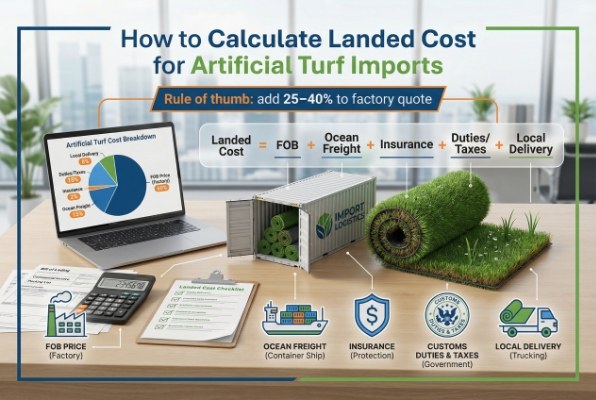
Many of my clients only look at the price per square meter from the factory. This is a huge mistake. If you ignore the supply chain costs, you will lose money on the deal. Let me walk you through every step so you do not lose money on your next container.
What Exactly Goes Into the Landed Cost of Turf Imports?
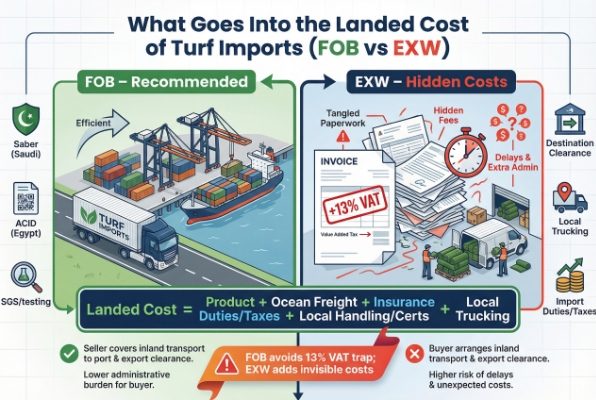
Factory quotes can be very confusing for new buyers. Picking the wrong trade term, like EXW1, costs you extra "invisible" money later. You must stick to FOB terms to save on tax and hassle.
Always request FOB pricing2. This includes the product cost plus transport to the Chinese port. Do not use EXW, as manufacturer cannot claim tax refunds, making it 13% more expensive. Landed cost also adds local handling and certification fees.
In my experience at QH Grass, I see many new buyers ask for EXW prices. They think it is cheaper because the factory price looks lower. It is not. Legitimate Chinese manufacturers quote FOB for a reason.
If a supplier gives you an EXW quote, they might just be a trading company. They are not the actual factory. Under EXW terms, the manufacturer cannot declare the goods for tax exemption. This means the 13% VAT stays on the bill. For the importer, this is a dead cost. If you insist on EXW, we have to find a trading company to fix the export papers. That costs you money and time. Always ask for FOB. This means I handle the trucking and paperwork inside China.
Once the ship arrives at your port, the costs continue. You have customs clearance3, trucking to your warehouse, and special documents.
- Saudi Arabia: You need the Saber certificate.
- Egypt: You need the ACID registration.
These are not free. Most importing companies struggle to handle customs documentation and regulations independently. You must budget for these before you send the deposit.
| Cost Component | Responsible Party (FOB) | Description |
|---|---|---|
| Product Cost | Buyer | The price of the grass itself. |
| China Export Tax | Manufacturer | Included in FOB price (we get the refund). |
| Ocean Freight | Buyer | Cost to move container across the sea. |
| Destination Clearance | Buyer | Hiring a local agent to release goods. |
| Special Certs | Buyer | Fees for Saber, ACID, or SGS tests. |
| Local Trucking | Buyer | Transport from port to your door. |
How Do Shipping Logistics Impact Your Turf Import Budget?
Shipping rates change almost every week. A slow ship can ruin your installation schedule and upset your clients. You must choose direct shipping or transshipment based on your business goal.
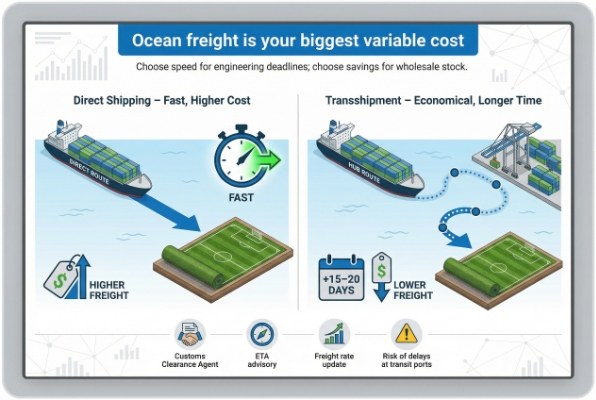
Ocean freight is your biggest variable cost. Direct shipping4 is expensive but fast, ideal for urgent engineering projects. Transshipment5 takes longer but saves money, which is perfect for wholesalers stocking up on inventory.
Shipping is a game of balance between time and money. I often ask my clients: "Do you need this for a specific deadline?" If you are buying materials for an engineering project, like a school field or a public park, you must choose direct shipping.
Direct shipping costs more. However, it guarantees the timeline. I have seen projects fail because the grass was stuck in a transit port for two weeks just to save $500. If you miss your paving completion date, the penalty fees from your customer will be much higher than the shipping savings. Reliable logistics ensure project progress.
On the other hand, if you are a wholesaler or distributor, time is less critical. You can choose transshipment shipping. The vessel stops at other ports on the way. It takes longer, maybe 15 to 20 extra days. But it is usually much cheaper. This offers better cost control for your inventory.
I recommend finding a reliable local customs clearance company6. They act as your import consultant. They can advise you on the current freight rates. They provide guidance on any concerns regarding the arrival time. Do not try to guess the shipping market yourself. Use a professional partner.
- Engineering Projects: Speed is priority. Use Direct Shipping.
- Wholesale Stock: Price is priority. Use Transshipment.
What Should You Know About Customs and Import Regulations?
Customs officers are very strict in countries like Brazil and the USA. One wrong paper can stop your container for weeks. You need a professional broker to avoid heavy fines and delays.
Every country has specific HS codes and duty rates7 for artificial turf. Mistakes here lead to demurrage charges8 at the port. Hiring a local customs broker is the smartest investment to navigate these complex legal requirements safely.
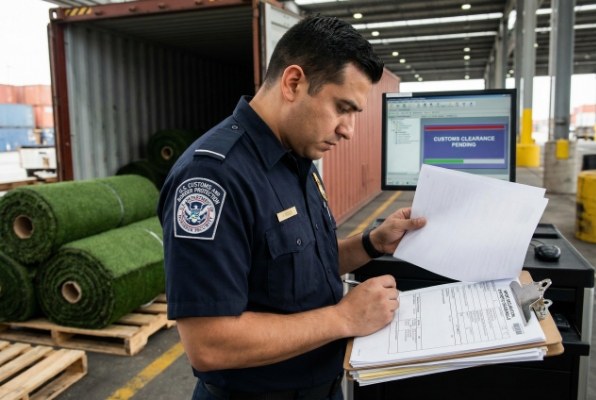
I provide the commercial invoice, packing list, and Bill of Lading. To me, these are standard. But your local government treats them differently. Your local regulations are the tricky part of the landed cost. As an engineer, I know how to make grass last for 10 years. But I do not know the tax law in Mexico or Russia.
You need a local partner for this. A good customs clearing agent handles the heavy lifting. They tell you exactly how much duty you will pay before the ship leaves China. They also help with the HS Code classification. Sometimes, a slight difference in the description of the backing material changes the tax rate.
Also, consider the "last mile" delivery. Trucking from the port to your warehouse can be surprisingly expensive. In the United States, drayage fees are high. In developing countries, the road conditions might require special trucks.
Here is a simple checklist I give to my partners:
- Check Import Duties: Verify the rate for Artificial Turf (usually HS Code 5703.30).
- Verify Standards: Does your country require heavy metal testing?
- Hire a Broker: Don’t do the paperwork yourself.
- Plan for Demurrage: Ensure your warehouse is ready to receive goods immediately to avoid port storage fees.
If you skip these steps, your "cheap" import becomes very expensive due to fines and storage fees at the dock.
Is Imported Turf Worth the Premium? A Cost-Quality Analysis?
Importing seems risky compared to buying locally. You might ask why you should pay shipping fees at all. The answer lies in the profit margin you get from the right product mix.
Yes, importing is worth it if you mix your product selection correctly. Successful importers buy 80% regular best-selling styles for cash flow and 20% high-quality custom styles to build their brand reputation.
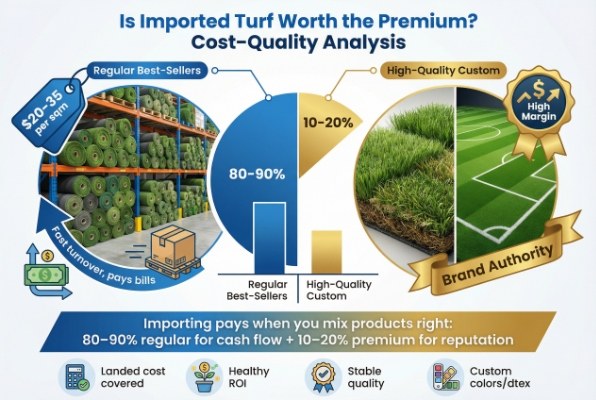
Many of my customers ask me: "Tom, how do I compete with local big brands?" The answer is in the mix of products you put in the container.
Every country has its regular best-selling styles. These are usually affordable. They look good enough for a typical backyard. My long-term partners typically purchase 80% to 90% of these styles. Why? because they sell fast. They are the "cash cow" of your business. They pay the bills and keep the warehouse empty.
However, you cannot build a strong name on cheap grass alone. You need the other 10% to 20% to be high-quality custom styles. This might be a super realistic landscape grass or a FIFA-standard sports grass.
These high-end products do two things:
- Brand Authority: They show your customers that you have technical expertise.
- Higher Margins: You can charge a premium price for these.
If you are an importer or wholesaler, use this reference. Don’t fill a container with only expensive items; your cash flow will die. Don’t fill it with only cheap trash; your reputation will die. The 80/20 mix covers your landed costs easily and leaves you with a healthy profit.
| Product Type | Volume in Container | Role in Business | Profit Margin |
|---|---|---|---|
| Regular Best-Sellers | 80% – 90% | Generates fast cash flow. | Low to Medium |
| High-Quality Custom | 10% – 20% | Builds brand and authority. | High |
Conclusion
Calculating landed cost requires adding product price, freight, insurance, taxes, and local fees. Use FOB terms, hire a customs broker, and mix your inventory to ensure high profits.
-
Learn about EXW to understand its implications on costs and tax refunds, helping you avoid common pitfalls in importing. ↩
-
Understanding FOB pricing is crucial for avoiding hidden costs in imports, ensuring you make informed purchasing decisions. ↩
-
Explore customs clearance processes to ensure smooth delivery of your goods and avoid unexpected delays. ↩
-
Exploring the benefits of direct shipping can help you make informed decisions for time-sensitive projects. ↩
-
Learning about transshipment can save you money and improve your inventory management strategies. ↩
-
Discovering the role of customs clearance can enhance your understanding of import processes and compliance. ↩
-
Understanding HS codes and duty rates is crucial for avoiding unexpected costs and ensuring compliance with import regulations. ↩
-
Learn about demurrage charges to prevent unexpected fees that can arise from delays in receiving your imported goods. ↩
_画板-1.png)