_画板-1.png)
Choosing the wrong tennis surface costs you money and time. It can affect game quality and even player safety. Understanding your options is key to making a smart investment.
The best choice for a tennis floor depends on your budget, maintenance capacity, local climate, and the desired playing style. You need to consider factors like ball speed, bounce, player comfort, and long-term costs to make the right decision for your project.
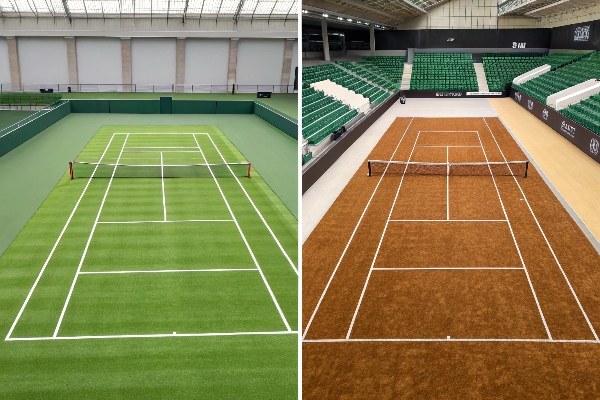
Making the right choice might seem complex, but it doesn’t have to be. As an engineer in this industry for years, I’ve helped many clients navigate these options to find the perfect fit for their needs. The key is to break down the decision into smaller, manageable parts. Let’s start by looking at what people mean when they ask for the "best" surface.
What is the best surface for a tennis court?
You want the "best" court, but the options are confusing. A wrong choice can lead to unhappy players and high maintenance bills. Let’s find the best fit for your specific needs.
There is no single "best" surface for every situation. The ideal choice balances player preference, maintenance budget, and climate. For example, hard courts are popular for all-around play, while clay courts are famously easier on a player’s body.
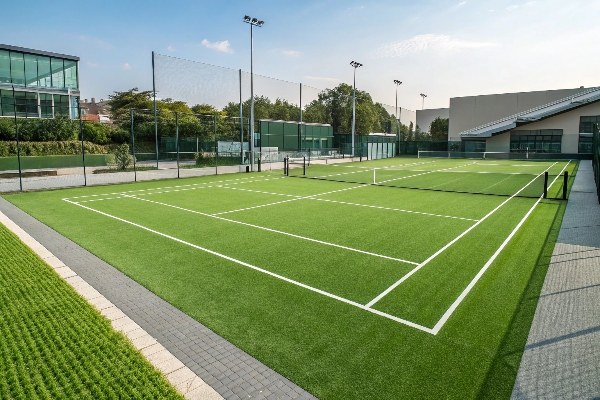
When a client asks me for the "best" surface, my first question is always, "Best for whom and for what purpose?" The answer is always a trade-off between performance1, cost, and upkeep. I once worked with a developer in a very rainy region. They initially wanted a classic clay court, but I had to explain that they would lose too many playing days to rain and face constant, costly maintenance. We looked at the options together. An acrylic hard court was a good choice, but they wanted something softer on the joints. In the end, we chose an artificial grass court with excellent drainage. It gave them the playability they wanted and maximized the court’s availability, which was crucial for their business.
Here’s a simple breakdown to help you think about it:
- Best for Professionals? It depends on their style. Some excel on fast grass, others on slow clay.
- Best for a private club? A surface that pleases most members and fits the budget. Often, this is a medium-speed hard court2 or high-quality artificial turf.
- Best for public parks? Durability and low maintenance are king. Hard courts are the typical choice here.
Ultimately, the best surface is the one that best serves your players and your business goals.
What are the 4 types of tennis surfaces?
Knowing the main court types is fundamental. Getting them mixed up can lead to a bad purchase decision. Let’s break down the four main surfaces used in tennis.
The four main types of tennis surfaces are hard court, clay, and natural grass, each used in Grand Slam tournaments. Artificial grass tennis courts have also become a very popular and practical fourth option, offering unique benefits for many facilities.
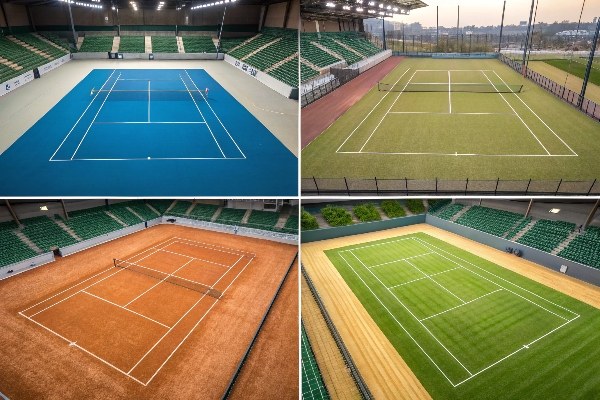
Each surface provides a completely different playing experience. As someone who supplies materials for these projects, I have to know the details of each one to give my customers the right advice. Understanding the differences is the first step to choosing correctly. Let’s look at them one by one.
Hard Courts
These are made of rigid materials. A base of asphalt or concrete is covered with layers of acrylic for cushioning and coloring. They offer a medium-to-fast ball speed and a high, predictable bounce. This is why it’s considered a great all-around surface that suits many playing styles. Maintenance is relatively low.
Clay Courts
These courts are made from crushed brick, shale, or stone. They are the slowest of the four types, causing the ball to bounce high and lose speed. This leads to longer rallies. While clay is gentle on players’ bodies, it requires a lot of maintenance, including daily watering, rolling, and brushing to keep it in playable condition.
Natural Grass Courts
This is the traditional surface of tennis. It’s known for being very fast with a low, often unpredictable bounce. Players who have a strong serve-and-volley game excel here. Natural grass courts demand the most intensive maintenance of all and are very sensitive to weather.
Artificial Grass Courts
This is a modern solution that is becoming more popular every year. It’s designed to look and play like a natural grass court but with much lower maintenance and greater durability. The sand-filled turf provides a consistent ball bounce and good shock absorption. It also drains quickly, so play can resume soon after rain.
| Surface Type | Ball Speed | Ball Bounce | Player Comfort | Maintenance Level |
|---|---|---|---|---|
| Hard Court | Med-Fast | High | Low-Medium | Low |
| Clay Court | Slow | High | High | High |
| Natural Grass | Fast | Low | Medium | Very High |
| Artificial Grass | Med-Fast | Med-High | High | Low |
What is Federer’s favourite surface3?
Pro player preferences can seem mysterious. You might wonder if what they like matters for your project. Understanding why they prefer certain surfaces gives you valuable insight for your own choice.
Roger Federer is famous for his skill on grass courts, which are widely considered his favorite surface. His aggressive, fast-paced style is perfect for the fast speed and low bounce of natural grass courts, where he has had historic success.
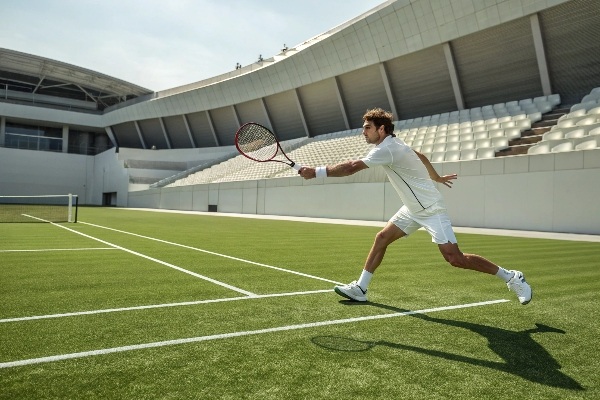
Federer’s preference for grass highlights a crucial point: the court surface directly brings out a player’s strengths. His game is built on big serves, quick points, and rushing the net. The fast, low-bouncing grass rewards this style perfectly.
Now, think about his rivals. Rafael Nadal is the "King of Clay" because the slow surface gives him time to set up his powerful, heavy-spin groundstrokes. Novak Djokovic is a master on hard courts, where the true bounce and neutral speed complement his incredible defense and all-around game. Their preferences are not random; they are based on what helps them win.
What does this mean for you, as someone building a court? It means you need to think about who will be playing on it.
- Are you building for elite training? Maybe a specialized surface makes sense.
- Are you building for a community club with players of all levels? A highly specialized surface like natural grass might be a bad idea. It’s expensive, hard to maintain, and only suits a small group of players.
I once had a client who was a huge Federer fan and wanted a "Wimbledon court." I had to gently explain that unless he had a full-time grounds crew and the perfect climate, it would be a very frustrating and expensive dream. We settled on a high-quality artificial grass court. It gave him the grass-court aesthetic and a fast game, but it was durable, easy to care for, and ready for play almost year-round. He was much happier in the end. For most projects, versatility is the smartest choice.
Conclusion
Choosing a tennis floor means balancing performance, budget, and maintenance. Understanding the main surface types helps you make a great investment for your players and your business’s success.
-
Explore the key factors that affect the performance of different tennis court surfaces and their impact on gameplay. ↩
-
Discover the characteristics of medium-speed hard courts and why they are popular for clubs and recreational play. ↩
-
Explore the reasons behind Roger Federer’s preference for grass courts and how it complements his playing style. ↩
_画板-1.png)