_画板-1.png)
Are dull office floors killing your team’s vibe and impressing no one? You want a fresh, modern look, but picking the wrong material can lead to maintenance nightmares and wasted budget.
To select the best office turf, prioritize high-density, short-pile options (10-20mm) for high-traffic areas. Ensure fibers are tough enough (high Dtex) to withstand rolling chairs. Always check for fire-resistance ratings to meet safety codes, and consider mixed green colors for a natural, professional aesthetic.
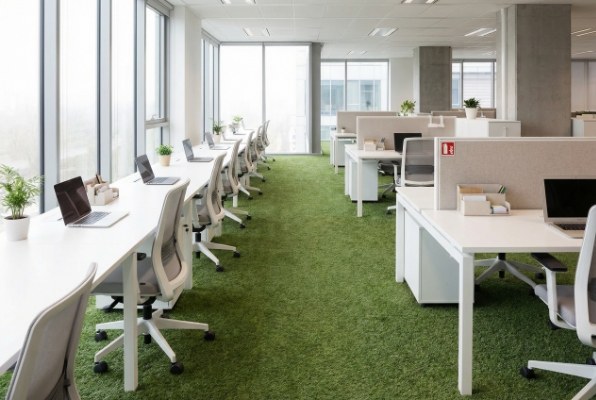
I remember when I first started as an engineer in the workshop, a client insisted on installing long, lush sports grass in their office lobby. It looked great for a week. But within a month, the long fibers were flat, the backing was showing, and it looked messy. Let’s avoid that mistake. I want to walk you through exactly what you need to look for so your office floor lasts for years, not months.
What Are the Benefits of Installing Artificial Turf in an Office?
Still thinking that cold concrete or standard grey carpet is the only professional choice? Sticking to old standards might mean you are missing a huge opportunity to boost morale and impress clients.
Artificial turf creates a novel, relaxed, and efficient work environment while leaving a memorable first impression on visitors. Beyond aesthetics, it offers practical safety benefits like non-slip surfaces1 and fire-resistant materials2, making it a smarter, safer choice than polished wood or tile.
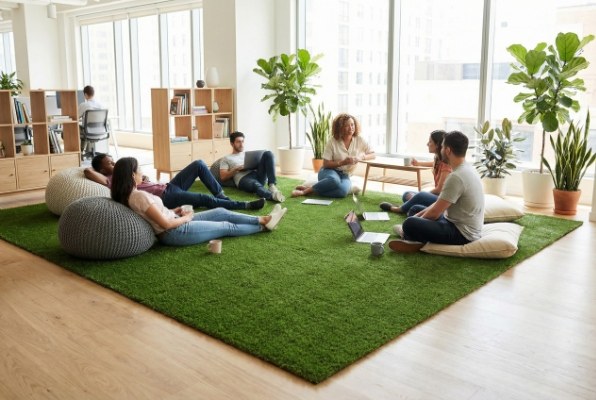
When we talk about office design, we are really talking about how people feel in a space. From my experience helping business owners upgrade their workspaces, installing artificial turf indoors does two main things. First, it helps employees. A touch of green creates a more relaxed and efficient work environment. It breaks up the monotony of grey cubicles. Second, it creates an excellent first impression for visitors, whether they are clients or partners. It shows that your company is innovative and cares about the environment.
But as an engineer, I look beyond just the looks. I look at safety. Polished concrete or wood surfaces can be slippery, especially if someone spills coffee or comes in with wet shoes. Artificial turf provides a non-slip surface that adds grip.
Most importantly, we must talk about fire safety. In an office, you cannot take risks. Artificial turf generally has good fire-resistant properties, which further enhances the safety of the working area. While almost all of our products are flame-retardant, you should always check the specific rating. For indoor use, this is non-negotiable.
| Feature | Artificial Turf | Polished Concrete | Standard Carpet |
|---|---|---|---|
| Visual Impact | High (Unique, Natural) | Medium (Industrial) | Low (Standard) |
| Safety | High (Fire-resistant, Non-slip) | Low (Slippery) | High (Non-slip) |
| Vibe | Relaxed, Creative | Cold, Hard | Neutral |
| Maintenance | Low | Medium | Medium (Stains easily) |
How Do You Select the Right Type of Artificial Grass for Office Spaces?
Worried that the grass will look fake, cheap, or wear out quickly under desk chairs? Choosing the wrong pile height and density is the most common reason office installations fail.
For office spaces, shorter is often better. We recommend 10-20mm mixed curly turf or 20-30mm monofilament blends. These resist flattening better than long fibers, while high density ensures the backing never shows through, even under heavy foot traffic.
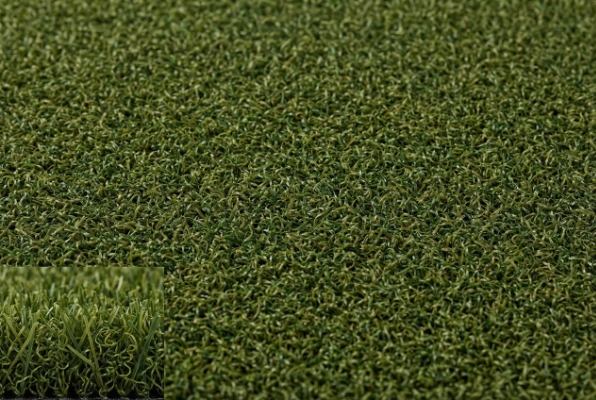
This is where my technical background comes in handy. Many people think "softer and longer is better," but for an office, that is wrong. Long-pile turf fibers (like 40mm or 45mm used in gardens [1]) struggle to overcome their own weight. They fall over easily. Once you add foot traffic and office furniture, they will stay flat and look bad.
For office spaces, I strongly recommend using short-pile, high-density artificial turf. Specifically, a 10-20mm mixed green curly turf is often the best choice for heavy areas. If you want a slightly more natural look, a 20-30mm monofilament + curly mixed turf works well too.
Here are the specific parameters you should ask your supplier about:
-
Density is King: In an office, people are walking close to the ground, and you are often looking straight down at the floor. If the density is low, you will see the black backing material. You want the fibers to be so thick that the backing is hidden.
- For 10-20mm curly turf, ask for at least 63,000 stitches/sqm.
- For 20-30mm mixed turf, ask for at least 16,000 stitches/sqm.
- Note: Of course, for decorative areas where no one walks (like a wall feature), you can save money by choosing a lower density.
-
Fiber Strength (Dtex): Office floors take a beating. They face high-intensity foot traffic and the crushing pressure of furniture wheels. You need fibers that spring back.
- Curly fibers should be at least 6000 denier (Dtex) or higher.
- Monofilament + curly mixed turf should be at least 8500 denier (Dtex) or higher.
If you ignore these numbers, your beautiful green office floor will look like a worn-out doormat in six months.
What Factors Should You Consider Before Installing Artificial Grass in Your Office?
Think you can just roll it out near a window and be done with it? Ignoring environmental factors like sunlight and underlay can turn your upgrade into a hot, uncomfortable regret.
Before buying, assess sunlight exposure. If the area gets direct sun, choose heat-resistant, matte-finish turf to prevent overheating and glare. Also, consider adding a cushioning pad3 underneath if you want a soft, carpet-like feel for added comfort.
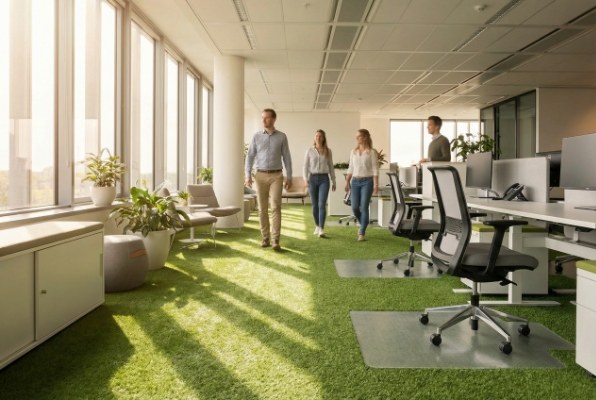
Before you finalize your order, you need to look at where the grass is going. The environment inside your office matters just as much as the product specs.
1. The Sunlight Factor
In the summer, or even on a clear winter day, the sun coming through office windows can be intense. It can heat the plastic fibers of artificial turf surprisingly quickly. If your office has large windows and areas exposed to direct sunlight, standard turf might get too hot to stand on, or it might create an annoying glare.
- The Solution: Choose heat-resistant, matte-finish artificial turf. I have worked with this series, and it stays about 10 degrees cooler than ordinary turf. It has long-lasting heat resistance, which is much better than trying to cool it down with water (which you can’t do indoors anyway!). This ensures a comfortable experience for your employees.
2. The "Feel" Factor
Artificial turf sits directly on the subfloor (usually concrete). While the grass is soft, the ground underneath is hard. If you want that plush, soft feel similar to hotel carpets, you should not rely on the grass alone.
- The Solution: Lay a cushioning pad (shock pad) under the artificial turf. This improves the underfoot feel immediately. It makes standing for long periods more comfortable and reduces noise.
3. Fire Safety Verification
As I mentioned earlier, fire resistance is becoming increasingly important for indoor installations. Although almost all of our artificial turf products are flame-retardant, standards vary by country.
- The Solution: Don’t just assume. Contact your suppliers and ask for models with higher flame-retardant properties if your local building codes are strict.
4. Furniture Planning
Artificial turf in office spaces must withstand the frequent movement of office chairs.
- The Solution: Even with high Dtex grass, use clear plastic chair mats4 under rolling chairs. This protects the fibers from the constant grinding motion of wheels, ensuring your investment lasts the 5-8 years expected for commercial applications.
Conclusion
To choose the right office turf, you must balance aesthetics with engineering. Select short-pile (10-20mm), high-density options with strong fibers to handle daily wear, and always verify fire ratings for safety.
-
Learn about the significance of non-slip surfaces for safety in workplaces and how they prevent accidents. ↩
-
Discover the critical role of fire-resistant materials in ensuring workplace safety and compliance. ↩
-
Learn how a cushioning pad can provide a plush feel and comfort underfoot, making your office more inviting. ↩
-
Discover how chair mats can protect your artificial grass investment and prolong its lifespan in high-traffic areas. ↩
_画板-1.png)