_画板-1.png)
When contractors ask me how to install hybrid turf, I usually start by asking about their past project failures. Many landscape and sports field builders treat open-woven hybrid grass like traditional synthetic turf, resulting in suffocated natural grass, poor drainage, and ruined projects. The solution requires a complete mindset shift: installing grow-through hybrid turf is an agronomic process for cultivating natural grass, not a standard synthetic turf construction.
To install hybrid turf correctly, you must follow an agronomic process. First, prepare and tamp the native soil. Next, spread nutrient-rich topsoil. Then, plant the natural grass seeds directly into the soil. After seeding, lay the open-woven hybrid turf over the area and secure it exclusively with Green PE U-nails. Do not use infill.
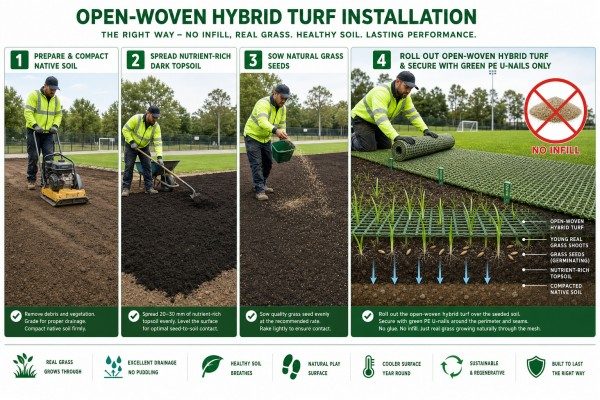
Bridging the gap between synthetic durability and natural grass biology requires strict adherence to this sequence. Let us break down the exact methodology to ensure your next municipal green belt or sports field project succeeds without costly callbacks or failed inspections.
Why is foundation preparation critical when you install hybrid turf?
Traditional synthetic turf requires a hard, compacted stone base to ensure stability and drainage. However, applying this heavy compaction method when you install hybrid turf completely destroys the project before it even begins.
The foundation for hybrid turf must support natural root growth. While standard artificial grass requires a compacted aggregate base, open-woven hybrid turf relies on aerated, nutrient-rich topsoil. A hard stone base prevents natural grass seeds from germinating, restricts root depth, and defeats the entire purpose of a grow-through turf system.
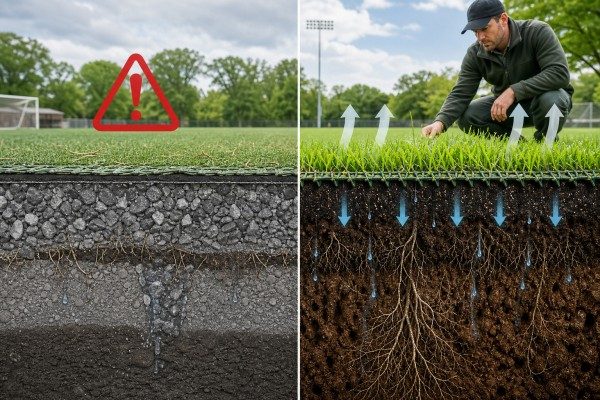
When I diagnose failed hybrid grass systems for engineering contractors, the most common culprit is the sub-base. Contractors lay down layers of gravel, crushed stone, and compacted sand. Natural grass simply cannot survive in this sterile, compacted environment. The open-woven backing of QH Hybrid Artificial Grass is specifically designed to let natural roots grow downward into the earth while the stems grow upward through the mesh.
If you block this downward path with a compacted stone base, the natural grass will suffer from shallow rooting. This leads to weak vegetation that dies during the first dry spell or heavy rainstorm.
Agronomic Soil Preparation
To prepare the foundation correctly, municipal landscapers and construction companies must think like agronomists. You need a soil profile that promotes healthy biological growth.
- Decompaction: Break up the native soil to ensure deep aeration.
- Drainage: Ensure the sub-grade has a natural slope for water runoff.
- Topsoil Quality: Apply a generous layer of high-quality, nutrient-rich topsoil mixed with organic compost.1
- Light Tamping: Tamp the soil lightly to create a level surface for the mesh, but do not compact it to the density required for standard artificial fields.
Here is a quick reference comparing the base requirements:
| Feature | Traditional Artificial Turf | Woven Hybrid Turf |
|---|---|---|
| Base Material | Crushed stone, gravel, and sand | Native soil and nutrient topsoil |
| Compaction Level | Highly compacted (95%+ density) | Lightly tamped (aerated for roots) |
| Drainage Mechanism | Sub-surface drainage pipes and rock | Natural soil percolation |
| Biological Activity | Zero (sterile environment) | High (supports active root growth) |
What is the correct sowing sequence for hybrid turf installation?
Timing and sequence dictate the success of any grow-through turf project. Reversing the steps or using traditional seaming materials will block the mesh structure and kill the vegetation.
The correct sequence for hybrid turf installation is the inverted foundation method. Tamp the natural ground, spread a layer of nutrient topsoil, and evenly sow the natural grass seeds. Finally, unroll the hybrid turf directly over the seeded soil and anchor it. Do not use seam tape or glue.
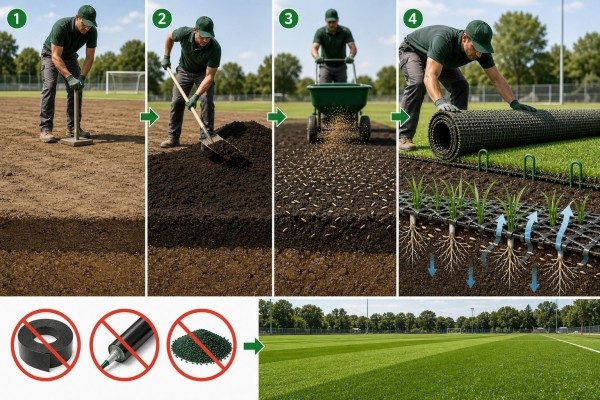
Many contractors assume they should lay the turf first and scatter seeds on top. This is a massive mistake. If you scatter seeds on top of the synthetic fibers, the seeds will not make adequate contact with the soil. They will dry out, blow away in the wind, or be eaten by birds.2
The Inverted Foundation Method
The "inverted" approach means the biological elements go down before the synthetic elements.
- Level and Tamp: Prepare your topsoil bed.
- Sow the Seeds: Broadcast your chosen natural grass seeds evenly across the bare topsoil. Apply starter fertilizer if specified by the landscape architect.
- Lay the Turf: Carefully unroll the open-woven hybrid artificial turf directly over the freshly seeded soil.
The Protective Blanket Effect
When laid correctly over the seeds, our open-woven hybrid turf acts as an incredible protective blanket. It shields the vulnerable seeds from heavy rain washout and hungry birds. More importantly, it creates a microclimate that retains soil moisture, often accelerating germination times compared to unprotected natural seeding.3
Contractors must completely abandon standard artificial turf joining methods. Do not use seam tape or polyurethane glue. Glue and tape will seal the open mesh at the seams, creating dead zones where no natural grass can grow and where surface water will pool. The rolls should simply be butted tightly together and anchored mechanically.
Why use Green PE U-nails to install hybrid turf?
Anchoring the turf seems like a standard procedure. Yet, using standard galvanized metal pins on an open-woven hybrid grass system introduces hidden safety hazards and mechanical failures.
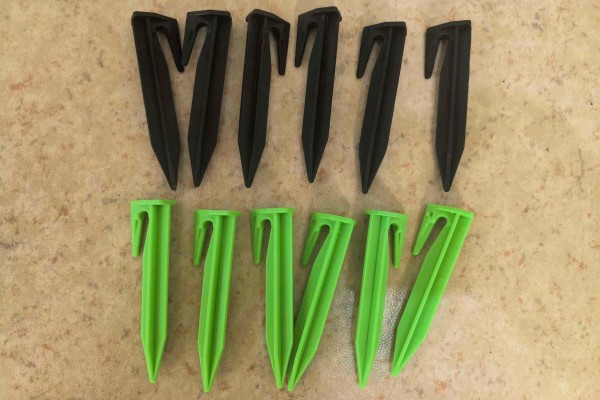
Contractors must use Green PE U-nails to install hybrid turf to protect the woven backing and ensure safety. Metal U-nails rust over time, pose injury risks on sports fields, and can slice the artificial fibers. Green PE nails remain structurally sound, visually hidden, and safely secure the mesh.
Standard artificial grass is heavily backed with SBR latex or polyurethane, making it thick and rigid. Our hybrid synthetic turf features an open-woven mesh backing. This structure gives it exceptional porosity, but it also means the yarn and backing are structurally different from solid carpets.
Protecting the Woven Structure
If a contractor hammers thick metal U-nails into the mesh, the sharp metal edges can sever the woven yarns under pressure. Furthermore, because the hybrid system relies on wet topsoil and frequent watering, metal nails will inevitably rust.4 Rusted metal degrades the surrounding synthetic fibers and contaminates the soil.
Green Polyethylene (PE) U-nails solve this problem entirely. They are specifically molded to hold down the mesh without cutting the fibers. They will never rust, rot, or degrade in the wet soil environment.
Safety on Municipal and Sports Projects
For government project suppliers and sports field contractors, liability is a major concern. If a metal nail works its way up to the surface of a football field or a public park, it becomes a severe laceration hazard for athletes and children. PE U-nails are made of rigid plastic. While they hold the turf firmly, they do not present the same danger as sharp, rusting steel spikes.
Additionally, during the initial weeks before the natural grass fully grows in, the bright green PE U-nails blend perfectly with the synthetic fibers, keeping the installation visually pristine for the client.
Can you use infill when installing hybrid artificial turf?
The instinct for any sports field contractor is to fill the turf with sand and rubber granules to stand the fibers up and provide weight. For hybrid turf, this instinct is highly destructive.
You cannot use quartz sand or rubber infill when installing hybrid artificial turf. This is the strict "Zero Infill" rule. Adding heavy infill blocks the open-mesh structure, suffocates the natural grass seeds, compacts the soil underneath, and causes complete drainage failure and root rot.
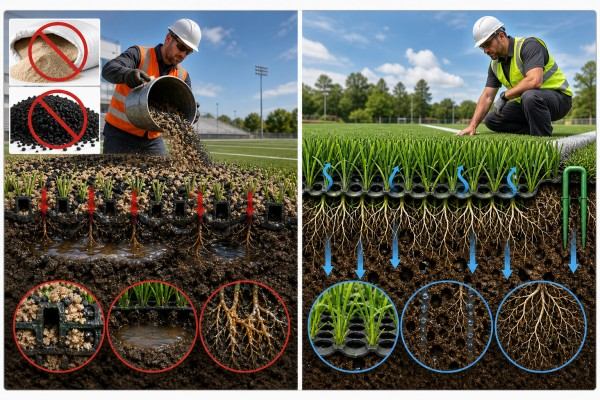
In a traditional synthetic turf system, quartz sand and EPDM/SBR rubber granules act as ballast to weigh the carpet down and support the artificial blades. In a hybrid grass system, the biological elements do this job.
Preventing Root Suffocation
QH Hybrid Artificial Grass is engineered with an open area in the backing specifically to allow natural grass to push through. If you brush quartz sand into the turf, that sand falls straight through the mesh and buries the un-germinated seeds under a dense, heavy layer of silica.
This suffocates the seeds. Even if a few seeds manage to sprout, the sand compacts over time, destroying the soil’s aeration. Water will stop draining, the topsoil will become waterlogged, and the natural roots will rot.5 I have seen entire municipal landscaping projects fail because a subcontractor unknowingly dumped sand onto a hybrid installation.
The Mechanics of Mutual Support
Without infill, how do the artificial fibers stand up? The answer lies in mutual support.
As the natural grass grows through the open-woven mesh, the natural blades and the synthetic fibers intertwine. The roots anchor the mesh firmly into the ground—providing vastly superior ballast compared to sand.6 Above ground, the natural grass leaves support the synthetic fibers, and the synthetic fibers protect the natural grass crown from wear and tear. You must trust the agronomy and strictly enforce the zero-infill rule with your installation teams.
How do you maintain the system after you install hybrid turf?
Handing over the project immediately after laying the turf requires careful client education. The system is not instantly ready for heavy use; it requires a critical biological establishment phase.
After you install hybrid turf, maintain it exactly like natural grass during the maturation gap. Water and fertilize the area regularly. Restrict high-intensity usage until natural roots fully entangle with the mesh. When mowing, set blades high enough to avoid cutting the artificial fibers.
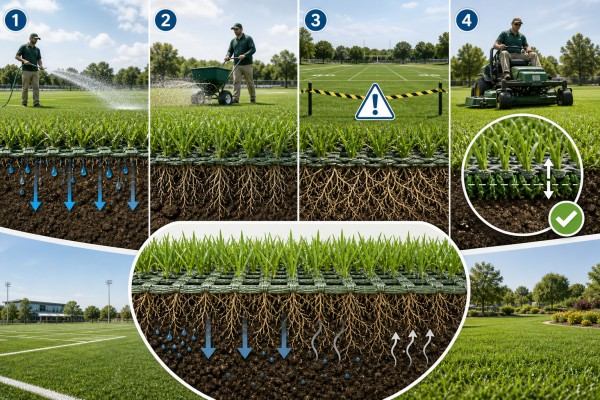
When you finish the installation, the site will instantly look green because of the artificial fibers. This often gives clients the false impression that a football field or commercial courtyard is "ready to play." As a B2B contractor, you must manage expectations regarding the "maturation gap."
Managing the Maturation Gap
The maturation gap is the period between installation and the moment the natural grass roots deeply entangle with the woven mesh. Depending on the season and seed type, this takes anywhere from 4 to 8 weeks.7
During this time, the client must water and fertilize the turf exactly as they would a newly seeded natural lawn. The water and nutrients pass directly through our open-mesh structure. Heavy sports, vehicles, or intense foot traffic must be restricted during this phase. If athletes play on the turf before the roots are established, the shearing force can shift the mesh and damage the young natural grass crowns.
Mowing Guidelines for Mixed Systems
Once the natural grass grows taller than the synthetic fibers, mowing begins. This requires a specific technical instruction: the mower blades must always be set higher than the artificial pile height.8
For example, if you purchased our 30mm pile height hybrid turf, the mower blade should be set no lower than 35mm to 40mm. If the blade is set too low, it will slice the tips off the synthetic fibers, permanently damaging the structural integrity of the artificial grass. As a supplier, I always recommend that buyers consult our factory to match the artificial pile height with the anticipated mowing height of their specific natural grass species.
Frequently Asked Questions
How long does it take for natural grass to grow through hybrid turf?
It depends on the climate and seed variety, but typically you will see visible growth within 2 to 4 weeks. Deep root entanglement, which provides the system’s structural strength, usually takes 6 to 8 weeks. Treat this period strictly as natural grass cultivation.
Can we install hybrid turf over an existing natural grass lawn?
No. You must prepare bare topsoil, sow new seeds, and lay the turf simultaneously. Laying the mesh over fully grown grass prevents proper root integration, creates an uneven surface, and ultimately smothers the existing plants.
What pile height should I choose for a hybrid grass project?
The pile height depends on the natural grass species you intend to plant. B2B buyers should consult our factory to match the artificial pile height (commonly 20mm to 40mm) with the final mowing height required by the project specifications.
Do we need shock pads under hybrid turf for sports fields?
Absolutely not. Shock pads block the soil, preventing natural grass roots from growing deep and destroying the drainage profile. In a hybrid system, the well-prepared natural topsoil and deep root matrix provide the necessary shock absorption for athletes.
Conclusion
Understanding how to install hybrid turf requires abandoning traditional synthetic grass methods and adopting an agronomic mindset. By utilizing an inverted foundation with nutrient topsoil, sowing seeds before laying the turf, securing the mesh with Green PE U-nails, and strictly avoiding infill, contractors can guarantee a successful grow-through system. Properly maintained through its maturation gap, this system offers the perfect blend of natural aesthetics and synthetic durability.
If you are a contractor, landscaper, or distributor looking to source premium open-woven hybrid grass for your next engineering project, QH Grass is your direct factory partner. We specialize in B2B wholesale and full-container orders (Custom MOQ: 3,000 sqm). Contact Alice Chen at [email protected] or via WhatsApp at +86 185 7566 0746 to discuss your project specifications today.
-
"Using Composts to Improve Turf Performance", https://extension.psu.edu/using-composts-to-improve-turf-performance/. Research by sports turf research institutes indicates that incorporating organic compost into topsoil improves soil structure, increases microbial activity, and enhances moisture retention during the critical turfgrass establishment phase. Evidence role: general_support; source type: institution. Supports: The benefits of amending topsoil with organic compost for turfgrass establishment.. ↩
-
"Response Patterns and Mechanisms of Seed Germination and Mortality …", https://pmc.ncbi.nlm.nih.gov/articles/PMC12525858/. Agricultural extension literature notes that grass seeds left exposed on the soil surface suffer high mortality rates due to rapid moisture loss, wind displacement, and foraging by granivorous birds. Evidence role: mechanism; source type: education. Supports: The primary causes of mortality for surface-sown grass seeds.. ↩
-
"The Cool-Season Turfgrasses: Basic Structures, Growth …", https://extension.psu.edu/the-cool-season-turfgrasses-basic-structures-growth-and-development/. Studies on turf covers and germination blankets show that permeable synthetic layers trap soil moisture and elevate surface temperatures, creating a microclimate that significantly reduces the time required for seed germination. Evidence role: mechanism; source type: research. Supports: The mechanism by which permeable covers accelerate seed germination through microclimate alteration.. Scope note: Research typically evaluates temporary germination blankets rather than permanent hybrid turf meshes, though the thermodynamic principles are identical. ↩
-
"Heavy Metals and Pesticides Toxicity in Agricultural Soil and …", https://pmc.ncbi.nlm.nih.gov/articles/PMC7996329/. Corrosion studies indicate that galvanized steel fasteners experience accelerated oxidation and degradation when subjected to the continuous moisture, oxygen, and fluctuating pH levels typical of irrigated agricultural soils. Evidence role: mechanism; source type: paper. Supports: The rapid corrosion of standard steel fasteners in moist, aerated soil environments.. ↩
-
"SL533/SS748: Improving Turfgrass Health: Proper Irrigation Techniques", https://ask.ifas.ufl.edu/publication/SS748. Turfgrass management guidelines warn against improper soil stratification; placing a layer of fine sand directly over heavier topsoil disrupts capillary action, leading to surface compaction, poor infiltration, and subsequent root rot. Evidence role: mechanism; source type: education. Supports: The negative effects of improper soil stratification, specifically fine sand over topsoil.. ↩
-
""The Characterization, Assessment, and Shear Strength of Turfgrass …", https://uknowledge.uky.edu/bae_etds/107/. Biomechanical evaluations of hybrid turf systems reveal that the entanglement of natural grass roots with synthetic backing matrices significantly increases the surface shear strength and provides substantial biological anchoring. Evidence role: mechanism; source type: paper. Supports: The mechanism by which root entanglement increases the shear strength and stability of reinforced turf systems.. ↩
-
"Lawn Establishment – Penn State Extension", https://extension.psu.edu/lawn-establishment. Agronomic extension services generally advise that newly seeded sports fields require a maturation period of 4 to 8 weeks, depending on climate and species, before the root system is robust enough to withstand traffic. Evidence role: statistic; source type: education. Supports: The standard 4 to 8 week timeline for turfgrass establishment from seed.. Scope note: Establishment times can vary widely outside this range depending on extreme weather conditions or specific grass cultivars. ↩
-
"Proper Mowing Practices for Your Lawn – Integrated Pest Management", https://ipm.missouri.edu/meg/2010/4/Proper-Mowing-Practices-for-Your-Lawn/. Guidelines from international sports turf management associations stipulate that mowing heights on hybrid systems must be strictly maintained above the synthetic pile height to prevent mechanical shearing of the artificial fibers. Evidence role: expert_consensus; source type: institution. Supports: Expert consensus on mowing heights for hybrid turf systems.. ↩