_画板-1.png)
Feeling stuck choosing between SBR and PU backing for your turf? The wrong choice can cost you money and lead to unhappy clients. Let’s find the best solution.
For wholesale budgets of $1-5 per square meter, SBR latex is a fantastic, cost-effective choice. For budgets over $5, or for projects requiring superior durability and water resistance like professional sports fields, PU backing is the better investment despite the higher initial cost.
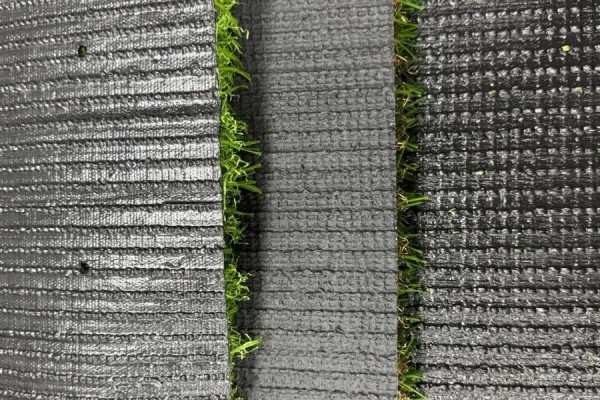
I have seen many clients struggle with this decision over the years. It’s not just about one feature; it’s about how the backing performs in the real world for your specific project. To really understand the difference, we need to break down what each material actually is. So, let’s dig a little deeper and start with the most common option you’ll find on the market.
What Exactly Is SBR (Styrene-Butadiene Rubber1) Latex Backing?
You have probably seen "SBR latex" on many spec sheets, but what does that term really mean? Not understanding it could mean you are not getting the best value. Let’s fix that.
SBR latex backing is the most common and cost-effective choice for artificial grass. It is a synthetic rubber coating applied to the back of the turf. This process securely locks the yarn fibers in place, providing good durability and performance for most landscape and sports applications.
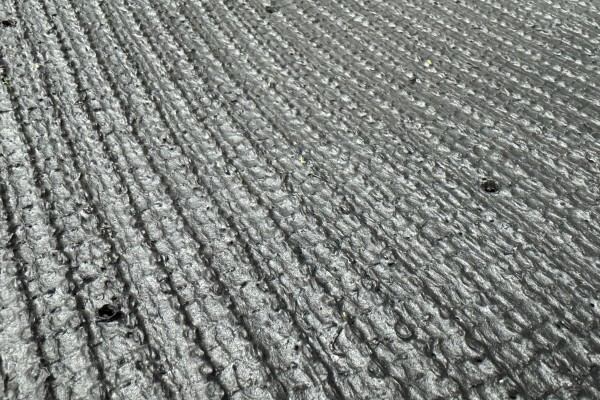
SBR has been the industry standard for a long time, and for good reason. It provides a solid foundation for the turf system. When we make turf, the yarn is tufted into a primary backing fabric. After that, we apply the SBR latex as a liquid coating that seeps around the base of each yarn stitch. Once it’s heated and cured, it solidifies, acting like a strong glue that holds everything together. This "tuft lock" is critical for the grass’s lifespan. A good quality SBR backing will give you a fiber pull-out strength of around 30 to 55 Newtons (N). This is more than enough for most residential lawns, playgrounds, and general landscaping projects. It’s a reliable workhorse that offers an excellent balance between performance and price.
Key Characteristics of SBR Backing
| Feature | Description |
|---|---|
| Material | Styrene-Butadiene Rubber |
| Application | Applied as a liquid coating and then cured with heat. |
| Tuft Lock | Good (Typically 30-55N) |
| Water Resistance | Absorbs some moisture; not fully waterproof. |
| Cost | The most budget-friendly option. |
And What Is Polyurethane (PU) Backing?
People often call PU backing the premium option, but is it actually worth the higher price tag? Making the wrong call here can hurt your profit margins. Let’s see what makes it different.
PU, or polyurethane2, backing is a premium coating known for its exceptional strength and water resistance. It offers a significantly higher fiber pull-out strength than SBR. This makes it ideal for high-traffic areas, professional sports fields, and climates with extreme weather conditions.
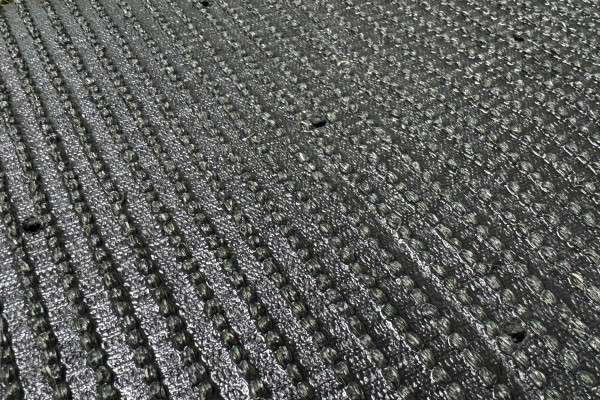
Think of PU backing as an upgrade. While SBR is great, PU takes performance to the next level. The main difference is the material itself. Polyurethane creates an even stronger bond with the turf fibers, resulting in a superior tuft lock. I’ve seen tests where PU backing achieves a pull-out strength of 60 to 70N, which is almost double that of some SBR products. This means the grass blades are far less likely to pull out, even under the stress of professional athletics or very active pets. Additionally, PU does not absorb water. This is a huge advantage in very wet climates or for indoor applications where moisture control is key. It’s also lighter than SBR, which can make a big difference for installers handling large, heavy rolls of turf all day. The trade-off, of course, is the cost.
Advantages of Choosing PU
- Superior Tuft Lock3: Reduces shedding and increases the product’s lifespan.
- Completely Waterproof4: Will not absorb moisture, preventing mold and mildew.
- Lighter Weight: Easier to transport and install, potentially saving on labor costs.
- Better Durability: Performs extremely well in freezing temperatures and intense heat.
How Do SBR and PU Compare on Cost, Durability, and Installation?
Deciding between SBR and PU for your wholesale order can feel complicated. A wrong choice can impact not just your budget but also your project’s final quality and lifespan. Let’s put them head-to-head.
SBR wins on initial cost, making it the perfect choice for budget-sensitive projects where conditions are moderate. PU backing costs more upfront but offers superior durability, water resistance, and fiber lock. For long-term projects or harsh conditions, PU provides better value despite the higher price.
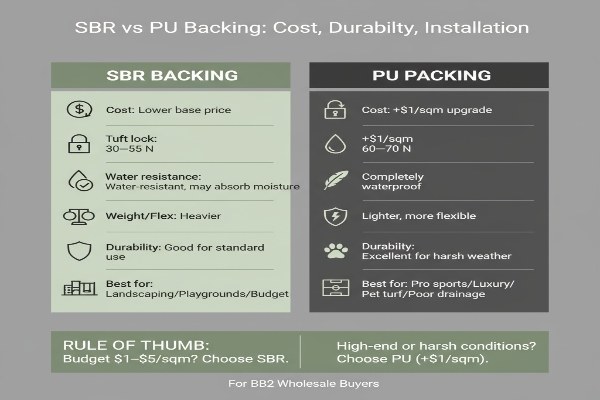
In my years helping clients, I have developed a simple rule of thumb. If the wholesale budget is between $1 and $5 per square meter, SBR is the smart choice. It gets the job done well for most standard landscape projects without overspending. However, when a client needs the absolute best for a professional sports field, a luxury villa courtyard, or an area with poor drainage, I always recommend they invest the extra dollar in PU. Generally, upgrading from SBR to PU backing adds about $1 per square meter to the cost. The peace of mind and long-term performance are often worth that extra investment for high-end applications. The table below gives a direct comparison to help you make the best decision for your business.
Direct Comparison: SBR vs. PU
| Feature | SBR Latex Backing | PU (Polyurethane) Backing |
|---|---|---|
| Cost | Lower (Base Price) | Higher (Adds ~$1/sqm) |
| Tuft Lock Strength | 30 – 55 N | 60 – 70 N |
| Water Resistance | Water-resistant, but can absorb moisture | Completely waterproof |
| Weight | Heavier | Lighter and more flexible |
| Durability | Good for most applications | Excellent, especially in extreme weather |
| Best For | Landscaping, playgrounds, budget projects | Pro sports fields, luxury homes, pet turf |
Conclusion
Ultimately, choosing between SBR and PU backing comes down to your project’s specific budget and performance needs. Both are excellent options when used in the right application.
-
Exploring the benefits of Styrene-Butadiene Rubber can help you appreciate its role in enhancing turf performance and longevity. ↩
-
Learn how polyurethane enhances turf quality and longevity, making it a worthwhile investment for various applications. ↩
-
Discover how Superior Tuft Lock technology reduces shedding and extends the lifespan of artificial grass. ↩
-
Find out why waterproof features are crucial for preventing mold and ensuring the longevity of turf in wet conditions. ↩
_画板-1.png)