_画板-1.png)
Buying the wrong sports turf ruins your reputation and risks athlete safety. Are you confused by technical specs and wondering which standard actually matters for your project?
The best standards require high-density polyethylene fibers, robust UV resistance, and specific pile heights ranging from 15mm for tennis to 60mm for football. Crucially, systems must include proper infill and shock pads. Always verify ISO9001 for manufacturing and FIFA or FIH lab reports for performance guarantees.
As an engineer who moved into sales, I have seen many buyers ignore these specs. They chose the cheapest option and faced complaints later. Let’s explore the specific standards you need to know to import the right product.
Why Do Sports Turf Standards Matter for Athlete Safety?
Ignoring safety specs leads to injuries and lawsuits. Do you know which physical properties prevent players from slipping or getting hurt during a game?
The safety standards define shock absorption and traction. A combination of sand and rubber infill provides stability, while a shock pad under the turf reduces impact on joints. This setup prevents severe injuries in schools and professional fields.
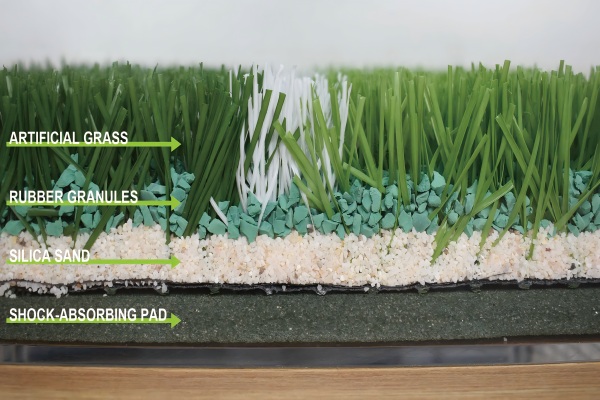
I always tell my clients that safety is the first standard we must discuss. When we look at the raw materials, we must choose high-density polyethylene (PE) synthetic fiber1. This material is soft enough to prevent skin burns when an athlete slides, but strong enough to last. In my experience, using cheap plastic results in a hard surface that hurts players.
Another critical factor is ultraviolet (UV) resistance2. We add high UV-resistant components to the raw materials during production. If the grass does not have this standard, the fibers will become brittle and break under the sun. This creates dust and a slippery surface, which is very dangerous for running.
We also need to look at the ground system. I strongly recommend laying shock-absorbing pads3 under the artificial turf. This is vital for school playgrounds or multi-purpose fields. The pad absorbs the energy when a child falls. On top of the grass, the combination of sand and rubber granules is essential. The sand weighs the grass down, and the rubber provides the "bounce" needed for safety.
| Safety Component | Function | Why it is a Standard |
|---|---|---|
| PE Fiber | Soft touch | Prevents skin abrasion (burns). |
| Shock Pad | Impact absorption | Protects heads and joints during falls. |
| Rubber Infill | Traction & Cushion | Stops slipping and mimics real soil. |
| UV Stabilizer | Material integrity | Prevents fiber breakage and dust. |
Which Certifications Truly Guarantee Quality? (ASTM, FIFA & Beyond)
A factory can claim their grass is good, but without papers, it is just talk. Are you relying on honest words instead of verified documents?
ISO9001 ensures the factory management is stable. RoHS and REACH prove the materials are non-toxic. However, for top-tier projects, specialized certifications like FIFA or FIH provide the highest protection and guarantee performance.
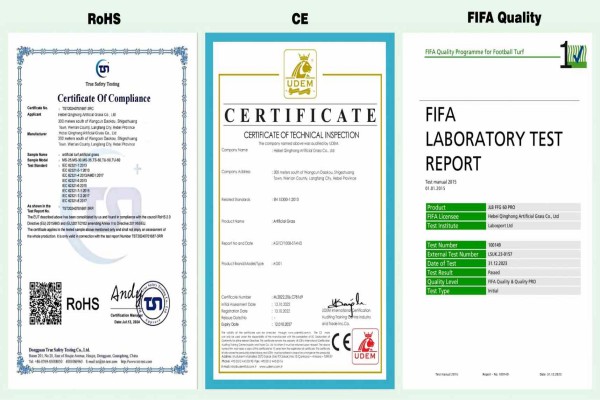
When I worked in the technical department, I learned that not all certificates are the same. You need to separate factory certificates from product certificates. For your business, ISO9001 is fundamental. It means the factory has a system to solve problems if something goes wrong. But this does not tell you if the grass is good for sports.
For the product itself, you must ask for RoHS or REACH reports4. These are chemical tests. They prove the grass does not contain lead or heavy metals. This is a strict requirement for imports into the US and Europe.
If you want to bid on a professional stadium project, you need more. You should look for FIFA (for football) or FIH (for hockey) certifications. These are the gold standards. They test ball roll, ball bounce, and rotational resistance. Even if you are not building a World Cup stadium, buying from a supplier who has these certificates is smart. It shows they have the technology to produce top-quality goods. It gives you greater protection for your project.
Common Certification Guide
- ISO90015: The factory is organized and reliable.
- RoHS / REACH: The product is safe and non-toxic.
- FIFA / FIH: The product performs like professional natural grass.
- ASTM6: Standard testing methods used often in North America for drainage and durability.
Turf Type Showdown: Which Construction Best Meets Your Sport’s Standards?
Using football grass for tennis is a disaster for ball speed. Do you know the exact pile height and density needed for each specific sport?
You must select fiber length based on the sport. Tennis requires short fibers (15-25mm) for fast ball bounce. Football needs long fibers (40-60mm) for grip and fall protection. Dense fleece layers add crucial stability.
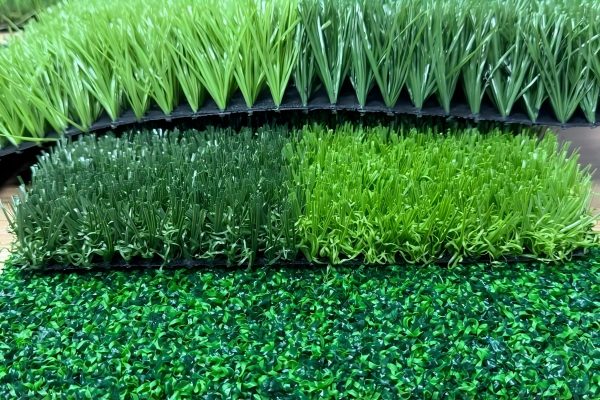
In my sales career, I have seen customers buy long grass for a tennis court because they thought "more material is better." This is a mistake. The ball will not bounce correctly. We have to match the construction to the sport.
For fast-moving ball sports like tennis, Padel, and field hockey, we choose shorter fibers. The standard height is usually between 15mm and 25mm. We also use a dense fleece layer. This is a curled fiber inside the grass that stays flat. It provides a flat, consistent surface so the ball moves fast and true.
For contact sports like football (soccer), rugby, and baseball, we need volume. We select fibers that are 40mm to 60mm high. These long fibers hold the rubber infill. They allow the players’ cleats (boots) to grip the surface without tearing the turf. This construction withstands heavy impacts.
You also need to look at the "Dtex" and stitching density. A high-Dtex means the fiber is thick and heavy. For sports, never choose a low-Dtex grass intended for a garden. It will flatten in one month.
| Sport Category | Recommended Height | Key Feature Needed |
|---|---|---|
| Tennis / Padel | 10mm – 20mm | Short pile, high density, fast ball speed. |
| Field Hockey | 13mm – 25mm | Non-directional surface, often uses water or sand. |
| Football / Soccer | 40mm – 60mm | Long pile to hold rubber infill, shock absorption. |
| Rugby | 60mm+ | Extra length for maximum impact protection. |
| Multi-use | 30mm – 40mm | A balance for general school activities. |
Beyond Compliance: How Standards Can Become Your Marketing Advantage?
Many competitors sell cheap, low-standard grass. Can you win more bids by proving your product’s superior quality and long-term durability?
Meeting high standards is not just about rules; it is a sales tool. Promoting UV stability and safe materials helps you win government bids and gain trust from parents and club owners.
I help many customers grow their business, and the ones who succeed are not the cheapest ones. They are the ones who sell "peace of mind." When you understand these standards, you become an expert in your market.
You can tell your clients: "My grass uses a high-density fleece layer and passes the 3,000-hour UV test." This sounds much better than just saying "My grass is green." You can show them the RoHS certificate and say, "This is safe for your children." This solves their pain point of worrying about safety.
Also, precise standards mean easier installation. When the backing is strong and the dimensions are perfect, your installation team works faster. This saves you labor costs. Strict production quality control in China means you do not have to replace the grass after two years.
By importing turf that meets these strict standards, you position yourself as a premium supplier. You can charge a better price because you offer a product that lasts longer and performs better.
Conclusion
To succeed, prioritize UV-resistant PE fibers, correct pile heights, and verified certifications like FIFA. High standards protect your reputation and help you win profitable projects.
-
Explore the advantages of PE fiber to ensure athlete safety and turf durability. ↩
-
Learn how UV resistance impacts turf longevity and safety for athletes. ↩
-
Discover the role of shock-absorbing pads in preventing injuries on sports fields. ↩
-
Learn about RoHS and REACH to ensure the safety and compliance of your materials. ↩
-
Understanding ISO9001 can help you ensure that your suppliers maintain high management standards. ↩
-
Discover the role of ASTM standards in ensuring the durability and performance of products. ↩
_画板-1.png)