_画板-1.png)
Do you feel confused when looking at the specification sheets for artificial turf? Choosing the wrong density can lead to rapid wear or unnecessary spending. Let me clarify the truth for you.
Many buyers believe higher density equals better quality, but this is a misconception. The ideal density depends on the application. Sports fields with infill need lower density for performance, while landscape grass needs higher density for aesthetics. You must balance density with pile height and material for durability.
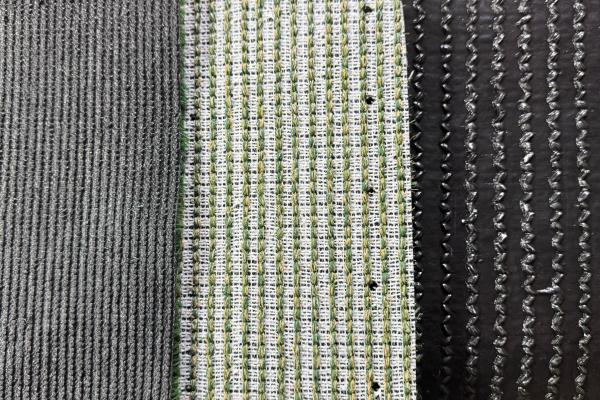
Many of my clients start by asking for the "thickest" grass available. They think more stitches mean a better product. However, after I explain the actual technical details to them, they realize that "more" is not always "better." Let’s look at the first big myth I often see in this industry.
Does higher density always mean a more durable grass?
You want to buy grass that lasts a long time for your customers in the USA or Brazil. You might pick the highest number you see on the spec sheet. But this can be a costly mistake.
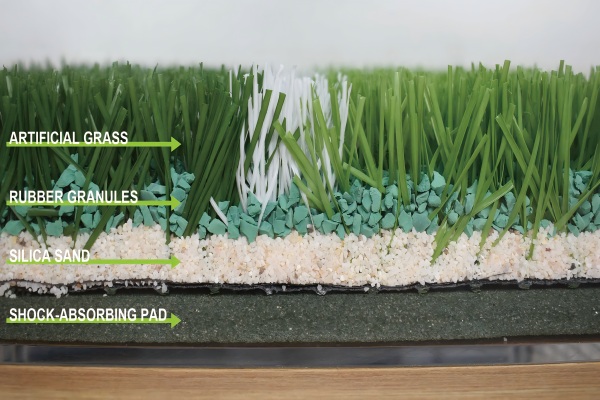
Higher density does not automatically mean greater durability. For sports grass that requires sand and rubber granules, a lower density is actually better. High density blocks the infill material, which reduces performance and increases your costs significantly.
In my years working as an engineer and now in sales at QH Grass, I have seen many people waste money on density they do not need. We need to look at this critically. Durability comes from the system, not just the stitch count.
If you are looking at monofilament artificial turf for sports like football, the standard density is often between 8,820 and 10,500 tufts/m². This number might seem low compared to other types. However, this is intentional. You need space between the grass blades. This space allows you to fill the turf with silica sand and rubber granules. These infill materials1 are crucial. They provide cushioning. They help the grass fibers stand up straight. They also take the impact of the players’ cleats.
If you order this type of grass with a very high density, two bad things happen. First, your factory price goes up because we use more yarn. Second, you cannot put enough sand and rubber in. The grass fibers are too close together. Without the infill, the fibers flatten quickly under foot traffic.
On the other hand, landscape grass is different. This is usually 13,650 to 18,900 tufts/m². We add curly fibers significantly to support the straight ones. This fills the space without sand.
So, if you buy non-infill grass, yes, higher density helps durability. But for most sports fields, lower density allows the infill to do its job. It protects the root of the system.
| Grass Type | Typical Density (tufts/m²) | Role of Infill |
|---|---|---|
| Sports Monofilament | 8,820 – 10,500 | Critical. Provides shock absorption and support. |
| Landscape / Leisure | 13,650 – 18,900 | Minimal or None. Curly fibers provide support. |
| Result | Space is needed for performance. |
At the same density, are longer grass fibers always better?
Your customers might ask for tall, lush grass because it looks expensive. You might think a 50mm pile height is always better than a 20mm pile height at the same price point.
With the same density, longer fibers are not necessarily better. Long fibers need more support. If the density stays the same but the grass gets taller, the fibers generally become weak and collapse. Shorter fibers stand upright much better at standard densities.
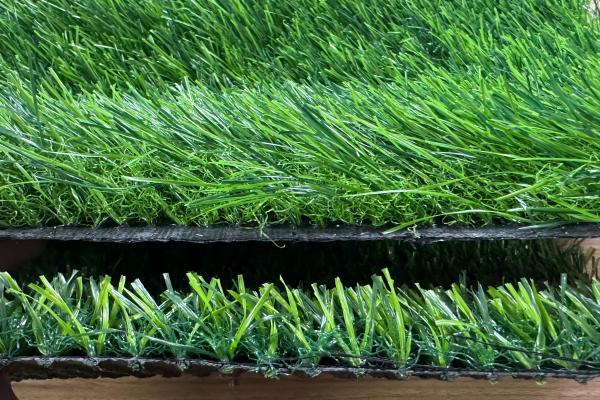
I often use a simple demonstration for my clients in our workshop. Think about a density of 16,800 tufts/m². This is a very common specification.
If we make the pile height 20mm at this density, the grass looks great. It stands up straight. It feels firm under your feet. The ratio of height to density is solid. But, if we take that same density of 16,800 tufts/m² and make the pile height 50mm, the result is poor.
The fibers are too long for the spacing at the bottom. There is not enough support to hold them up. Gravity and foot traffic will crush them immediately. This leads to "matting2." The grass just lays flat. It creates a slippery surface. It creates knots and tangles. It looks old very quickly.
This is a big pain point for installers and end-users. You install the grass, and inside one month, the customer complains it looks flat.
When you choose a longer pile height, you must increase the density or the weight of the face yarn. You cannot just stretch the fiber and keep the same stitch count. It defies physics.
For high-traffic areas, a shorter fiber at a standard density is much more durable than a long fiber at the same density. Do not be fooled by the "lush" look of a long sample in a box. Think about how it performs on the ground.
| Density (tufts/m²) | Pile Height | Performance Outcome |
|---|---|---|
| 16,800 | 20mm | Excellent. Stands upright. Resilient. |
| 16,800 | 50mm | Poor. Falls down. Tangles. Mats easily. |
Is it a mistake to focus only on density and ignore the grass fiber material?
You might compare two quotes purely based on the density number. One supplier offers 63,000 density and another offers 18,900. You might think the first one is stronger.
Focusing only on density and ignoring the fiber material is wrong. Cheap decorative grass has very high density but uses weak yarn. Professional landscape grass has lower density but uses thick, heavy-duty yarn. The material weight (Dtex3) is the true sign of strength.
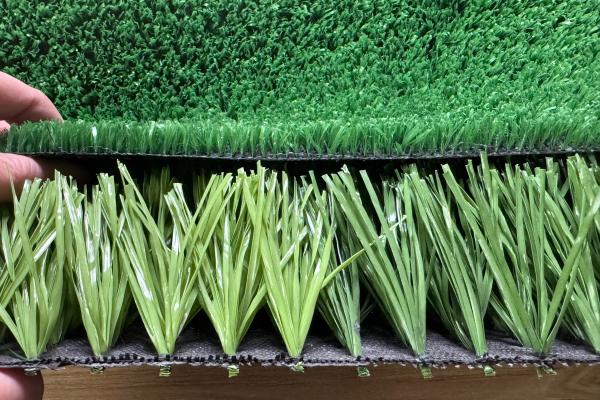
This is where many importers in developing countries get tricked. They see a high number and think "high quality." Let’s break down the material differences. I want you to understand the concept of Dtex. Dtex measures the weight of the yarn.
Take "split-film" decorative short grass. This is common in cheap markets. The density is incredibly high, maybe 63,000 tufts/m². It sounds amazing. But the Dtex is very low, usually only 1,400 to 2,600. The material is often thin Polypropylene (PP). This material is brittle. It breaks down in the sun. It crushes instantly. It is not suitable for long-term trampling.
Now, look at high-quality landscape grass. It uses a mix of Polyethylene (PE) monofilament and PP curly filament. The density might only be 18,900 tufts/m². This sounds three times "worse" than the cheap grass if you only look at density.
However, the Dtex here is 12,000. Each blade of grass is five or six times thicker and stronger than the cheap stuff. PE is soft but tough. It recovers after you step on it.
So, a low density with a high Dtex (thick yarn) is always more durable than a high density with a low Dtex (thin yarn). When you inspect quality at the factory, feel the individual blade. Is it paper-thin? Or is it thick like a real leaf? That matters more than counting the stitches.
| Feature | Cheap Decorative Grass | Quality Landscape Grass |
|---|---|---|
| Material | PP Split-film | PE Monofilament + PP Curly |
| Density | High (~63,000) | Medium (~18,900) |
| Dtex (Thickness) | Low (1,400 – 2,600) | High (7,500 – 14,000) |
| Durability | Low | High |
How should you choose the right grass density?
You have a project to bid on, or you need to stock your warehouse. There are too many numbers. You need a clear standard to follow so you do not make a mistake.
You should match density to the specific category of grass. Do not guess. Use the industry standards for Decorative, Landscape, and Sports applications. Each category has a specific density range that balances cost and performance perfectly.
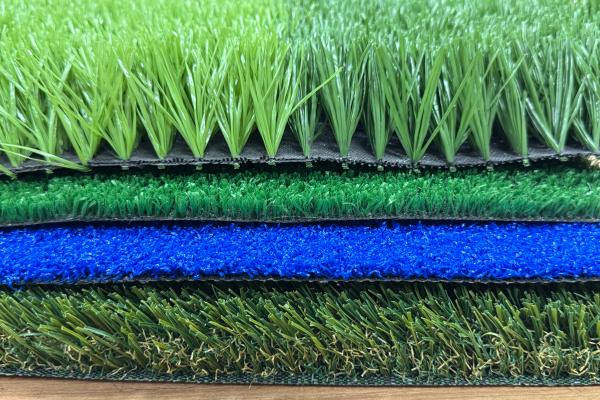
I know these numbers can be dizzying. To help you succeed, I have compiled my experience into a simple guide. This is what we use at QH Grass when we advise our clients. You can use these ranges to check if a supplier is offering you something weird or correct.
1. Decorative Turf (The Budget Option)
This is usually for temporary events or low-budget areas.
- Pile Height: 7-15mm
- Yarn: Split-film
- Dtex: 1,400 – 2,600
- Density: 52,500 – 84,000 tufts/m²
- Note: High density is needed here because the yarn is so thin.
2. Landscape Turf (The Quality Garden Option)
This is for homes, parks, and hotels.
- Pile Height: 20-40mm
- Yarn: Monofilament + Curly Mix
- Dtex: 7,500 – 14,000
- Density: 13,650 – 25,000 tufts/m²
- Note: This is the sweet spot. It looks natural and lasts long.
3. Sports Turf (Hockey, Tennis, Padel)
This needs a very flat, dense surface for ball roll.
- Pile Height: 10-20mm
- Yarn: Curly filament primarily
- Dtex: 4,000 – 9,000
- Density: 63,000 – 84,000 tufts/m²
4. Sports Turf (Football, Baseball)
This is the performance field grass.
- Pile Height: 40-60mm
- Yarn: Monofilament
- Dtex: 9,500 – 21,000
- Density: 8,820 – 12,600 tufts/m²
- Note: Remember, lower density here allows for sand/rubber infill.
If you stick to these ranges, you will be safe. If you are still unsure about a specific project, you can simply ask me. At QH Grass, we help analyze your market needs to find the exact specification that maximizes your profit.
Conclusion
Selecting artificial grass density is not just about choosing the highest number. You must consider the infill, pile height, and yarn thickness. If you have doubts, contact QH Grass for expert advice.
-
Discover the importance of infill materials in artificial turf and how they contribute to durability and player safety. ↩
-
Find out how to prevent matting in grass installations to ensure longevity and aesthetic appeal. ↩
-
Understanding Dtex helps you choose stronger, more durable grass materials over just density. ↩
_画板-1.png)