_画板-1.png)
Struggling to figure out the right size for your mini-football pitch? An incorrect size can ruin the game and waste your investment. I am here to help you.
Standard mini-football field sizes vary. For 5-a-side, a common dimension is 44 x 24 meters. However, the best size depends on player count and available space. A good rule of thumb is to use a length-to-width ratio of approximately 1.54:1 for a balanced playing experience.
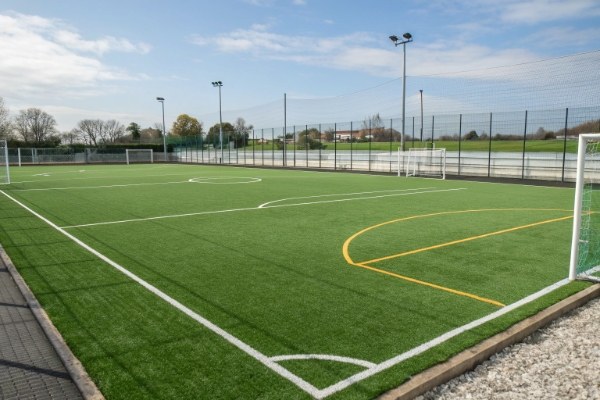
In my years as an artificial turf engineer, I’ve helped many clients, like Michael from the US and Ahmed from the UAE, design the perfect fields for their businesses. They need stable quality and competitive prices to succeed, and getting the dimensions right is the first step. Now, let’s explore how to choose the right dimensions for your specific needs.
How Do Field Sizes Change Based on Player Count?
Wondering how many players your field can support? The number of players directly impacts the required space. This affects game flow and safety. Let’s match the field to the team.
More players need a larger field. A 3-a-side game can be played on a pitch as small as 20 x 12 meters. A 7-a-side game often requires a field around 60 x 40 meters. It is all about balancing space with the number of players.
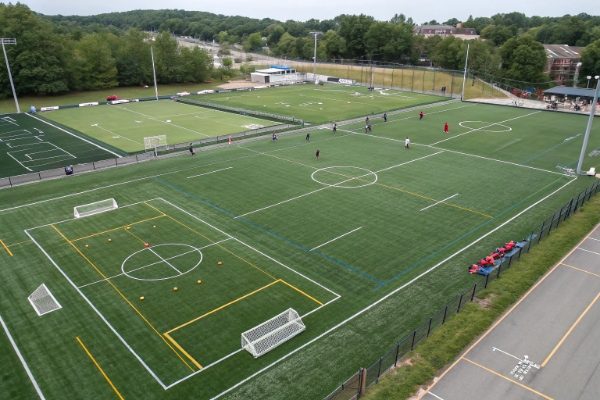
As a manufacturer, I always advise my customers to think about the end-user experience. The size of the field is crucial for the quality of the game. If you have too many players on a small field, the game becomes crowded and slow. No one has room to run or make a good pass. On the other hand, if you have too few players on a large field, players get tired quickly, and the game has less action. It is important to find the right balance.
Matching Field Size to Team Size
To make it simple, I have created a table that I share with clients like James from Australia and Budi from Indonesia. It gives them a clear starting point for their projects.
| Player Format | Recommended Length (m) | Recommended Width (m) |
|---|---|---|
| 3-a-side | 18 – 25 | 12 – 17 |
| 5-a-side | 30 – 45 | 20 – 30 |
| 7-a-side | 50 – 65 | 30 – 45 |
A 3-a-side game is fast-paced and works well in very small areas. 5-a-side is the most popular format for commercial mini-football venues. A 7-a-side field provides a game experience that feels closer to a full 11-a-side match. Choosing the right format depends on your target customers and the space you have.
Which Field Size Works Best for Different Venues?
Do you have a specific location in mind but are not sure if a field will fit? Whether it’s a rooftop, an old warehouse, or a backyard, size constraints are a real challenge.
The key is to maximize your available space. For a non-standard area, measure the total dimensions. Then subtract a safety buffer zone1 of at least 1 meter on all sides. Finally, apply the ideal 1.54:1 length-to-width ratio to the remaining area.
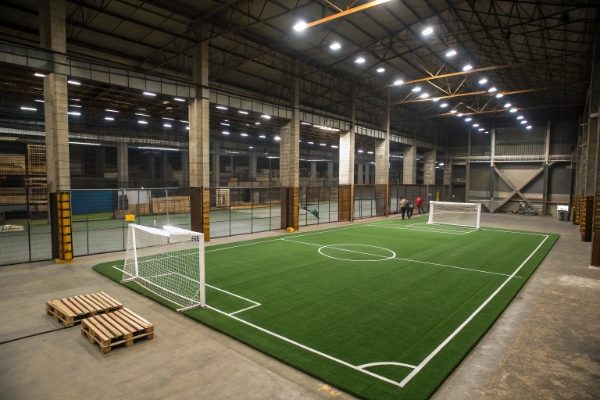
I once had a client, Carlos from Mexico, who wanted to build a mini-football park in a 30 x 50-meter warehouse. He was concerned that the space was not suitable. I showed him a simple calculation to prove that it was not only possible but also ideal. This is the method I have used to help many customers turn challenging spaces into profitable businesses.
A Practical Calculation for Any Space
Let’s use Carlos’s warehouse as an example. This simple formula will help you plan your project.
-
Measure Your Total Space:
His warehouse was 30 meters wide and 50 meters long. -
Subtract the Safety Buffer:
Safety is the top priority for any project. I recommend a minimum buffer zone of 1 meter on all sides. This gives players a run-off area and prevents them from hitting walls.- Available Width: 30m – 1m – 1m = 28m
- Available Length: 50m – 1m – 1m = 48m
-
Apply the Golden Ratio:
A standard 11-a-side pitch is 105 x 68 meters. This gives us a length-to-width ratio of 105 / 68 ≈ 1.54. This ratio creates a field that feels right for playing soccer. We take the narrowest dimension, the width, to guide our calculation.- Ideal Length = 28m (Available Width) * 1.54 = 43.12m
-
Finalize Your Plan:
The calculated playing field is 28m x 43.12m. This fits perfectly within the available 28m x 48m area. The remaining space (48m – 43.12m = 4.88m) is more than enough for goals, player benches, and access pathways. Carlos was very happy with this practical solution.
What Additional Factors Affect Mini Football (Soccer) Field Sizing?
You have considered the players and the venue, but are you forgetting something? Other small details can significantly impact your field’s final design and player experience. Let’s cover the final checks.
Beyond the playing area, you must account for safety buffer zones (run-off areas), goal post space2, and player access. Also, consider the type of artificial turf and infill. This can influence the base construction, though not the playing dimensions directly.
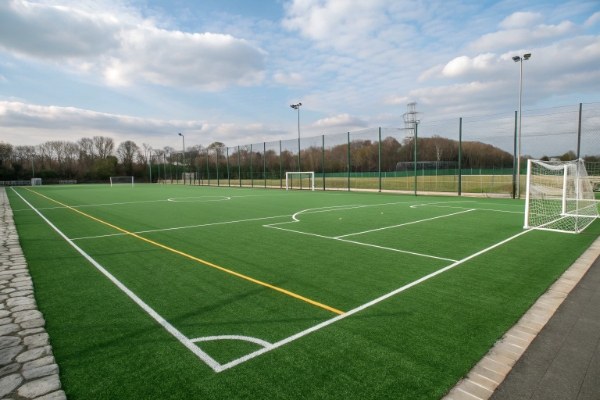
I always remind my clients, from Ivan in Russia to Mohammed in the UAE, that a successful project is in the details. They are business owners who need to avoid costly mistakes. Forgetting these additional factors can lead to project delays or a field that is unsafe or unprofessional. It pays to be thorough from the beginning.
Safety Run-Off Areas
The buffer zone is not empty space. It is a critical safety feature. For mini-football, a run-off area of 1-2 meters around the entire playing field is standard. This area must be free of any obstacles. It gives players space to slow down without crashing into fences or walls. When you measure your total venue, always remember to subtract this safety zone first before you determine your actual pitch dimensions.
Goal and Ancillary Space
Remember that the goals sit behind the goal line, not on it. You need to allocate space for the depth of the goals plus some extra room behind them. Also, think about where players will enter and exit the field and where they will sit. Planning for benches, gates, and even small spectator areas is part of designing a complete and functional facility.
Base and Turf Specifications
While the turf itself doesn’t change the playing dimensions, the product you choose affects the overall construction. For example, a 5-a-side field typically uses artificial turf with a pile height of 32-40mm. This turf needs to be filled with specific amounts of quartz sand and rubber granules to ensure good performance and player safety. Knowing these technical details helps in planning the foundational work and budget for your project. As a supplier, I ensure my clients understand these requirements to guarantee a high-quality, long-lasting field.
Conclusion
Choosing the right mini-football field dimensions is a balance of player count, space, and safety. By following these guidelines, you can build a successful and profitable pitch.
_画板-1.png)