_画板-1.png)
You want the right grass for your project, but the options are confusing. Choosing the wrong type ruins performance and aesthetics. Don’t worry, the solution is simple.
Sports turf prioritizes durability and performance using taller, thicker fibers with sand and rubber infill. Landscape turf focuses on realism and softness using denser, shorter fibers with thatch. The main differences lie in fiber structure, pile height, density, and intended use for either high-intensity play or visual appeal.
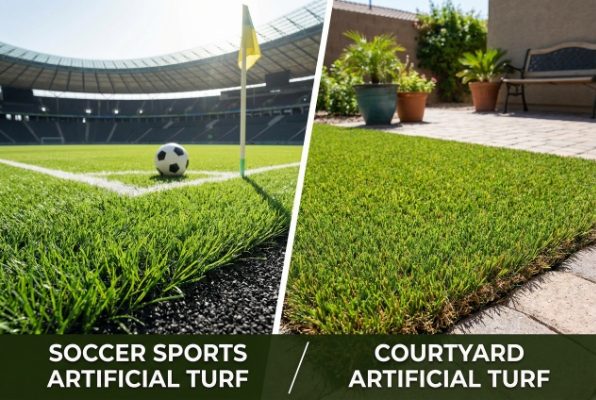
I remember a client, Michael, who almost bought landscape grass for a local soccer field project. He thought it looked softer and nicer. This would have been a disaster for his reputation. The grass would have flattened in a week. As an engineer who has worked from the workshop floor to the sales office, I want to help you avoid this mistake. Let me break down exactly why these two products are different so you can make the right purchasing decision.
How Do Design Purpose and Functional Requirements Differ Between Sports Turf and Landscape Turf?
Are you buying for looks or for heavy usage? Mixing these up leads to unhappy end-users and wasted money. You need to understand the core purpose.
Sports turf is engineered for ball roll, traction, and shock absorption during intense physical activity. Landscape turf is designed to look like a lush, natural lawn and feel soft underfoot. The function dictates the entire manufacturing process.
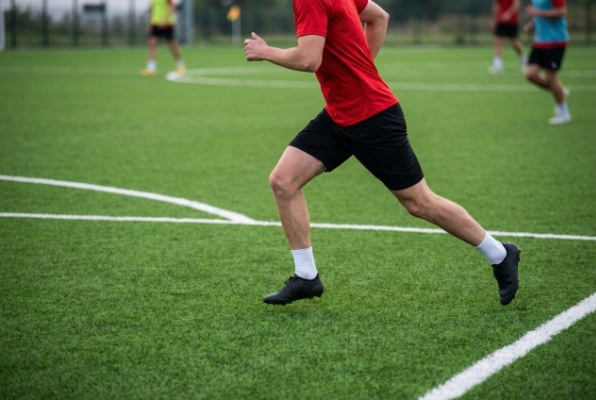
In my years helping clients like you, I see many people think artificial grass is just plastic. This is not true. We design these products with completely different goals in mind. You must think about what the user will do on the grass.
Sports turf is a tool. Think of it like a gym floor. Its main job is to let athletes run, stop, and slide safely. It must interact with a ball correctly. If a soccer ball hits the grass, it should roll naturally, not bounce in random directions. The design purpose here is "Function over Form." We care about how it plays, not just how green it looks.
On the other hand, landscape turf is decoration. Its purpose is to mimic nature. We want it to look like a perfect garden that needs no water. Users will walk on it slowly, sit on it, or let their pets play on it. It must be soft to the touch. The design purpose here is "Visual Aesthetics and Comfort." If you use landscape grass for a football match, the soft fibers will break, and the players will slip.
| Feature | Sports Turf Purpose | Landscape Turf Purpose |
|---|---|---|
| Primary Goal | Player safety and game performance | Realistic look and soft touch |
| Usage Intensity | High (Running, Sliding, Cleats) | Low to Medium (Walking, Sitting) |
| Key Interaction | Ball roll and foot traction | Visual appeal and comfort |
What Are the Differences in Fiber Composition, Pile Height, and Structural Design?
Detailed specs often confuse buyers. Dtex, pile height, and stitch rate can look like a mess of numbers. Let’s make these technical terms clear.
Sports turf uses tall (40-60mm), thick monofilament fibers with lower density to allow for infill. Landscape turf features shorter (20-50mm), softer fibers mixed with curly thatch at high density (16,000+ stitches) to stand up without much infill.
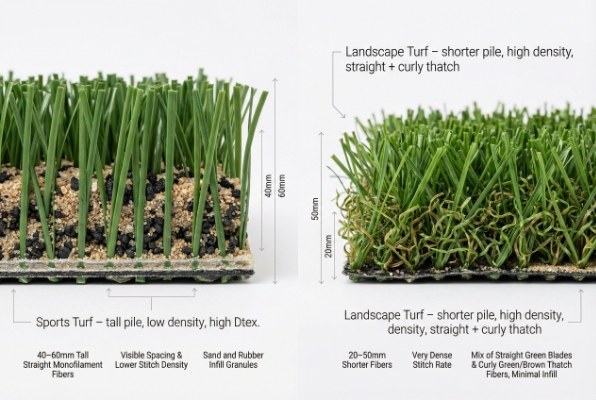
As a technician, I spent a long time setting up the machines for these different products. The "ingredients" we use are very different. For sports turf, we use a fiber that is very thick and strong. We measure this strength in "Dtex." Sports turf has a high Dtex because it must resist splitting when a player steps on it with sharp cleats.
Also, the structure is open. We set the machine to leave space between the stitches. The density is usually around 10,500 stitches per square meter. Why do we leave gaps? Because we need space to pour in sand and rubber later. The pile height is tall, usually 40mm to 60mm, to hold all that infill.
For landscape turf, we do the opposite. We want it to look full immediately. We mix straight fibers with curly fibers (thatch). The curly part acts like a spring to support the straight grass. We stitch this very tightly. The density is much higher, often between 16,800 and 23,000 stitches per square meter. The pile height is usually lower, from 20mm to 50mm. This makes the grass stand up on its own without needing a lot of heavy infill material.
| Spec | Sports Turf | Landscape Turf |
|---|---|---|
| Pile Height | 40mm – 60mm | 20mm – 50mm |
| Density (Stitches/m²) | Approx. 10,500 (Low) | 16,800 – 23,000 (High) |
| Fiber Type | Straight Monofilament (Thick) | Straight + Curly Thatch (Soft) |
| Fiber Hardness | Stiff for durability | Soft for comfort |
How Do Infill Choices and Shock Absorption Systems Vary for Safety and Performance?
Ignoring the infill is a common rookie mistake. Without the right bottom layer, your turf system will fail. You must choose the correct support.
Sports turf relies heavily on silica sand and rubber granules to keep fibers upright and provide cushioning. Landscape turf often uses no infill or a small amount of sand just to weigh it down and provide stability.
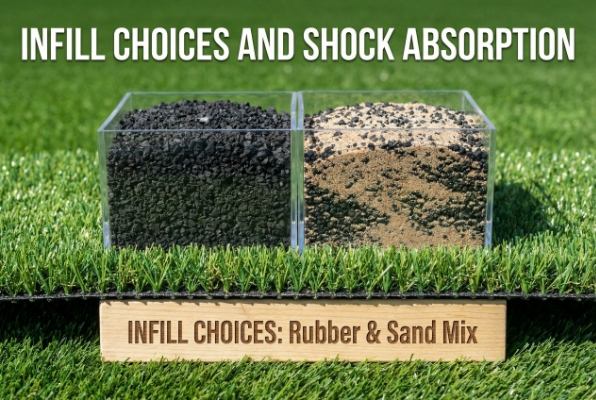
When I explain this to purchasing managers, I tell them: Sports turf is a system, not just a carpet. The grass fiber is only 50% of the product. The other 50% is the infill.
In a sports field, we pour tons of silica sand first. This protects the root of the grass. Then, we add rubber granules (SBR, TPE, or EPDM). These rubber crumbs are vital. They do two things. First, they support the tall grass blades so they stand straight up. Second, and most important, they act as a shock absorber. When a player falls, the rubber absorbs the impact, not the player’s knees.
Landscape turf is different. Because we stitch it so densely with that curly thatch layer, the fibers support themselves. We usually call this "non-infill" or "low-infill" turf. We often recommend adding just a small amount of silica sand. This is not for shock absorption. It is simply to make the turf heavy so it lays flat on the ground and does not expand or shrink too much with the temperature. You do not want black rubber granules in a garden; they get hot and act messy.
| Component | Sports Turf System | Landscape Turf System |
|---|---|---|
| Infill Material | Silica Sand + Rubber Granules | Silica Sand (Optional/Small amount) |
| Role of Infill | Shock absorption & Fiber support | Weight/Stabilization |
| Cushioning | Provided by rubber infill | Provided by the grass fiber itself |
How Do Durability, Maintenance Needs, and Lifespan Compare in Real-World Use?
Everyone fears buying a product that falls apart quickly. You want a long-term investment that lasts. Let’s look at the real lifespan.
Both types last 8-10 years if high quality. Sports turf requires regular brushing and infill top-ups to maintain performance. Landscape turf is low maintenance, needing only occasional cleaning and leaf removal to stay looking good.
My customers often ask, "Tom, which one lasts longer?" The answer surprises them. If you buy top quality for both, they both have a similar lifespan, usually 8 to 10 years. This is because the main enemy of plastic is the sun (UV rays), not just the walking. Good quality grass has strong UV stabilizers.
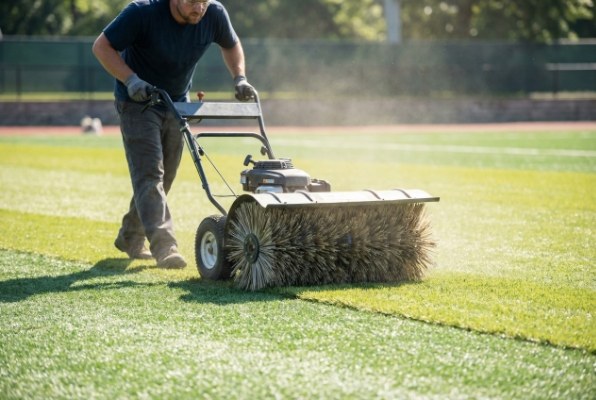
However, "durability" works differently in real life. Sports turf is built for war. It takes a beating from cleats and running. But, to keep it durable, you must maintain it. You need to brush it with a machine regularly to keep the rubber level. You need to de-compact the infill so it stays soft. If you ignore maintenance, a sports field will fail in a few years.
Landscape turf is easy. It sits there and looks pretty. It does not face the same physical stress. Its maintenance is very passive. You just use a leaf blower to remove debris or use water to clean off dust or pet waste. It keeps its appearance with very little effort from the owner.
| Area | Sports Turf | Landscape Turf |
|---|---|---|
| Lifespan | 8-10 Years (Quality dependent) | 8-10 Years (Quality dependent) |
| Wear Resistance | Extremely High | Moderate |
| Maintenance | High (Brushing, De-compacting) | Low (Cleaning, Blowing) |
| Main Threat | Mechanical wear & Infill compaction | UV Exposure & Flattening |
Conclusion
Sports turf is for performance and safety with heavy infill, while landscape turf is for visual realism and comfort. Choose the right type for your specific application to ensure success.
_画板-1.png)