_画板-1.png)
Worried about buying artificial grass because of common myths? These misconceptions can lead to costly mistakes and keep you from making a great investment for your business.
Many people mistakenly believe artificial grass is unsafe, looks fake, is bad for pets, and is a poor investment. The truth is, modern high-quality turf is a safe, realistic, pet-friendly, and cost-effective solution with excellent drainage, making it a durable choice for many projects.
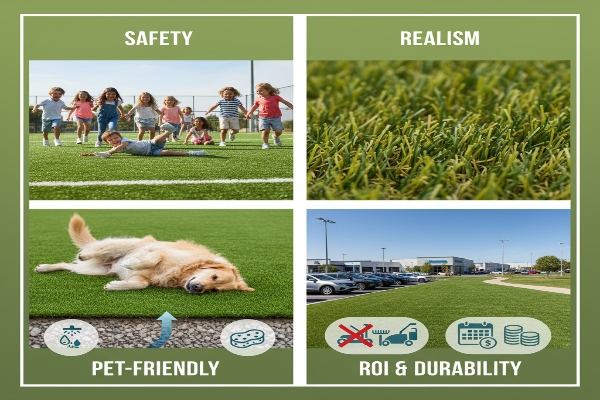
I hear these concerns all the time from my clients, people just like you. They read something online or hear a story from a friend’s bad experience. To make the best choice for your business and your customers, you need the real facts. So, let’s go through each of these myths one by one. I’ll share what I’ve learned from my years working in the factory and helping customers grow their businesses.
Is Artificial Grass Safe for Families and Pets?
You want a beautiful lawn, but safety for kids and pets is your top priority. Doubts about turf materials can make you hesitate. Let me give you the facts.
Absolutely. High-quality artificial grass that meets international safety standards like RoHS and REACH is completely safe. It contains no lead or harmful heavy metals, making it perfectly fine for children and pets to play on. Always ask your supplier for these certifications.
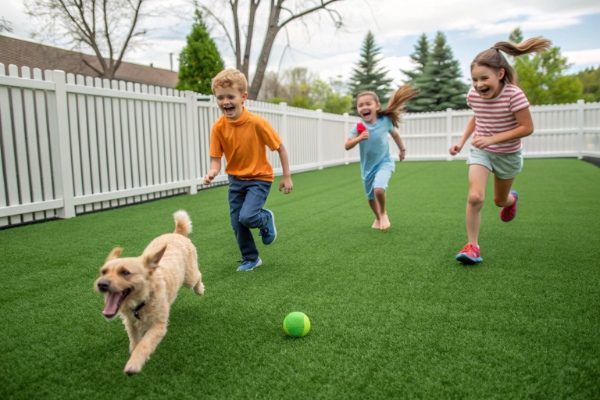
I remember a customer, David from Australia, who was building a large community playground. His biggest fear was safety. He asked me directly, "Tom, can you promise me this grass is safe for small children?" This question is one I take very seriously, as safety should always be the number one priority. The answer lies in the certifications. These documents are not just pieces of paper; they are a promise of safety to you and your clients.
What are RoHS and REACH?
These are crucial international standards. RoHS stands for Restriction of Hazardous Substances. It confirms the product is free from specific toxic materials like lead, mercury, and cadmium. REACH is a European regulation that covers the Registration, Evaluation, Authorisation and Restriction of Chemicals. A product that is REACH compliant is free from a very long list of chemicals known to be harmful to human health.
What to Ask Your Supplier
When you are talking to a supplier, you must ask for their test reports for these standards. A trustworthy manufacturer will provide them without hesitation.
| Certification | What it Means for You |
|---|---|
| RoHS | Your grass is free from specific toxic heavy metals. |
| REACH | Your grass is free from a wide range of harmful chemicals. |
| UV Resistance Test | The grass won’t break down into small plastic pieces under the sun. |
When I showed David our up-to-date test reports, he was relieved. He knew he could build his playground with confidence. Never buy from a supplier who cannot provide these basic safety documents.
Does Modern Artificial Grass Still Look Fake?
You want the benefits of turf but worry it will look like a cheap plastic carpet. This fear of a fake-looking lawn is very common. But the technology has changed a lot.
Not anymore. Modern artificial grass uses multiple colors and textures to mimic natural grass. High-end products even include a brown "thatch" layer for extra realism. The only clue might be its perfect uniformity, which natural lawns rarely have.
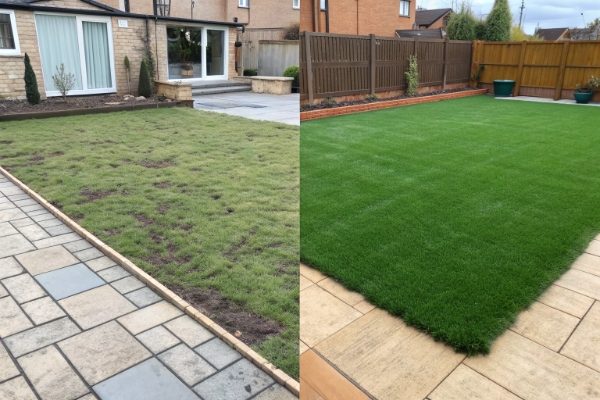
When I first started working in the factory years ago, artificial grass was a very simple product. It was usually one shade of bright green and had a noticeable plastic shine. It did look fake. Today, the manufacturing process is much more advanced and focused on realism. We can produce grass that looks incredibly natural, even up close.
The Role of Color and Shape in Realism
The biggest change is in the yarn itself. We no longer use a single color. Instead, we blend several different shades of green fiber, like emerald, olive, and lime green. We also mix in beige or brown fibers at the base to create a "thatch" effect, just like you would see in a real lawn. The shape of the yarn fiber also plays a big part. Fibers with a C-shape or S-shape are less reflective than flat fibers, which reduces that unnatural plastic shine and helps the blades stand up better.
The "Flaw" of Perfection
Ironically, the biggest giveaway that grass is artificial is that it often looks too perfect. A real lawn is messy. It has uneven patches, a few weeds, and blades of different lengths. Our artificial grass is perfectly uniform in height and color. For many of my commercial clients, this uniformity is a key selling point for projects where a clean, consistent look is important. For customers who want an ultra-realistic garden, I suggest adding natural borders or potted plants to break up the perfect surface.
Is Artificial Grass a Good Choice for Pet Owners?
Pet owners worry about messes, smells, and their pet’s comfort. You might think natural grass is the only option. But artificial turf can be a much better solution.
Yes, it is an excellent choice. Artificial grass is durable enough to handle playing and digging. Its permeable backing allows urine to drain through easily, and solid waste is simple to pick up. Regular rinsing keeps it clean, and enzyme cleaners can eliminate any odors.
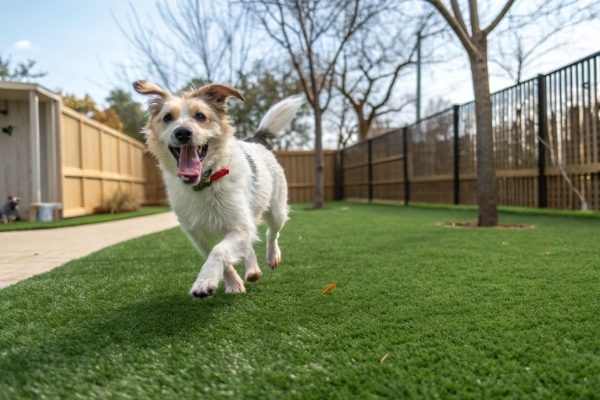
I have a client, Mohammed in the UAE, who owns a dog boarding facility. His two biggest problems were endless mud being tracked indoors and dogs digging up his entire yard. He was spending a lot of time and money trying to maintain a natural lawn that was constantly being destroyed. After he switched his facility to our pet-friendly turf, he told me it solved both issues overnight. His facility stays clean, and his outdoor area always looks great.
Dealing with Pet Waste
This is the top concern for pet owners. The system is simple and effective. The turf has drainage holes, so liquid waste passes right through into the sub-base below. Solid waste sits on top of the fibers, making it even easier to pick up than from natural grass. For daily maintenance, a quick spray with a garden hose is usually enough. For very hot climates or areas with many pets, I recommend a weekly spray with a simple enzyme cleaner. This breaks down any remaining bacteria and keeps the area completely odor-free.
Durability and Cleanliness
Compared to natural grass, artificial turf offers huge benefits for anyone with pets.
| Feature | Artificial Grass | Natural Grass |
|---|---|---|
| Mud | No muddy paws, clean home | Yes, especially after rain |
| Digging | Strong backing resists digging | Easily damaged, creates holes |
| Pests | No soil-based pests like fleas/ticks | Can harbor pests in the soil |
| Cleaning | Easy to hose down and disinfect | Absorbs odors, gets yellow spots |
The durability and ease of cleaning make it a very practical and hygienic surface for pets.
Is Artificial Grass an Expensive Long-Term Investment?
The upfront cost of artificial grass can seem high. This makes many business owners and buyers question if it’s worth the money. Let’s look at the numbers over time.
The initial cost is higher than natural sod, but the long-term savings are significant. You eliminate costs for watering, mowing, fertilizers, and pesticides. Over its 10-15 year lifespan, artificial grass often proves to be the more economical choice.
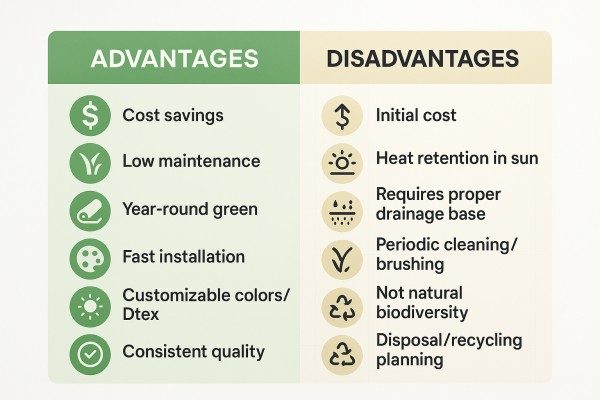
A purchasing manager, James from Canada, once told me, "Tom, the price per square meter is much higher than seed." He was right about the initial purchase price. So, we sat down and calculated the total cost of ownership over ten years for a typical landscaping project his company would bid on. The results surprised him.
The Upfront Cost vs. Long-Term Savings
Yes, the initial purchase of the turf rolls and the installation is a larger single expense. But that’s where the major spending stops. With a natural lawn, the spending never stops. You have to account for:
- Water bills, which can be very high in dry climates.
- Lawnmower fuel and regular maintenance.
- Fertilizers and pesticides, purchased every year.
- The cost of labor for a lawn care service, or your own team’s time.
A Predictable Business Expense
I explained to James that buying a natural lawn is like a subscription service you pay for every single year. Buying artificial grass is more like a one-time purchase with a very long life. For his landscaping company, this meant he could offer his clients lower maintenance contracts, giving him a competitive edge. It also made his costs more predictable. The initial investment usually pays for itself in just 3-5 years, and after that, the savings go directly to your bottom line.
How Difficult Is It to Install an Artificial Grass?
You see the beautiful, finished product and it looks simple. But you might worry that the installation process is too complex or specialized for your teams to handle.
Professional installation is always recommended for a perfect, long-lasting result. The process involves extensive ground preparation, laying a base, rolling out the turf, seaming it carefully, and adding infill. While DIY is possible for small, simple areas, larger projects require special tools and expertise.
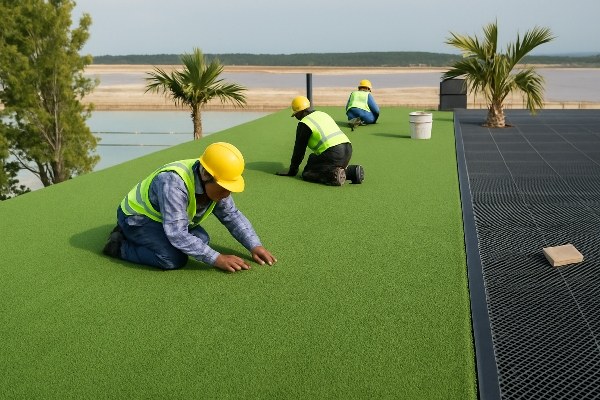
Over my career, I’ve seen many installation projects, both good and bad. The ones that look the best and last the longest always start with excellent ground preparation. This is the most important step, and it’s where most DIY projects go wrong. A poor foundation will ruin even the highest-quality grass.
Key Installation Steps
A proper installation follows a clear process that requires know-how and the right equipment.
- Excavation: The first step is to remove the old grass, weeds, and about 3-4 inches of soil.
- Base Preparation: Next, a layer of crushed rock or aggregates is put down, graded for drainage, and compacted multiple times to create a hard, stable base.
- Laying the Turf: The grass is rolled out and positioned. It must be brushed to help the fibers stand up and left to relax, often in the sun.
- Seaming: This is a critical skill. Where two pieces of turf meet, they must be trimmed perfectly and joined with special seam tape and adhesive. A bad seam is very obvious and can come apart over time.
- Infilling: Finally, sand infill is spread evenly over the entire surface and brushed deep into the fibers. This weighs the turf down, protects the backing, and helps the blades stand upright.
My advice to distributors like Carlos from Mexico is to either train a dedicated installation team or partner with experienced local installers. Providing a full, professional service is a huge value-add for your customers.
Can You Integrate Trees and Live Plants with Artificial Grass?
You love the idea of a low-maintenance lawn but don’t want a sterile, all-green landscape. Many people wonder if they can mix in natural elements. Let’s explore how it’s done.
Yes, you can easily design a landscape that combines artificial grass with live trees, shrubs, and flower beds. The turf is simply cut to fit around these natural elements, creating a beautiful and balanced look that blends the best of both worlds.
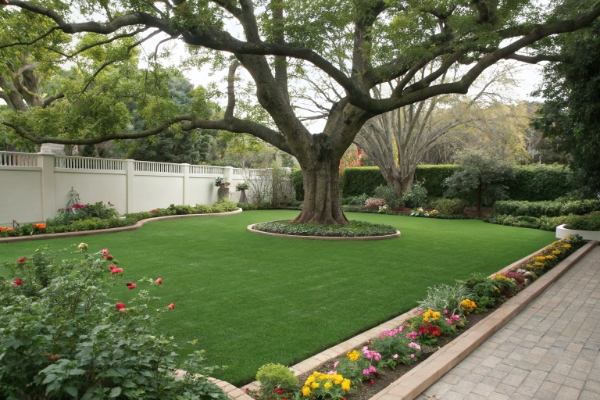
This is one of my favorite topics because it involves creativity. Many clients think it’s an ‘all or nothing’ choice between artificial grass and a natural garden. But the most stunning and high-end landscape designs I’ve seen mix the two perfectly. This approach gives you the clean, green look of turf while keeping the beauty of live plants.
How It Works
The technique is quite simple. Before you install the grass, you plan where your trees or flower beds will be. You create a physical border around these areas using materials like stone, brick, or flexible plastic edging. This border separates the plant beds from the turf area. You then install the sub-base and the artificial grass, cutting it precisely to fit right up against the border.
Why Separation is Key
This border is not just for looks; it serves a crucial function. It keeps the soil, mulch, and fertilizer from your plant beds from washing out onto your clean artificial grass during rain or watering. It also allows you to water your live plants without constantly soaking the sub-base of the turf. The drainage system for turf is designed for rainwater, not concentrated watering of plants. This simple separation ensures both your plants and your turf stay healthy and look their best for many years. It is a professional technique that all the best landscapers use.
Will Artificial Grass Fade Over Time from Sun Exposure?
You are investing in a green lawn, and you expect it to stay green. The fear of the sun turning your investment into a faded, brittle mat is a major concern, especially in sunny climates.
Cheap, low-quality grass will definitely fade. However, high-quality modern turf is manufactured with advanced UV inhibitors mixed directly into the raw materials. This protects the fibers from sun degradation, ensuring the color stays vibrant for over 8 years, even in harsh sunlight.
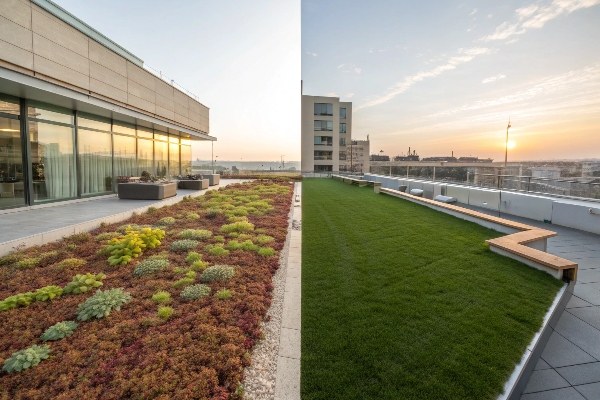
I get this question from almost every client in a sunny region, from Ahmed in Saudi Arabia to Budi in Indonesia. They have seen old, pale institutional turf from 20 years ago and are right to be worried. I tell them that the secret to long-lasting, vibrant color is not on the surface of the grass; it’s inside the plastic itself.
The Importance of UV Inhibitors
Think of UV inhibitors as a powerful sunscreen that is mixed into the formula for the grass fibers. During production, right before the plastic is made into yarn, we mix in special additives. These additives are designed to absorb harmful ultraviolet radiation from the sun. They prevent that radiation from breaking down the chemical bonds in the plastic and the color pigments. Without good UV inhibitors, the sun’s rays would bleach the color and make the fibers brittle, causing them to break.
How to Check for Quality
Don’t just trust the marketing photos. As a serious buyer, you need to ask your supplier for their UV resistance test report. This is a lab report that shows how the grass performed in an accelerated aging test, which simulates years of intense sun exposure. At QH Grass, we provide an 8-10 year warranty on color fastness because we use top-grade raw materials from trusted suppliers. A very low price often means the manufacturer used cheaper raw materials with poor UV protection. It might look good for a year, but it will not last.
How Well Does Artificial Grass Drain After Rain?
No one wants a soggy lawn with puddles everywhere after a storm. You might worry that an artificial surface made of plastic and rubber will trap water. The reality is actually the opposite.
Modern artificial grass has excellent drainage capabilities. The backing of the turf is perforated with evenly spaced drainage holes. This allows water to pass through quickly into the specially prepared aggregate base below, which then drains it away from the surface. In most cases, it drains much better and faster than natural soil.
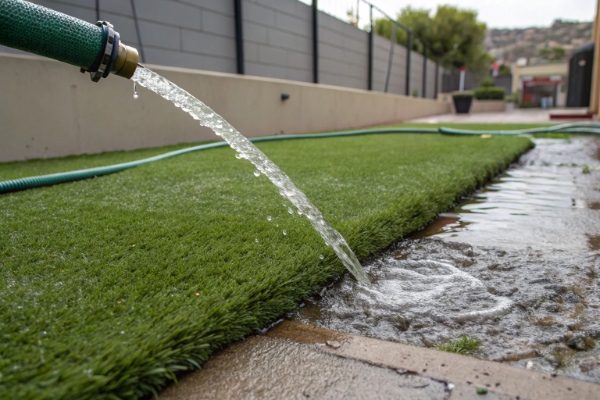
A client from Malaysia, Azlan, was planning to install turf on a rooftop sports area for a school. He was very concerned about drainage during the heavy monsoon season. He could not risk having water pooling on the roof. I explained to him that proper drainage is a two-part system, and both parts must be done correctly.
Part 1: The Turf Backing
If you look at the back of any good quality turf, you will see small holes punched all over the surface. These are precision-drilled drainage holes. Our standard is to have a drainage rate of over 60 inches per hour per square yard. Water hits the surface of the grass, runs down the fibers, and passes straight through these holes. There is no way for water to get trapped on top of the turf backing itself.
Part 2: The Sub-Base
This second part is just as important as the first. The turf is not installed directly on soil. It is installed on top of a compacted base of crushed rock and aggregates, usually several inches deep. This base acts like a giant French drain. It has lots of empty space between the stones. Water flows through the turf and into this base layer, which then allows the water to drain away slowly and evenly into the ground below. This complete system prevents puddles from forming and ensures the surface is ready for use very quickly after rain stops.
Conclusion
Don’t let old myths and outdated information hold you back. Modern, high-quality artificial grass is a safe, realistic, and smart investment that solves many more problems than it creates.
_画板-1.png)