_画板-1.png)
Contractors often face a frustrating dilemma when bidding on large projects. Natural grass looks great but dies under heavy traffic, while standard synthetic grass fails to meet strict municipal ecological and water permeability standards. If you are losing bids due to these rigid requirements, understanding the strategic uses of hybrid artificial turf is your best solution.
The primary uses of hybrid artificial turf include municipal landscaping, roadside green belts, high-traffic parks, and wholesale pet grass mats. As an open-mesh woven system, it allows natural grass to grow through the synthetic fibers, combining instant visual greening with long-term ecological benefits and high wear resistance for commercial engineering projects.
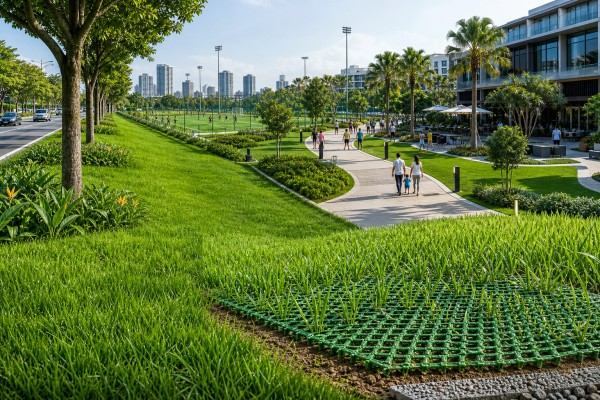
I have helped dozens of B2B contractors, municipal suppliers, and wholesale buyers integrate this grow-through turf system into their project proposals. Let’s explore how this product acts as a powerful technical tool to win bids, lower lifecycle costs, and satisfy demanding landscape requirements.
How does hybrid artificial turf win municipal and high-end landscape bids?
Government contracts and luxury hotel developers demand instant, flawless results for project handovers. However, newly planted natural grass looks patchy, and replacing dead grass months later destroys your profit margins. Woven hybrid artificial turf solves this by delivering immediate visual greening while protecting long-term natural growth.
Hybrid artificial turf wins municipal and high-end landscape bids by guaranteeing an instant green handover while meeting strict ecological permeability standards. The open-mesh structure protects natural grass roots, drastically reducing long-term replanting, watering, and weeding expenses, which translates to a lower overall lifecycle cost.
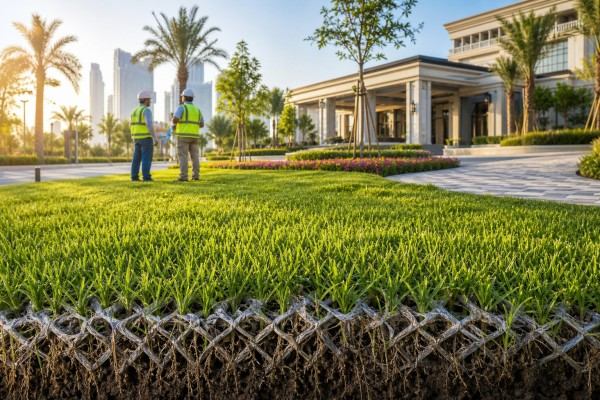
The "Instant Greening" Advantage for Project Handovers
Contractors know that the visual appeal at the time of project handover is critical to getting invoices paid and securing future contracts. With an open-mesh hybrid grass system, you unroll a visually perfect green surface immediately. I often remind my landscape clients: the property developer sees a finished landscape on day one, even before the natural grass seeds germinate. As the real grass grows through the synthetic mesh, the synthetic fibers shield the fragile new blades from environmental stress, heavy rain, and early foot traffic.
Lowering Lifecycle Costs for the End User
While the initial manufacturing and material cost of woven hybrid turf is higher than standard landscaping options, you must position this to your clients as an investment in lifecycle savings. Standard natural grass requires constant reseeding, heavy irrigation, and frequent weed control.
By presenting the data clearly, you can justify the upfront investment in your bid:
| Feature | Traditional Natural Grass | Standard Synthetic Turf | Woven Hybrid Turf |
|---|---|---|---|
| Initial Cost | Low | Medium | High |
| Ecological Permeability | High | Low (relies on punched holes) | High (100% open mesh) |
| Visuals at Handover | Patchy / Soil visible | Instantly Green | Instantly Green |
| Replanting Frequency | High (annual patching) | None | Extremely Low |
| Lifecycle Cost (5 Yrs) | High | Medium | Low |
The Critical Role of Soil Preparation
To ensure this hybrid synthetic turf performs optimally in landscape engineering, proper soil preparation is non-negotiable. You cannot simply lay this on dead dirt and expect a miracle. You need well-aerated topsoil mixed with nutrient-rich compost, careful selection of local grass seeds that match the regional climate1, and proper leveling to prevent water pooling.
I always advise contractors to specify these agronomic steps in their proposals. It shows your clients that you understand the biological ecosystem, not just the synthetic material. Note: The natural grass component still requires routine mowing. It is not 100% maintenance-free, but it is vastly more resilient and cheaper to maintain over a decade.
Can hybrid artificial turf solve muddy patches in high-traffic parks?
Public parks, school campuses, and community fields suffer from concentrated, relentless foot traffic. Over time, natural grass is trampled to death, leaving behind ugly, muddy patches2 that become unusable and unsafe after rain. An open-mesh grow-through turf system prevents this soil compaction and root destruction.
Yes, hybrid artificial turf prevents muddy patches in high-traffic areas by acting as a protective barrier over the soil. The synthetic mesh absorbs the friction of heavy foot traffic and protects the natural grass crowns. This ensures the grass roots survive, keeping the surface green, stable, and completely mud-free.
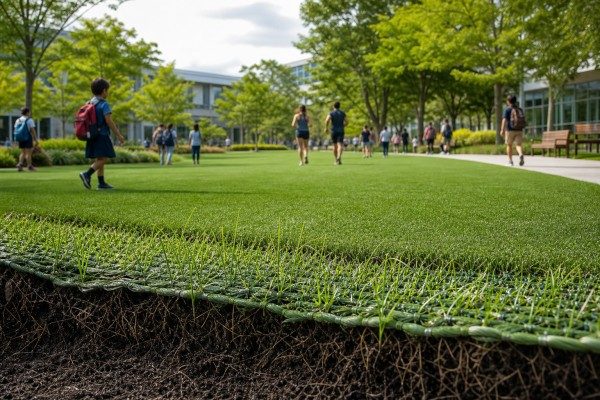
Protecting the Grass Crown and Roots
In commercial landscaping, the weakest and most vital point of natural grass is the crown—the point where the shoot meets the root system just above the soil. When hundreds of people walk, run, or play across a community field, their shoes crush these crowns. Once the crown dies, the root dies, and the soil turns to mud.
The woven hybrid turf sits slightly above the soil line, acting like a protective suit of armor. The industrial-grade synthetic fibers take the physical wear and tear, allowing the natural grass crowns to thrive safely below the friction zone. Even if the natural grass blades are temporarily worn down by heavy weekend use, the roots remain intact, allowing the grass to recover quickly.
Blending Wear Resistance with Natural Ecology
For municipal contractors, specifying a hybrid grass system is a powerful way to secure public bids. City planners are increasingly rejecting traditional, impermeable synthetic turf due to microplastic runoff concerns3 and the "urban heat island" effect.4
Here is how a grow-through turf system creates a superior high-traffic surface:
- Unmatched Permeability: The open-mesh backing allows 100% of rainwater to pass through immediately. No drainage holes are needed because the entire backing is a woven net.
- Natural Temperature Control: As natural grass grows through, natural transpiration cools the surface. This prevents the severe heat buildup common with standard artificial turf5, making it safer for children and athletes.
- Deep Root Anchoring: Within a few weeks, the natural grass roots weave deeply into the synthetic mesh, anchoring the entire system securely to the ground without the need for excessive chemical adhesives or heavy sand infill.
When I consult with landscape architects, I emphasize that this product provides a living, breathing ecosystem reinforced by advanced synthetic manufacturing.
Why is woven hybrid artificial turf ideal for wholesale pet mats?
E-commerce brands and pet product wholesalers struggle to find high-quality, durable pet grass pads. Cheap plastic mats look fake, drain poorly, and degrade quickly, leading to awful odors and high customer return rates. Supplying retail-ready woven hybrid turf mats is a highly profitable B2B alternative that solves these consumer complaints.
Woven hybrid artificial turf is ideal for wholesale pet mats because its open-mesh backing provides unmatched liquid drainage, eliminating odor buildup. As a factory partner, we supply finished, edge-locked, and retail-packaged mats with a low minimum order quantity of 1,000 sqm to help brands scale.
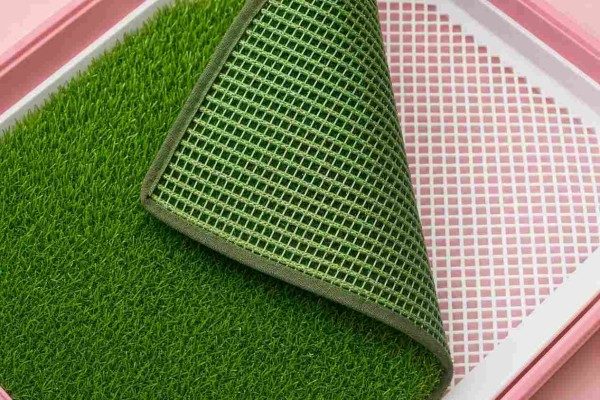
Supply Chain Value for E-commerce Brands
While large municipal engineering projects require full 40HQ containers of raw turf rolls, the pet product sector demands finished, ready-to-sell goods. I frequently work with pet brand sourcing agents who need a reliable OEM partner that understands retail logistics. For this specific application, our factory does not just weave the hybrid synthetic turf; we handle the complete downstream processing.
Our B2B pet mat supply chain includes:
- Precision cutting to standard retail sizes (such as 3×4 ft, 4×6 ft, or custom dimensions).
- Professional edge-locking (serging) with high-durability yarn to prevent fraying during washing.
- Custom retail packaging, including branded PE bags or master cartons ready for e-commerce fulfillment.
- A flexible Minimum Order Quantity (MOQ) of 1,000 sqm for finished mats, allowing brands to test market demand without over-committing capital.
Crucial Technical Warning: Avoid High-Chloride Cleaners
Drainage is the most critical feature of a pet mat. Because woven hybrid turf uses an open net backing rather than a solid polyurethane layer punched with sparse holes, urine drains instantly. This is what keeps the mat sanitary and eliminates persistent odor buildup.
However, I always give wholesale buyers a strict technical warning to print on their packaging and pass on to their retail customers: Do not use high-chloride cleaners or strong bleach disinfectants.
While the turf is highly durable and machine washable, high concentrations of chloride will rapidly degrade the polyethylene (PE) and polypropylene (PP) yarns6, as well as the woven backing. I have seen end-users ruin a product engineered for a 10-year lifespan in just a few months by soaking it in harsh industrial bleach. As a B2B supplier, you must recommend mild enzyme cleaners to your end-users7. This ensures maximum lifespan, reduces warranty claims, and protects your brand’s reputation.
How does open-mesh hybrid turf differ from professional stadium systems?
Confusion is rampant in the sports and landscape turf industry. Many contractors hear "hybrid turf" and immediately promise their clients a professional FIFA-level stadium pitch. Misunderstanding the technical differences between these distinct systems will cause you to fail municipal inspections, blow your budget, and lose client trust.
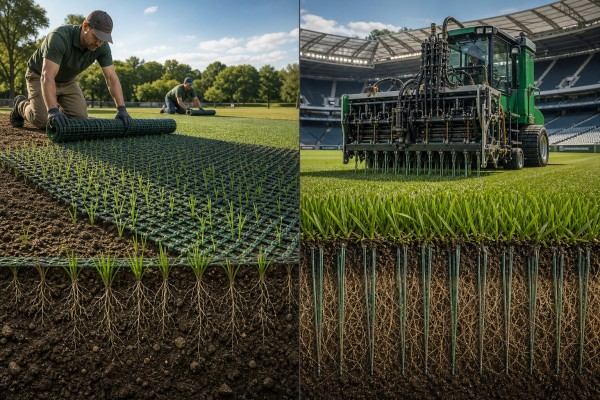
Open-mesh hybrid turf is a woven, grow-through system laid directly over seeded soil, designed for commercial landscaping and light sports. It differs entirely from professional stadium systems, which use heavy machinery to stitch or inject synthetic fibers deep into an existing natural grass root zone.
Defining the Technical Boundaries
Transparency is the foundation of B2B trust. I always clarify to sourcing agents and engineering contractors exactly what our factory produces. Our product is an open-mesh woven hybrid grass system. It comes in rolls, features a highly permeable grid-like backing, and is rolled out over prepared soil before or after natural grass seeds are planted. The natural grass grows up through the net, intertwining with the synthetic blades.
This system is perfect for municipal parks, private estates, high-end courtyards, school campuses, and community football fields where durability and ecology must balance with a reasonable budget.
Stitched and Injected Systems
Conversely, professional stadium hybrid systems (the kind used in top-tier international football leagues) are incredibly complex, highly specialized, and vastly more expensive. These are usually referred to as "stitched" or "injected" systems. In those scenarios, huge, slow-moving automated sewing machines drive on top of an already established natural grass pitch. These machines stitch synthetic yarns up to 20 centimeters deep into the sand and root zone.
Why the Distinction Matters for Your Bids
Do not blur the technical lines to hijack a bid. If a municipality asks for a community football field, a school campus green area, or a roadside green belt, our woven hybrid artificial turf is the most cost-effective and ecologically sound choice. It requires standard earth-moving equipment and typical landscape labor to install, keeping your project margins healthy.
However, if a client explicitly requests a certified professional tournament pitch for a major stadium, you need a specialized stitched system contractor. We do not claim our open-mesh product is a direct replacement for multi-million-dollar stadium injections. By accurately specifying the capabilities of the open-mesh grow-through turf, you build authoritative trust with government planners and landscape architects, positioning yourself as an honest, knowledgeable expert.
Frequently Asked Questions
What is the minimum order quantity for hybrid artificial turf?
For standard wholesale and full-container B2B orders, the MOQ for custom manufacturing specifications is 3,000 square meters. However, for finished, edge-locked wholesale pet mats, we offer a lower MOQ of 1,000 square meters to support brand scaling.
Is woven hybrid synthetic turf 100% maintenance-free?
No. Because the system integrates with living natural grass, routine agronomic maintenance like watering, fertilizing, and mowing is still required. However, the synthetic mesh prevents root damage and soil compaction, drastically reducing the need for costly replanting and deep soil repair.
Can hybrid artificial turf be recycled?
Yes. Our woven hybrid grass systems are manufactured using eco-friendly, fully recyclable materials. Unlike traditional turf that relies on heavy SBR latex or solid polyurethane backings, the unified woven structure is highly sustainable and meets strict municipal environmental standards.
How long does a 40HQ container of hybrid turf take to produce?
A standard 1x40HQ container typically takes 15–20 days to manufacture at our factory. If your project requires highly customized specifications, production takes 25–30 days. You should add roughly 10 extra days for each additional container in your order.
Conclusion
Understanding the precise uses of hybrid artificial turf allows contractors to present winning, highly technical bids for municipal landscapes, public parks, and school campuses. By providing instant visual greening, protecting natural grass roots from heavy foot traffic, and offering unmatched water permeability, this woven system solves the most demanding ecological requirements. Furthermore, its application as wholesale pet mats offers excellent, ready-to-sell supply chain value for e-commerce brands.
-
"Using Composts to Improve Turf Performance", https://extension.psu.edu/using-composts-to-improve-turf-performance/. University agricultural extension programs emphasize that successful turfgrass establishment requires alleviating soil compaction, incorporating organic amendments, and selecting cultivars adapted to the local microclimate. Evidence role: expert_consensus; source type: education. Supports: The agronomic consensus on the necessity of proper soil preparation and climate-appropriate seed selection for successful turf establishment.. Scope note: Specific soil amendment ratios and seed varieties must be tailored to the results of a localized soil test. ↩
-
"Assessing the impact of human trampling on vegetation – PMC", https://pmc.ncbi.nlm.nih.gov/articles/PMC4017817/. Research on turfgrass wear tolerance demonstrates that concentrated foot traffic causes severe soil compaction, reducing macroporosity and leading to plant mortality. Evidence role: mechanism; source type: research. Supports: The mechanism by which heavy foot traffic induces soil compaction, leading to turfgrass death and soil exposure.. Scope note: The rate of degradation depends heavily on soil moisture levels at the time of traffic and the soil’s clay content. ↩
-
"Plastic Turf FAQ | Supervisor Otto Lee I District 3", https://d3.santaclaracounty.gov/take-action/plastic-turf-faq. Environmental policy reports indicate an increasing number of municipalities are restricting artificial turf installations to mitigate microplastic runoff into local waterways. Evidence role: general_support; source type: government. Supports: The growing trend of municipalities restricting or banning traditional artificial turf due to microplastic pollution concerns.. Scope note: Policy shifts are currently more prevalent in regions with strict coastal or watershed protection mandates. ↩
-
"The effect of synthetic grass sports surfaces on the thermal environment", https://pmc.ncbi.nlm.nih.gov/articles/PMC11272752/. Climatology studies show that traditional artificial turf absorbs significant solar radiation, reaching surface temperatures substantially higher than natural grass and contributing to localized urban heating. Evidence role: statistic; source type: paper. Supports: The thermal properties of artificial turf and its measurable contribution to the urban heat island effect.. Scope note: The intensity of the heat island effect varies based on the color of the turf, infill material, and local climate conditions. ↩
-
"Transpirational cooling (biological)", https://en.wikipedia.org/wiki/Transpirational_cooling_(biological). Environmental research confirms that natural turfgrass utilizes evapotranspiration to dissipate solar energy, maintaining significantly lower surface temperatures than synthetic alternatives. Evidence role: mechanism; source type: research. Supports: The mechanism of evaporative cooling through natural grass transpiration and its effect on surface temperatures.. Scope note: The cooling effect is dependent on adequate soil moisture; drought-stressed grass will exhibit reduced transpiration and higher temperatures. ↩
-
"The effect of polyethylene microplastics on the disinfection …", https://pubmed.ncbi.nlm.nih.gov/35447168/. Polymer science literature documents that prolonged exposure to strong oxidizing agents, such as high-concentration sodium hypochlorite, accelerates the oxidative degradation of polyethylene and polypropylene. Evidence role: mechanism; source type: paper. Supports: The chemical vulnerability of polyethylene and polypropylene to oxidation and degradation from high-chloride solutions.. Scope note: The rate of degradation is influenced by the specific polymer grade, UV exposure, and the exact concentration of the chloride solution. ↩
-
"Best cat pee cleaner? Not Nature’s Miracle-Doesn’t Work : r/laundry", https://www.reddit.com/r/laundry/comments/1phlr28/best_cat_pee_cleaner_not_natures_miracledoesnt/. Biochemical studies on odor control demonstrate that enzymatic cleaners effectively hydrolyze uric acid crystals and urea, neutralizing pet odors without the corrosive effects of harsh chemical solvents. Evidence role: mechanism; source type: research. Supports: The biochemical mechanism by which enzyme cleaners break down uric acid to eliminate pet odors safely.. Scope note: Enzyme cleaners require sufficient dwell time and specific temperature ranges to effectively catalyze the breakdown of organic matter. ↩