_画板-1.png)
Do you worry about your artificial turf fading, flattening, or breaking down too soon? Replacing bad turf costs money and hurts your business reputation. You need to know exactly what makes grass last.
The lifespan of artificial grass is mainly determined by the quality of raw materials like PE granules and UV additives, the volume of foot traffic it receives, and how well it is installed and maintained. High-quality fibers and regular brushing can keep turf usable for over 8 to 10 years.
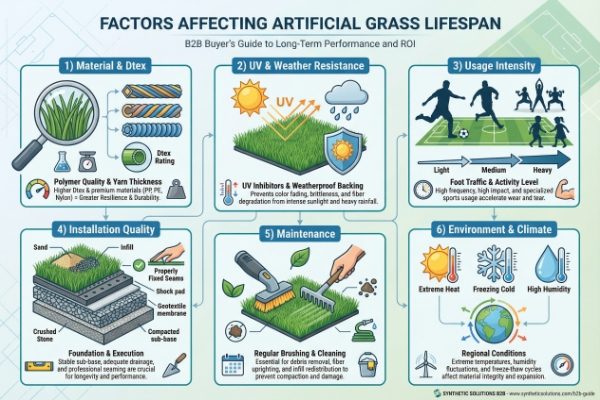
Many suppliers claim their grass lasts forever. But as an engineer and sales executive at QH Grass, I know the truth lies in the details. Let me explain the technical facts so you can buy with confidence and secure your profits.
How Do Raw Materials and Dtex Affect Turf Durability?
Cheap materials look good at first but fail fast in the sun. Don’t be fooled by samples. You must look at the technical specifications to ensure long-term performance.
Raw materials are the foundation of durability. High-quality PE granules1, premium color masterbatch, and sufficient UV-resistant additives2 prevent fading and breaking. Additionally, a higher Dtex with thicker individual fibers makes the grass stand up longer against wear.
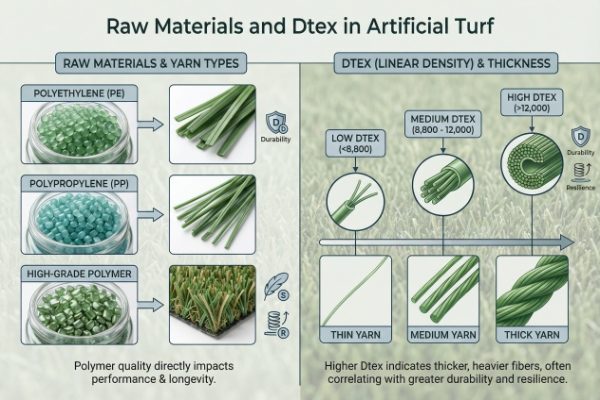
I always tell my clients that you get what you pay for. Durability starts with the plastic pellets. We use high-quality PE (Polyethylene) granules. We also add premium color masterbatch and strong UV stabilizers. If a factory saves money here to lower the price, the grass will crack and fade after one summer. You cannot see this with your eyes initially. You have to trust your supplier’s integrity.
Then there is Dtex. This measures the weight of the yarn. But total Dtex is not the only important number. You must look at the single fiber. Imagine you have two ropes. Both weigh the same.
- Case A: The tuft has 4 single fibers. Each fiber is 2,500 Dtex.
- Case B: The tuft has 8 single fibers. Each fiber is 1,250 Dtex.
Case A is better for durability. Thicker fibers are stronger. They do not split or break easily. Thin fibers feel soft, but they cannot handle heavy use. I advise you to check the thickness, not just the total weight.
Material Quality Comparison
| Component | Standard Quality | Premium Quality (QH Standard) | Result |
|---|---|---|---|
| PE Granules | Recycled mix | 100% Virgin Material | Stronger tensile strength |
| UV Additives | Low percentage | Sufficient / High Grade | Resists sun damage for years |
| Fiber Structure | Many thin fibers | Fewer, thicker fibers | Better wear resistance |
What Is the Impact of Traffic and Usage on Its Lifespan?
Putting the wrong grass in a busy area is a disaster for your project. It flattens in months. You need to match the product specifications to the expected daily usage.
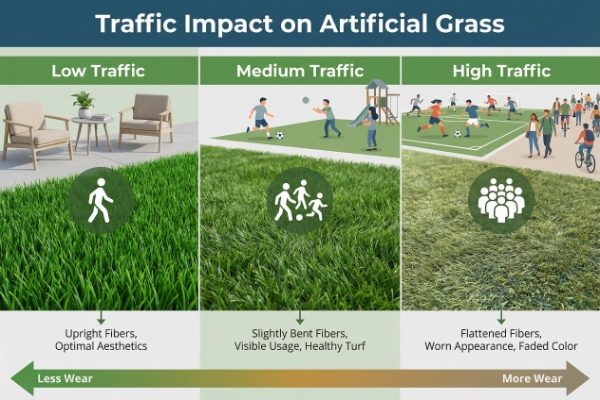
High foot traffic accelerates fiber wear. Commercial areas and busy sports fields put stress on the turf surface. Frequent friction breaks down fibers faster than in decorative gardens. You must choose heavy-duty specifications for high-use zones.
We have a saying in China: "With enough effort, an iron rod can be ground into a needle." This proverb illustrates the principle of friction. Constant rubbing wears anything down. Artificial grass acts the same way. The lifespan depends heavily on how many people walk on it.
A backyard lawn sees little walking. It might last 10 to 15 years. A soccer field or a public park sees thousands of steps a day. This friction cuts the fibers. It flattens the pile.
When I managed the sales team, I saw customers buy cheap landscape grass for a playground. It failed in two years. This is not a quality problem. It is a selection problem.
You must analyze the location.
- Low Traffic: Home gardens, rooftops. You can use softer, thinner grass.
- High Traffic: Schools, sports fields, walkways. You need stiff, thick monofilament fibers.
If the fiber is too soft, it lies flat instantly. Once it lies flat, the foot traffic steps on the side of the fiber. This increases the surface area of wear. Upright fibers last longer.
Can Proper Installation and Maintenance Extend the Life of Your Turf?
Even the best grass fails if installed poorly or ignored. Loose edges look terrible. You can prevent this with strict installation discipline and a maintenance schedule.
Yes, correct installation and maintenance are vital. Secure seams and edges prevent peeling, while regular brushing and refilling infill materials protect the fibers from crushing. These actions can add years to the product’s usable life.
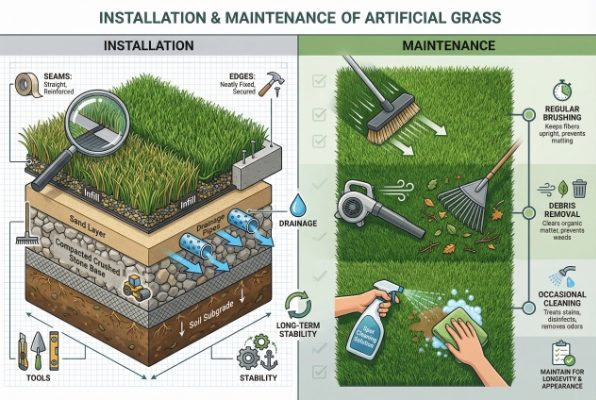
I have helped many customers who blamed the product, but the problem was the glue or the base. Installation is critical. Seams must be tight. Edges must be nailed or glued down hard. If water gets under the turf, it lifts the backing. This tears the grass.
Maintenance is the other half of the equation. Many people think artificial grass needs zero work. This is wrong.
You must check the infill. Sand and rubber granules act like a shock absorber. They support the yarn. They protect the root of the fiber. Over time, rain washes the infill away. You must replenish it.
You also need a turf grooming machine3 or a stiff brush. Regular brushing stands the fibers up. When fibers stand up, they resist UV rays better. They look better.
Essential Maintenance Tasks
- Weekly: Remove debris (leaves, trash) to prevent drainage blocks.
- Monthly: Check seam strength and edge security.
- Quarterly: Brush the turf to lift fibers.
- Yearly: deep clean and top up infill especially in high-traffic spots.
Proper care protects your investment. It helps your customers save money in the long run.
Conclusion
To maximize lifespan, choose thick fibers with UV protection, match the specs to the traffic intensity, and ensure solid installation and maintenance. This guarantees profit and success.
-
Explore how high-quality PE granules enhance turf durability and performance, ensuring long-lasting results. ↩
-
Discover the importance of UV-resistant additives in preventing sun damage and extending the life of your turf. ↩
-
Discover how using a turf grooming machine can enhance the appearance and longevity of your artificial grass. ↩
_画板-1.png)