_画板-1.png)
Are municipal greening regulations clashing with heavy foot traffic on your engineering projects? Natural grass often turns to mud under constant pressure, while standard synthetic options fail strict ecological inspections. A hybrid turf grass field offers the perfect structural engineering solution to this exact deadlock.
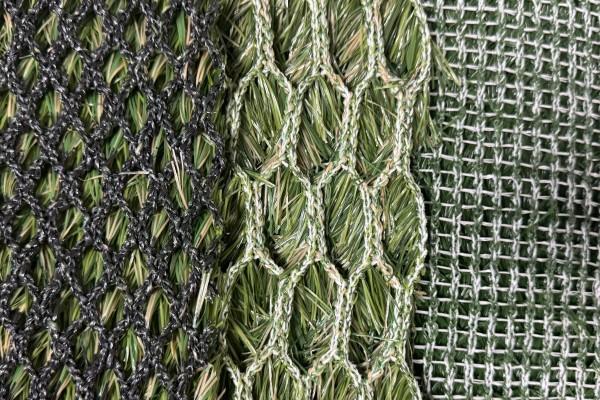
A hybrid turf grass field is an engineered landscaping solution featuring an open-weave grid structure. It combines synthetic fibers with real grass, allowing natural roots to grow through the breathable backing. This interwoven system provides extreme durability against heavy traffic while meeting mandatory greening coverage requirements for municipal and commercial projects.
Understanding how this integrated system works goes beyond just looking at the surface aesthetics. Let’s break down the structural mechanics, timeline benefits, and actual lifecycle costs for large-scale landscaping contractors and wholesale buyers.
How does a hybrid turf grass field differ from regular artificial grass?
Landscaping developers often struggle to balance aesthetic durability with environmental compliance. Traditional synthetic grass looks great and requires low maintenance, but it features a closed polyurethane backing that completely blocks natural ecological cycling.
Regular artificial grass relies on a closed backing system, making it entirely synthetic and impermeable to plant growth. In contrast, a hybrid turf grass field uses an open-weave grid. This breathable foundation allows natural grass to grow directly through the synthetic fibers, creating a living, ecological root system.
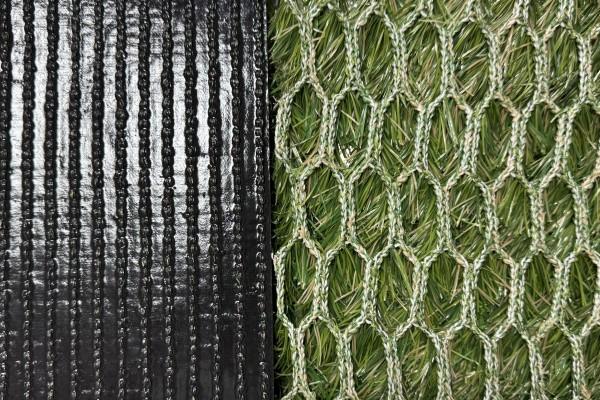
To be clear, as a manufacturer with 10 production lines, we produce both traditional artificial grass and hybrid synthetic turf. Neither is inherently "bad"—they simply serve entirely different application scenarios. Regular artificial turf is perfect for areas where zero maintenance and total soil coverage are required. However, when you are bidding on government municipal projects, closed-backing turf often fails "greening coverage" inspections because it does not support biological life or natural water drainage to the soil below.
This is where a hybrid turf grass field becomes essential. The open-weave grid design fundamentally changes how the surface interacts with the earth beneath it.
Structural Comparison Breakdown
| Feature | Regular Artificial Grass | Hybrid Turf Grass Field |
|---|---|---|
| Backing Structure | Closed (PU or SBR Latex) | Open-weave mesh grid |
| Ecological Impact | Blocks soil ecosystem | Promotes natural root growth |
| Water Drainage | Through punched drainage holes | 100% permeable through the open grid |
| Primary Application | Pure synthetic coverage, DIY, standard sports | Municipal landscaping, eco-parking, slope protection |
| Greening Compliance | Usually fails ecological quotas | Passes natural greening quotas |
When real grass grows through the open grid of a hybrid turf grass field, the natural roots intertwine with the synthetic mesh. This creates a reinforced root zone.1 In applications like slope protection or roadside green belts, this interlocking structure prevents soil erosion far better than natural grass alone. The synthetic blades take the brunt of the surface friction, while the natural grass thrives underneath, ensuring your project passes strict ecological audits without sacrificing durability.
Do you have to wait for a hybrid turf grass field to grow?
Project timelines are incredibly tight, and handing over a muddy, seeded site delays final project approvals and contractor payouts. Many engineering buyers worry that installing a mixed biological system means waiting months for a presentable green result.
You do not have to wait for a hybrid turf grass field to look green. The synthetic fibers provide immediate, instant green coverage the moment they are installed. This allows for rapid project handover, while the natural grass quietly germinates and grows through the protective grid over the following weeks.
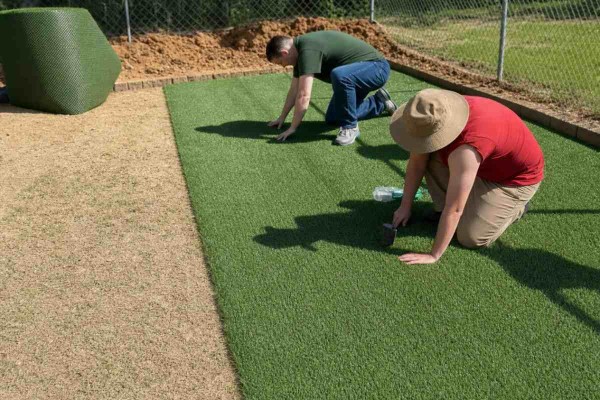
The concept of "instant green" is one of the strongest selling points for commercial landscaping contractors. When you roll out a woven hybrid turf system, the site immediately transforms. The property developer or municipal inspector sees a lush, uniform green landscape on day one.
The Germination Protection Mechanism
The engineering brilliance of a hybrid turf grass field lies in how it protects young, fragile natural grass. In a standard natural grass seeding scenario, if pedestrians walk across the area or vehicles drive over it, the grass crowns are crushed. The seeds die, and you are left with bare patches of dirt.
With a hybrid system, the synthetic fibers and the woven grid act as a physical shield. They bear the weight of foot traffic and distribute the pressure. As the natural seeds germinate in the soil below, their crowns are safely tucked underneath the synthetic canopy.
- Week 1: The site looks perfectly green due to the high-quality synthetic fibers. Seeds begin to germinate in the protected soil underneath.
- Week 4: Natural grass blades push up through the open-weave grid, blending seamlessly with the synthetic blades.
- Week 8+: The natural roots have locked entirely into the grid and the soil. The hybrid turf grass field is now a fully integrated, ultra-durable biological surface.
This unique combination gives contractors the best of both worlds: the immediate visual impact required for quick project handover, combined with the long-term ecological benefits of living vegetation.
Is a woven hybrid turf grass field the same as professional stadium turf?
When international buyers hear the word "hybrid," they often picture the high-tech pitches used in the FIFA World Cup or the English Premier League. This confusion frequently leads to mismatched specifications and inflated procurement budgets for commercial landscaping projects.
A landscaping hybrid turf grass field is not the same as professional stadium hybrid turf. Top-tier stadiums use "sewn-in" or "injected" systems where synthetic fibers are individually stitched deep into a sand base.2 Woven hybrid turf uses an open-mesh roll laid over the soil, designed specifically for landscaping.
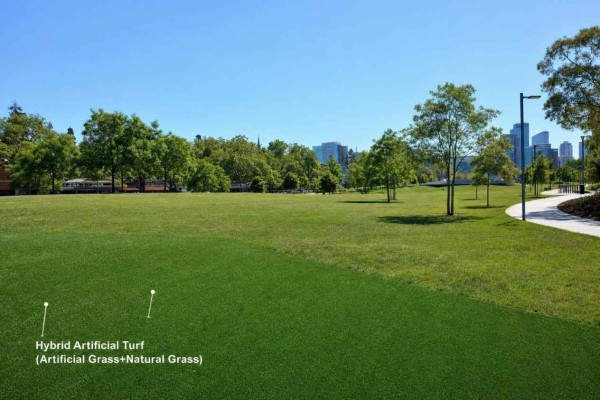
In my experience exporting hundreds of containers globally, clarifying this distinction early saves buyers massive amounts of time and money. Let’s look at the two distinct categories of hybrid systems.
1. Injected / Sewn-In Hybrid Systems (Professional Sports)
These systems are utilized almost exclusively for elite professional sports leagues. Giant, specialized laser-guided machines drive individual synthetic fibers deep into a prepared sand rootzone.
- Cost: Extremely high.
- Installation: Requires massive, specialized machinery on-site.
- Purpose: To stabilize sand-based pitches for professional athletes’ cleats.
2. Open-Weave Grid Hybrid Systems (Landscaping & Municipal)
This is the type of hybrid turf grass field we manufacture at QH Grass. It is produced in scalable rolls, much like standard artificial turf, but with an open-mesh backing.
- Cost: Cost-effective for large-scale engineering projects.
- Installation: Installed in rolls over prepared topsoil, easily handled by standard landscaping crews.
- Purpose: To solve heavy foot traffic, pass ecological inspections, and provide soil stabilization.
For wholesale buyers, sourcing agents, and municipal contractors, the woven hybrid turf grass field is the exact product you need for parks, school campuses, eco-parking lots, and high-end hotel resorts. It is highly scalable. A standard 1x40HQ container can hold thousands of square meters, allowing you to cover massive commercial areas efficiently. At our factory, standard container orders take just 15–20 days to produce, ensuring your project stays exactly on schedule.
What is the true cost and value of a hybrid turf grass field?
Procurement managers often balk at the initial unit price of hybrid systems when comparing them side-by-side with basic artificial grass. But judging a heavy-duty ecological engineering project strictly by its upfront material cost is a costly mistake.
The true value of a hybrid turf grass field lies in its long-term lifecycle cost and compliance capabilities. While the initial unit price is higher than standard synthetic grass, it eliminates the constant replanting of dead natural grass and avoids fines from failing municipal ecological greening inspections.
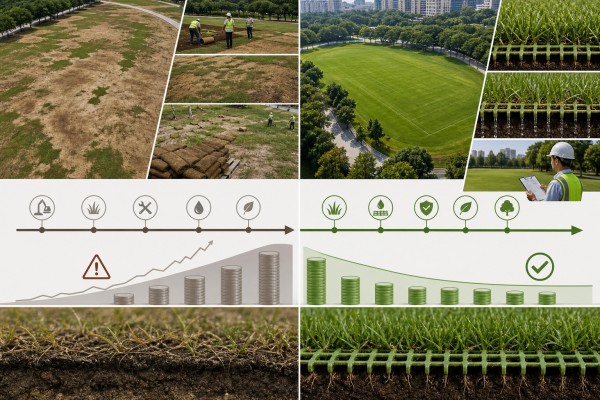
Let’s address the price objection directly. Yes, a woven hybrid turf grass field is generally more expensive per square meter than conventional landscape turf. The manufacturing process is more complex, requiring specialized weaving techniques to create a grid that is both strong enough to withstand high traffic and open enough to let natural grass thrive.
However, professional B2B buyers must evaluate procurement through the lens of Total Lifecycle Cost.
High-Value Application Scenarios
Consider the construction of an eco-parking lot. If you use 100% natural grass, the weight and friction of car tires will destroy the grass in a matter of weeks, leaving a muddy, unusable mess. If you use standard artificial grass with a closed backing, water runoff cannot drain naturally, and you will likely violate local ecological building codes for permeable surfaces.
A hybrid turf grass field handles the vehicle weight effortlessly, drains naturally, and keeps the area looking green year-round.
Here is how the long-term value breaks down for your clients:
- Zero Replanting: Natural grass in high-traffic areas requires constant reseeding, re-sodding, and labor. The interwoven roots in a hybrid system cannot be easily ripped out, ending the cycle of endless replanting.
- Regulatory Compliance: Failing a municipal greening inspection can halt a project and result in massive fines. Hybrid turf ensures compliance with permeable surface and biological vegetation quotas.
- Aesthetic Continuity: High-end resorts and private estates want the authentic feel of real nature without the bald patches. The hybrid turf grass field ensures pristine aesthetics 365 days a year.
- Sustainability: Woven from eco-friendly, recyclable materials, it aligns with modern green-building standards.
By shifting the conversation from "unit price" to "project lifespan savings," you easily justify the investment to stakeholders and project owners.
Frequently Asked Questions
What is the wholesale MOQ for a hybrid turf grass field?
For custom manufacturing runs, our Minimum Order Quantity (MOQ) is 3,000 square meters per specification. We exclusively serve B2B wholesale buyers and ship in full container loads to ensure the best factory-direct pricing for large engineering projects.
Can a hybrid turf grass field be recycled?
Yes. Because the open-weave grid system does not rely on heavy, closed polyurethane or SBR latex backings, the materials used in our woven hybrid turf are highly eco-friendly and fully recyclable at the end of their long lifespan.
How long does it take to produce a full container order?
With our 10 production lines, a standard 1x40HQ container takes approximately 15–20 days to manufacture. Customized specifications take about 25–30 days. Each additional container adds roughly 10 extra days to the production timeline.
Conclusion
A hybrid turf grass field represents the future of commercial landscaping and municipal engineering. By moving away from closed-backing plastics, this open-weave technology perfectly bridges the gap between synthetic durability and natural ecological compliance. It delivers instant green aesthetics for immediate project handover, protects natural root systems under heavy traffic, and ultimately lowers total lifecycle costs by ending the cycle of constant replanting.
If you are a landscape contractor, importer, or sourcing agent looking to supply large-scale projects, we are ready to support you. To help us provide an accurate wholesale quote, please email me with your target destination port, expected project cycle timeline, and technical specifications (such as required pile height and density). Let’s secure your next successful engineering bid.
-
"Hybrid grass – Wikipedia", https://en.wikipedia.org/wiki/Hybrid_grass. Geotechnical and agronomic evaluations show that integrating three-dimensional synthetic meshes into the root zone increases the shear strength of the soil-root matrix as roots grow through and anchor to the grid. Evidence role: mechanism; source type: research. Supports: The structural reinforcement of soil and root systems through the integration of geosynthetic meshes.. Scope note: Root reinforcement efficacy requires adequate initial establishment time and proper soil conditions. ↩
-
"verdemix: stitched hybrid technology – Limonta Sport", https://www.limontasport.com/en-us/products/hybrid-grass/verdemix-stitched-hybrid-technology/. Elite professional sports pitches commonly employ stitched hybrid systems, where specialized machines inject synthetic fibers approximately 20 centimeters deep into a sand-dominated rootzone to provide surface stability. Evidence role: definition; source type: encyclopedia. Supports: The definition and construction method of stitched or injected hybrid turf systems used in professional sports.. Scope note: Pitch construction technologies evolve rapidly, and some stadiums may use alternative reinforcement methods. ↩