_画板-1.png)
You just landed a massive sports field project, but your client is demanding the exact hybrid grass used in stadiums. Panic sets in when you realize the immense budget required for elite turf systems. Many B2B contractors lose significant money because they misunderstand the financial and mechanical realities of these high-end sports surfaces.
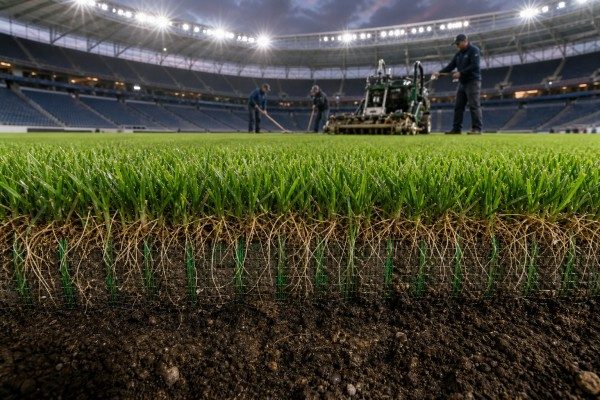
The hybrid grass used in stadiums is a high-performance sports surface combining natural grass with synthetic fibers. Elite stadiums primarily use stitched or injected hybrid systems where specialized machinery sews artificial turf fibers deep into the root zone. This reinforces the natural grass, preventing severe pitch damage during professional matches.
Understanding this surface is just the beginning. Before you specify elite stadium turf for your next municipal or campus project, you need to look past the green aesthetics and evaluate the massive financial reality hiding beneath the soil.
How does stitched and injected hybrid grass work?
Contractors often assume installing a hybrid pitch means simply unrolling a carpet and throwing down some seeds. The reality hits hard when you discover the complex mechanical engineering required. You need to know exactly how these elite systems are constructed before submitting your tender.
Stitched and injected hybrid grass systems rely on massive, laser-guided sewing machines that move slowly across a natural grass pitch. These machines inject synthetic fibers 20 centimeters deep into the sand profile every two centimeters1, creating an unbreakable anchor for natural grass roots.
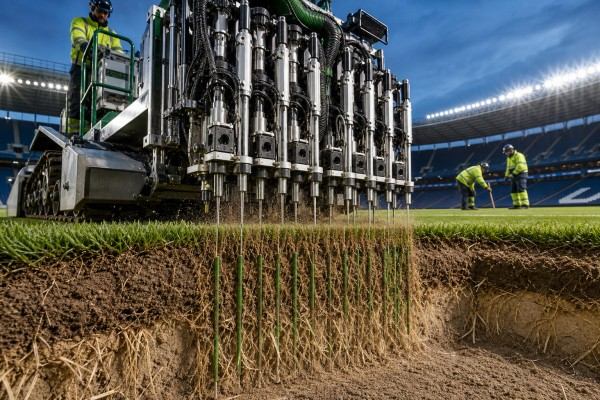
I once reviewed a tender for a regional sports center where the contractor quoted a standard synthetic turf price for a "hybrid pitch." They completely misunderstood the heavy-asset engineering involved and nearly bankrupted their firm. The top-tier hybrid grass used in stadiums is not a manufactured roll of carpet; it is an on-site construction process.
When you look at a professional pitch, you are looking at roughly 95% natural grass and 5% artificial fibers2. The magic lies entirely in the root zone. As the natural grass grows, its roots entwine with the injected artificial fibers. When a player slides across the surface, the synthetic fibers hold the root zone together, preventing the grass from tearing out in massive divots.
To achieve this, professional contractors use two primary methods:
1. The Stitched System
This method uses giant, gantry-style sewing machines positioned directly on the field. The machine creeps across the prepared sand and soil base, physically sewing spools of artificial yarn deep into the ground. It can take several weeks for one machine to stitch an entire standard football pitch3.
2. The Injected System
Similar in concept but slightly different in execution, injected systems use specialized equipment to plant individual synthetic fibers into the root zone. This is sometimes done alongside a liquid binding agent to stabilize the sand base.
| Evaluation Metric | Stitched Hybrid System | Injected Hybrid System |
|---|---|---|
| Primary Mechanism | Sewing yarn directly into the base | Planting fibers into the root zone |
| Installation Time | 2 to 3 weeks on-site | 1 to 3 weeks on-site |
| Equipment Needed | Giant specialized sewing machinery | Specialized injection tractors |
| Target Application | Elite professional stadiums | Professional training grounds |
For a B2B contractor, the takeaway is simple: you cannot buy this type of hybrid grass in a standard shipping container. You are paying for the rental, shipping, and operation of multi-million-dollar machinery.
Securing the budget for the physical materials is the easy part. The real financial nightmare begins when contractors realize that maintaining a professional hybrid pitch demands a heavy-asset commercial commitment. Without this knowledge, your client’s maintenance budget will collapse within months.
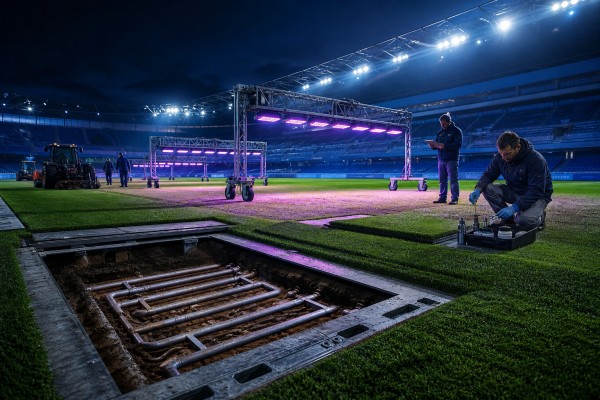
The hidden costs of elite stadium hybrid grass stem from specialized installation logistics and extreme daily maintenance. You must account for heavy machine rentals, expensive underground heating systems, specialized UV grow lights, and full-time professional agronomists to keep the natural grass alive.
Choosing hybrid grass for a stadium is not just a material procurement issue; it is a heavy-asset commercial decision. The initial installation price tag is only the tip of the iceberg. I always advise procurement teams to evaluate the total lifecycle cost before committing to a stitched system.
The Heavy Machinery Barrier
As a contractor, you cannot simply hire a local landscaping crew to install a stitched pitch. You must contract a specialized firm that owns the giant sewing machines. Transporting these massive rigs across countries or oceans adds astronomical freight and logistics costs to your project before a single blade of grass is planted.
Extreme Agronomy and Maintenance
The fundamental flaw in many municipal business plans is the assumption that hybrid turf requires less maintenance than pure natural grass. The opposite is true. Because the sand base required for stitched systems drains water and nutrients extremely fast4, the natural grass is essentially living on life support.
To keep the natural grass alive, elite stadiums require:
- UV Grow Lights: Massive light rigs must be rolled onto the pitch daily to simulate sunlight, especially in shaded stadiums.
- Under-Soil Heating: To prevent the root zone from freezing during winter matches, expensive hydronic heating pipes must be installed and constantly fueled.
- Constant Fertilization: The high-drainage sand profile requires continuous chemical management by a highly paid, full-time turf agronomist.
- Specialized Mowers: Heavy traditional tractors will compact the pitch; you must use specialized lightweight cylinder mowers.
If your client is a municipal government or a local school district, they simply do not have the annual operating budget to sustain this level of care.
Do you really need elite certifications for your project?
Municipal buyers and school districts often demand FIFA-certified hybrid pitches without understanding the implications. This obsession with elite badges drains public budgets and forces contractors into impossible bids. You must align the project requirements with practical reality.
You do not need elite stadium certifications for most municipal, school, or regional sports projects. Blindly chasing top-tier badges forces you to buy heavy-asset stitched systems that overkill the project requirements. Contractors must evaluate the actual usage hours and match the turf technology to the budget.
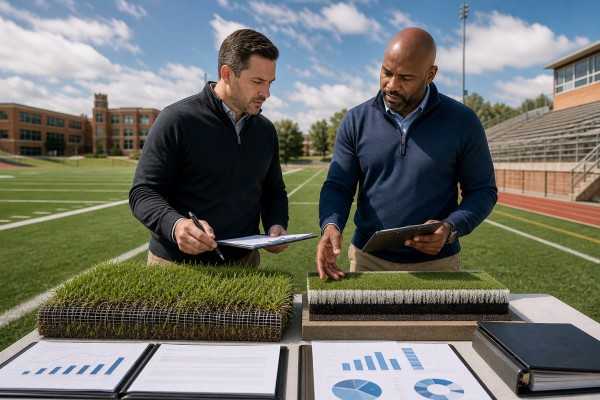
One of the biggest mistakes I see in B2B procurement is the "certification illusion." A local university wants a new football field, so the purchasing department copies and pastes the specifications from a Premier League stadium, demanding strict international certifications.
Here is why this is a catastrophic procurement strategy: elite professional pitches are designed to host one or two matches a week. The extreme maintenance routine happens during the off-days. A municipal park or university field, however, might host three games a day, seven days a week.
If you put an elite stitched hybrid system in a heavy-use municipal park, the natural grass will die within weeks because it never gets time to recover. You are then left playing on a hard, sandy surface with just 5% artificial fibers sticking out.
How to Evaluate Project Feasibility
Before you source hybrid grass used in stadiums, ask your client these hard questions:
- What is the weekly usage? If the field will be used for more than 20 hours a week, natural grass (even reinforced with elite stitching) will struggle to survive.
- What is the annual maintenance budget? If they cannot afford to hire a full-time agronomist and run UV grow lights, walk away from stitched systems.
- What is the actual certification requirement? Treat certifications as documents you verify for specific project needs, not default marketing badges. Unless you are hosting sanctioned international matches, you do not need to pay the premium for a certified elite system.
Is there a cost-effective woven alternative for non-elite stadiums?
Walking away from an expensive stitched system does not mean abandoning hybrid turf entirely. If your client has a strict budget but still wants the structural benefits of a hybrid surface, you need a pragmatic solution. Woven hybrid grass bridges this gap perfectly.
Woven hybrid grass is a highly cost-effective alternative for non-elite stadiums. Also known as a grow-through system, it features an open mesh backing laid directly over the soil. Natural grass grows through the woven grid, offering excellent root protection without expensive stitching machinery.
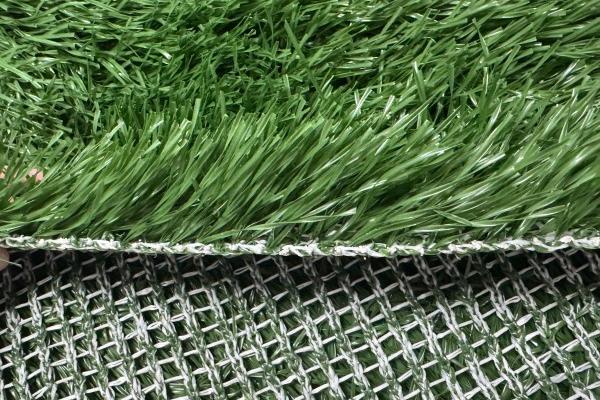
For B2B contractors, engineering companies, and municipal purchasers, the woven hybrid turf system (often called Grow-Through Turf) is a game-changer. It strips away the heavy-asset machinery barrier while delivering a highly durable, green surface.
The Open Woven Structure
Unlike traditional artificial turf that uses a solid polyurethane or latex backing, woven hybrid grass utilizes an open, grid-like mesh. You lay this turf down like standard artificial grass over a prepared soil base. Then, you plant natural grass seeds either beneath the mesh or brush them into the turf pile.
As the natural grass grows, its roots penetrate right through the open mesh backing deep into the soil. The crowns and roots of the natural grass are fully protected by the synthetic matrix.
Why Contractors Prefer Woven Hybrid Systems
From a procurement and installation standpoint, woven systems offer massive advantages for mid-tier projects:
- No Specialized Machinery: You do not need to rent a giant sewing machine. Your standard turf installation crew can lay the rolls.
- Instant Green Aesthetics: Because the artificial fibers are visible immediately, the site looks perfectly green while the natural grass takes its time to grow through.
- Excellent Drainage: The open-grid backing provides superior water permeability compared to traditional punched-hole turf backings.
- Eco-Friendly: High-quality woven hybrid turf is typically made from 100% recyclable polyolefins, appealing to government projects with strict environmental guidelines.
| Feature | Elite Stitched System | Woven (Grow-Through) System |
|---|---|---|
| Installation Method | On-site mechanical sewing | Laid in manufactured rolls |
| Machinery Required | Heavy gantry sewing machines | Standard turf installation tools |
| Target Budget | High (Professional leagues) | Medium (Municipal, Schools) |
| B2B Procurement | Service-based contract | Container-based wholesale |
Woven hybrid turf is the pragmatic choice for municipal landscaping, roadside green belts, school campuses, and regional sports field contractors who need hybrid performance without the elite stadium price tag.
Frequently Asked Questions
What is the exact hybrid grass used in stadiums?
Professional stadiums typically use stitched or injected hybrid grass systems. These are not standard turf rolls; they require heavy machinery to sew artificial fibers directly into a natural grass sand profile to reinforce the root zone.
Can you install stadium hybrid turf without specialized machinery?
You cannot install stitched or injected systems without specialized machinery. However, you can install woven (grow-through) hybrid turf using standard landscaping crews, making it a much more accessible option for standard B2B contractors.
How long does a woven hybrid grass system last?
The lifespan of a woven hybrid grass system depends on usage and maintenance. Because the artificial fibers protect the natural grass crowns, these systems can sustain high-traffic municipal and school sports activities for years if standard agronomy practices are followed.
What is the difference between stitched and woven hybrid turf?
Stitched turf sews fibers into an existing natural grass pitch using giant machines. Woven hybrid turf is manufactured as a roll with an open mesh backing; it is laid on the ground, allowing natural grass to grow up through the artificial grid.
Conclusion
Understanding the hybrid grass used in stadiums requires looking past the aesthetics and evaluating the commercial realities. While elite stitched systems are perfect for professional leagues, their reliance on heavy machinery and extreme daily maintenance makes them a financial liability for standard projects. For B2B contractors, school districts, and municipal purchasers, woven grow-through systems offer a highly durable, cost-effective alternative that can be installed without specialized equipment.
If you are a contractor, landscape engineering firm, or an importer looking to source premium woven hybrid turf, factory-direct procurement is your best strategy. QH Grass manufactures open-mesh woven hybrid grass systems designed for municipal, commercial, and sports applications. We supply strictly to wholesale B2B buyers with container purchasing capability. Contact Alice Chen at [email protected] or WhatsApp +86 185 7566 0746 to discuss technical specifications and container pricing for your next project.
-
"Hybrid Grass Fields", https://www.sispitches.com/us/surface/hybrid-grass/. Technical evaluations of stitched hybrid turf systems confirm that specialized machinery typically injects synthetic yarns to a depth of 18 to 20 centimeters at intervals of approximately 2 centimeters to anchor the root zone. Evidence role: mechanism; source type: paper. Supports: The mechanical depth and spacing specifications for stitched hybrid turf systems.. ↩
-
"Hybrid grass", https://en.wikipedia.org/wiki/Hybrid_grass. Research on reinforced natural turf systems indicates that stitched hybrid pitches typically maintain a surface composition of approximately 95% natural grass and 5% synthetic fibers. Evidence role: statistic; source type: research. Supports: The standard composition ratio of stitched hybrid sports surfaces.. Scope note: Exact percentages may vary slightly depending on the specific brand and the spacing of the injected fibers. ↩
-
"New rapid hybrid turf solutions from SIS Pitches", https://sportsfieldmanagementonline.com/2026/03/17/new-rapid-hybrid-turf-solutions-from-sis-pitches/19085/. Industry case studies and sports field construction guidelines note that the mechanical stitching process for a standard professional football pitch generally requires two to three weeks of continuous operation per machine. Evidence role: case_reference; source type: institution. Supports: The typical duration required to stitch a full-size professional football pitch.. Scope note: Installation times can be reduced if multiple stitching machines are deployed simultaneously. ↩
-
"Best management practices for construction of sand-based …", https://extension.oregonstate.edu/catalog/pnw-675-best-management-practices-construction-sand-based-athletic-fields-football-soccer. Agronomic studies on sand-based sports fields demonstrate that while high-sand root zones provide excellent drainage and compaction resistance, they exhibit low cation exchange capacity, leading to rapid leaching of water and essential nutrients. Evidence role: mechanism; source type: education. Supports: The relationship between high-drainage sand profiles and nutrient leaching in sports turf.. ↩