_画板-1.png)
When contractors ask me exactly what is hybrid turf made of, they usually face a crisis: failed municipal tenders or dead natural grass caused by poor drainage. Choosing the wrong synthetic materials ruins landscape projects fast. Understanding the exact material composition solves these expensive compliance and agronomic failures.
True woven hybrid turf is made of UV-resistant Polyethylene (PE) and Polypropylene (PP) yarns woven into an open-mesh backing, secured by a recyclable latex coating. Unlike conventional artificial grass with punched drainage holes, this specific composition allows natural grass roots to grow freely through the open grid.
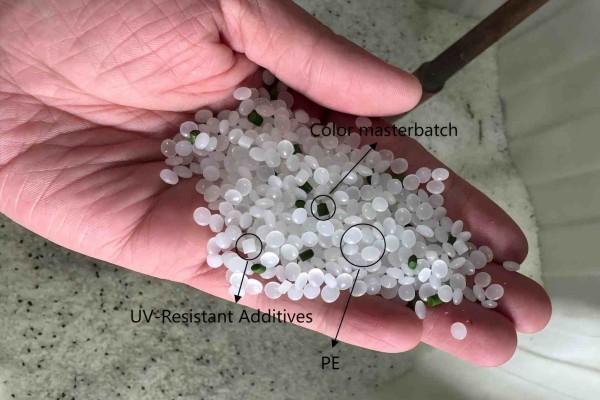
Let us look closer at the factory floor. The raw materials and manufacturing techniques determine whether your landscape project thrives or fails. Here is the technical breakdown of hybrid artificial grass components.
What is hybrid turf made of compared to conventional punched grass?
Many buyers assume hybrid systems are simply standard synthetic turf with extra drainage holes. This dangerous assumption traps contractors into buying conventional products for hybrid projects. Real hybrid turf requires a completely different base structure.
Genuine hybrid turf is not standard artificial grass with punched holes. It is manufactured with an open-woven mesh structure using high-tensile PE and PP yarns. This open grid provides substantial open space, guaranteeing unimpeded root growth and natural water drainage that punched holes cannot match.
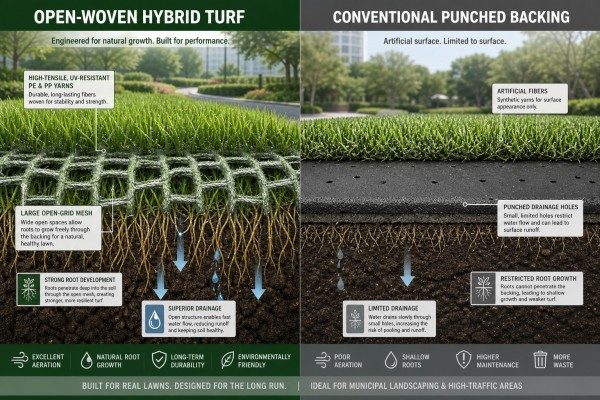
Last year, a European landscape contractor visited our factory complaining that his previous hybrid project died within three months. When he showed me the sample he bought from another supplier, the problem was obvious. It was just standard landscape grass with extra machine-punched holes. The materials were entirely wrong for a grow-through application.
To understand what is hybrid turf made of, you must look at the structural foundation. We extrude high-quality Polyethylene (PE) to create the soft, UV-resistant grass blades. We then use high-strength Polypropylene (PP) yarns to construct the base grid. Instead of tufting these blades into a solid sheet of fabric, our factory looms weave the PE and PP together. This creates a highly durable, open grid.
Natural grass requires oxygen, water, and physical space for the root system to expand. A conventional backing with punched holes covers roughly 95% of the soil surface. This smothers natural grass and creates heat build-up. The open-woven structure of true hybrid turf covers far less soil surface, creating the perfect micro-climate for natural seeds to germinate and thrive alongside the synthetic fibers.
Material Comparison: Woven Hybrid vs. Punched Conventional
Buyers must evaluate these structural differences before placing wholesale container orders.
| Feature | Conventional Punched Turf | Woven Hybrid Turf |
|---|---|---|
| Base Material | Solid PP woven cloth + non-woven fabric | Open-grid PP woven yarns |
| Drainage Method | Machine-punched holes (every 10-15cm) | 100% permeable open mesh structure |
| Natural Grass Growth | Highly restricted, roots rot easily | Unimpeded root penetration |
| Primary Application | Fully artificial landscape surfaces | Co-existing natural and synthetic landscapes |
| Risk of Project Failure | High (if used as a hybrid system) | Low (specifically engineered for this purpose) |
Understanding these physical properties helps B2B buyers avoid disastrous sourcing mistakes. When you know what materials to look for, you can protect your landscape contractors from costly project failures.
What is hybrid turf made of: Latex vs. SBR backings?
Environmental regulations in municipal tenders are becoming stricter every year. Using non-recyclable polyurethane (PU) or Styrene-Butadiene Rubber (SBR) backings risks immediate project disqualification. The right backing material is critical for commercial compliance.
Woven hybrid turf is made with a specialized, recyclable latex backing instead of conventional non-recyclable SBR or PU. This eco-friendly latex securely binds the yarns while meeting stringent CE and RoHS standards1, ensuring landscape contractors pass strict municipal procurement evaluations safely.
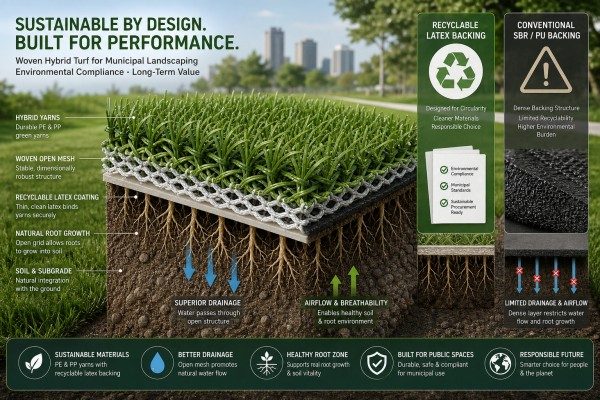
The boundary between high-end hybrid turf and cheap imitations often lies in the backing application. Most conventional artificial grass uses heavy SBR latex or PU to lock the tufted yarns in place. While these materials are cheap and widely available, they are very difficult to recycle. More importantly, standard SBR backing methods cannot be used on an open-mesh product.
On our factory production lines, applying latex to an open woven mesh is a highly technical process. This craftsmanship creates a major moat against low-quality manufacturers. If the latex coating is too thick, it floods the open spaces of the grid, blocking natural grass growth and destroying the drainage capacity. If the latex application is too thin, the PE blades will easily pull out under the stress of foot traffic.
We use a specially formulated, environmentally friendly latex. Our technicians carefully calibrate the tension of the woven mesh as it moves through the backing oven. This ensures the latex only coats the structural yarns, leaving the open spaces perfectly clear.
Passing Strict Municipal Tenders
When municipal buyers evaluate what is hybrid turf made of, environmental compliance is their top priority. They demand safe, recyclable materials for public parks, school campuses, and roadside green belts.
- Recyclability: Our latex backing allows the entire turf system to be more easily recycled at the end of its lifespan.
- Non-Toxic: It prevents heavy metal leaching into the local water table, a common concern with low-grade SBR materials.
- Documentation: High-quality latex compositions pass CE and RoHS testing.
Sourcing agents and importers must treat certifications as documents to be verified. Always ask your factory supplier for the specific RoHS and CE test reports for the exact hybrid turf model you intend to purchase. Presenting these verified documents to your municipal clients drastically increases your chances of winning lucrative landscape tenders.
Does the material hybrid turf is made of require expensive machinery?
You might worry that installing advanced hybrid grass systems requires heavy capital investment. Stitched hybrid systems demand multi-million-dollar specialized machinery. This frightens away many standard landscape contractors from bidding on lucrative projects.
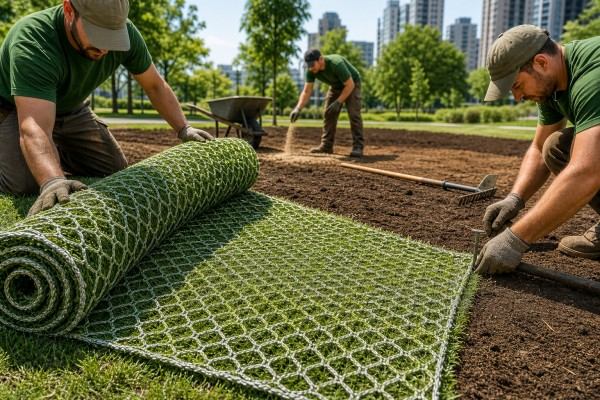
Because woven hybrid turf is made of flexible PE/PP yarns and a pliable latex backing, it does not require specialized installation machinery. Standard landscape contractors can unroll, peg, and seed these flexible hybrid rolls using their existing conventional landscaping equipment.
I often receive messages from sourcing agents who are confused by the general term "hybrid turf." They assume their engineering clients cannot afford the installation costs. This confusion happens because the industry uses the same name for entirely different technologies.
You must separate stitched systems from woven systems. Stitched hybrid turf is made of synthetic fibers that are sewn directly into a prepared sand base using massive, expensive tractors. This is reserved for professional stadium projects. Woven hybrid turf, however, is manufactured in our factory as flexible, open-mesh rolls.
This material composition directly reduces the barrier to entry for your clients. Importers can order standard 1x40HQ containers filled with these woven rolls. Once delivered to the job site, standard landscape crews handle the installation.
Cost-Effective Project Execution
Knowing what is hybrid turf made of allows you to accurately calculate your project logistics and timelines.
- Site Preparation: Contractors prepare the soil base just like they would for natural grass seeding.
- Unrolling: The flexible mesh rolls are unrolled across the soil.
- Securing: The turf is pegged down using standard landscaping pins.
- Seeding and Brushing: Workers spread natural grass seeds and topsoil over the mesh, brushing it down through the open grid.
Because we focus exclusively on wholesale B2B manufacturing, we optimize our production materials for efficient shipping and deployment. A standard 1x40HQ container order takes roughly 15 to 20 days to produce on our 10 production lines. For custom specifications—which require a minimum order quantity (MOQ) of 3,000 square meters—production takes 25 to 30 days.
By choosing open-woven hybrid materials over stitched systems, importers eliminate hidden machinery costs. You empower local municipal and landscape contractors to deliver high-end, grow-through green spaces without upgrading their equipment fleet.
Frequently Asked Questions
What is the primary material in hybrid artificial grass blades?
The synthetic blades are extruded from high-quality Polyethylene (PE) resins. PE provides excellent UV stability, flexibility, and a natural appearance, ensuring the artificial blades blend seamlessly with growing natural grass in commercial landscape projects.
Can natural grass roots break through the woven backing?
Yes. The backing is an open-woven mesh constructed from high-tensile Polypropylene (PP) yarns. This grid design offers ample open space, allowing natural roots to penetrate deeply into the soil sub-base while protecting the natural grass crown.
Is the latex backing environmentally safe?
Yes, the specialized latex backing used in high-quality woven hybrid turf is recyclable and environmentally safe. Buyers should always verify that the manufacturer provides CE and RoHS test reports to guarantee compliance with municipal environmental standards.
Conclusion
Understanding exactly what is hybrid turf made of is the first step toward securing high-quality commercial projects. By selecting an open-woven mesh constructed from durable PE and PP yarns, you guarantee natural grass survival. By insisting on a recyclable latex backing over standard SBR or PU, you protect your clients from environmental compliance failures in strict municipal tenders. These precise material boundaries separate successful landscape engineering from costly project disasters.
If you are an importer, sourcing agent, or landscape contractor looking for factory-direct woven hybrid turf, QH Grass is ready to support your supply chain. Contact Alice at [email protected] or WhatsApp +86 185 7566 0746 to discuss your next wholesale container order.
-
"Compliance FAQs: CE Marking | NIST", https://www.nist.gov/standardsgov/compliance-faqs-ce-marking. The Restriction of Hazardous Substances (RoHS) directive limits the use of specific heavy metals and toxins in manufactured goods, while CE marking indicates conformity with European health, safety, and environmental protection standards. Evidence role: definition; source type: government. Supports: The definitions and regulatory scope of CE marking and the RoHS directive.. ↩