_画板-1.png)
maintaining a natural lawn bowling surface is a constant battle against costs, weather, and inconsistent playing conditions. If the grass is too long or uneven, your members will complain, and your maintenance bills will keep rising without bringing in more players.
The best bowling green turf uses curled Polyethylene fibers with a pile height of 13mm to 15mm and a high density of over 60,000 stitches per square meter. It must be installed on a perfectly level concrete or asphalt base with a shock pad to guarantee a consistent ball roll speed and true trajectory.
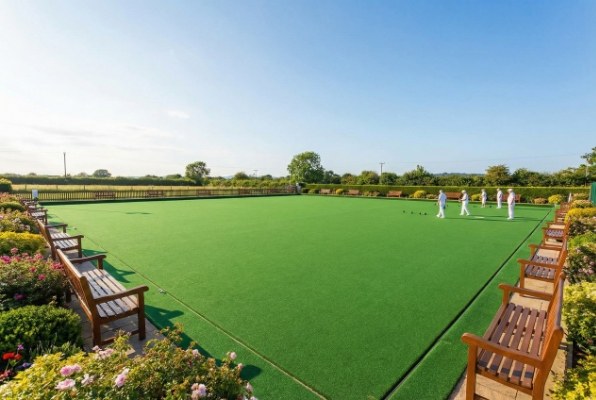
I have seen many club owners struggle with this decision. You want to save money, but you cannot sacrifice game quality. If the ball does not roll straight, players will leave. In this article, I will share my experience to help you choose the right product.
What Is Bowling Green Turf and How Does It Differ from Other Sports Surfaces?
Many buyers strive to find one type of grass that fits every sport, but using soccer or landscape grass for bowling is a disaster. If the surface is not specialized, the ball will bounce unpredictably, and the game becomes impossible to play.
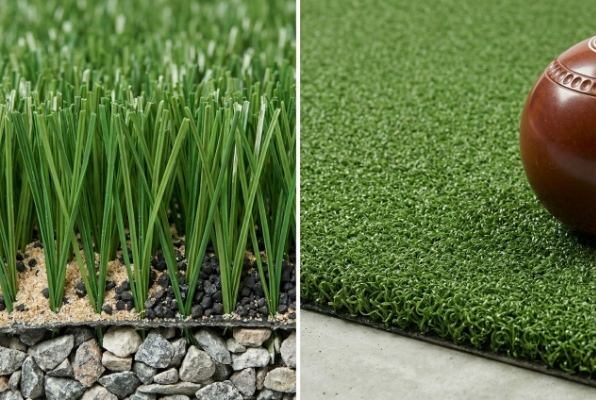
Bowling green turf is a specialized surface made from short, curled fibers designed to be non-directional. Unlike soccer turf which uses long straight fibers for traction, bowling turf creates a dense, mat-like surface that ensures the ball rolls smoothly and stays flat against the ground.
The Critical Differences
When I worked in the technical department, we often had to explain to customers why they could not use cheap landscape grass for their bowling greens. It comes down to physics and precision.
1. fiber Structure
In soccer turf, the fibers stand up straight to grip the player’s cleats. In bowling, we use curled (texturized) fibers. These fibers act like a spring. They mat down to form a smooth surface that looks like bentgrass. This texture allows the bowl to glide rather than bounce.
2. The Importance of Density
This is where many suppliers try to cheat. For a good bowling green, you need a density of 63,000 to 84,000 stitches/m². If the density is too low, the bowl will wobble. High density supports the ball weight evenly.
3. The Base Requirement
General sports turf can sit on crushed stone. Bowling turf cannot. It requires a concrete or asphalt base1. In lawn bowling, precision is paramount. An uneven surface affects even the best shots. A solid base ensures the surface remains perfectly flat for years.
Here is a quick comparison to help you understand the specs:
| Feature | Standard Sports Turf (Soccer) | Bowling Green Turf |
|---|---|---|
| Fiber Shape | Diamond or C-shape (Straight) | Curled / Texturized |
| Pile Height | 40mm – 60mm | 13mm – 18mm |
| Infill | Sand + Rubber Granules | Minimal Sand (or none) |
| Goal | Shock absorption & Traction | Ball roll consistency |
| Base | Crushed Stone | Concrete / Asphalt |
What Are the Top Benefits of Artificial Turf for Bowling Greens?
Natural grass greens develop dips and bumps over time, which ruins the accuracy of the game and frustrates skilled players. You might be losing tournaments and revenue simply because your facility cannot guarantee a high-quality surface every day.
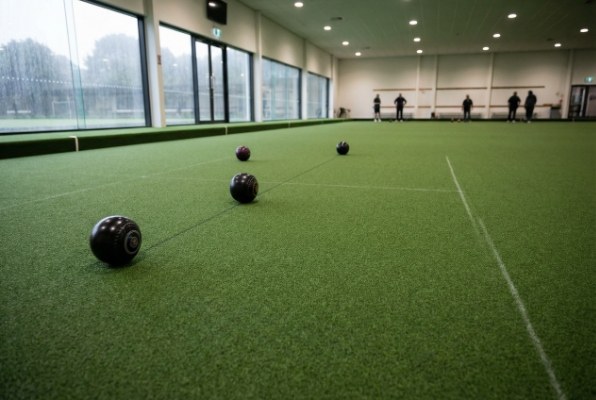
Artificial turf for bowling greens eliminates surface imperfections, providing a consistent "true roll" regardless of the weather or time of day. It allows clubs to host games year-round, removes the need for expensive mowing and watering, and ensures a flat playing field that boosts player confidence.
Consistency is Profit
From my years in sales, I know that for a business owner like you, a product is an investment. The biggest benefit of artificial bowling turf is consistency.
The Problem with Natural Grass
Natural grass changes throughout the day. In the morning, it is wet with dew and slow. By the afternoon, it is dry and fast. It also develops "runs" or tracks where players step often. This leads to unpredictable game outcomes.
The Artificial Advantage
Artificial turf mimics the flatness and rolling speed of the best natural grass but keeps it that way permanently. It does not develop dips or uneven areas. This means a player knows that if they bowl the same shot at 8 AM or 8 PM, the result will be the same.
Financial Efficiency
I helped a customer in Australia switch from natural to artificial. He was worried about the initial cost. However, we calculated his savings:
- No Water Bills: A huge saving in dry climates.
- No Chemicals: No fertilizers or pesticides.
- Manpower: No daily mowing or rolling.
- Uptime: He could rent the lanes out for indoor play or during winter months when natural grass would be dead.
This surface is ideal for all-weather play. Whether installed indoors or outdoors, the specialized PU adhesive and drainage holes handle water well, letting you play almost immediately after rain.
Which Bowling Green Turf Model Offers the Best Value for Money?
You are likely flooded with quotes from different factories, some offering very cheap prices and others asking for a fortune. If you choose the cheapest option, the fibers will flatten in a year; if you choose the most expensive, you are wasting margin.
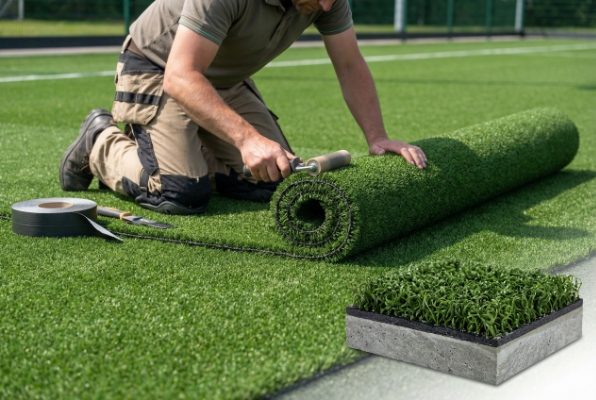
The model that offers the best value uses a 100% Polyethylene (PE) curled fiber with a 6,600 to 8,800 Dtex and a PU backing. This combination resists UV degradation and fiber splitting while remaining affordable, striking the perfect balance between professional durability and a reasonable investment cost.
Making the Smart Purchase
I always tell my friends in the industry: "Don’t buy the most expensive, buy the most suitable." Here is how you break down the value.
1. Material: PE vs. PP
If you are on a strict budget, you might look at Polypropylene (PP). It is cheaper. However, PP is stiffer and can become brittle in the sun. For a few dollars more, Polyethylene (PE) is softer and lasts much longer. It represents better value because you won’t replace it as soon.
2. Pile Height and Dtex
Be careful here. Some factories sell 10mm grass to save yarn. But 10mm wears out too fast.
- Optimal Range: 13mm to 15mm (up to 20mm if you want a slower green).
- Dtex (Weight): Look for 6000-9000 Dtex. This ensures the fiber is thick enough to stand up to constant walking and rolling.
3. The Backing Glue
This is a hidden detail.
- SBR Latex: Standard black glue. It is cheaper and works fine for dry areas.
- PU Adhesive: Green adhesive. It provides a much stronger lock for the fibers and resists moisture better. If you are in a wet climate (like the UK) or humid area (like Southeast Asia), pay the extra for PU. It prevents the grass from coming loose.
Detailed Specification Recommendation
| Component | Budget Option (Good) | Best Value Option (Recommended) |
|---|---|---|
| Material | PP (Polypropylene) | PE (Polyethylene) |
| Pile Height | 10mm – 12mm | 13mm – 15mm |
| Stitch Density | 50,000 / m² | 63,000 – 70,000 / m² |
| Backing | SBR Latex | PU (Polyurethane) |
| Lifespan | 3-5 Years | 8-10 Years |
By choosing the "Best Value" column, you ensure your customers get a professional feel without you paying for "FIFA grade" certifications that you do not need for a private club or local project.
Conclusion
To choose the best bowling green turf, prioritize high-density curled PE fibers (around 65,000 stitches/m²) on a stable concrete base. This ensures specific ball roll accuracy, low maintenance, and long-term profitability.
-
Discover the importance of a solid base for maintaining a flat and precise bowling surface over time. ↩
_画板-1.png)