_画板-1.png)
Understanding the difference between hybrid grass and natural grass is critical when your commercial landscaping project faces heavy foot traffic. Pure natural grass easily turns into muddy, barren patches under constant trampling. An engineered hybrid system solves this fundamental problem by protecting the natural roots while maintaining an authentic botanical landscape.
The main difference between hybrid grass and natural grass is structural engineering. Pure natural grass relies entirely on fragile root systems that easily crush under high traffic. Hybrid grass uses an open woven synthetic mesh that acts as physical armor, protecting the natural roots while allowing real grass blades to grow through the synthetic fibers.
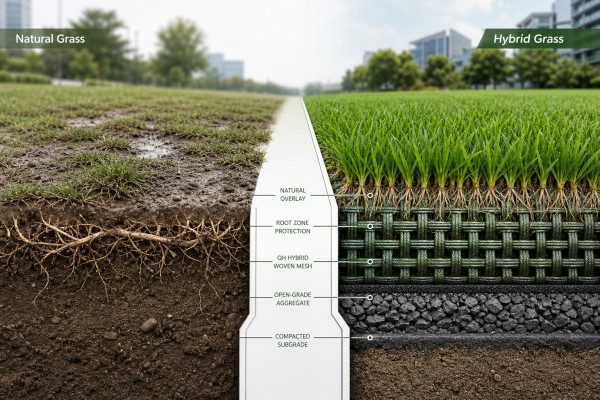
You might wonder how this structural upgrade actually impacts your project timeline and commercial maintenance budget. Let us break down the physical parameters and engineering benefits that separate these two landscaping options for B2B contractors.
How does the physical structure differ between hybrid grass and natural grass?
Municipal landscapers often watch expensive natural grass die in high-traffic zones. Soil compaction and direct impact destroy pure natural turf.1 An engineered mesh structure prevents this mechanical damage right at the soil level.
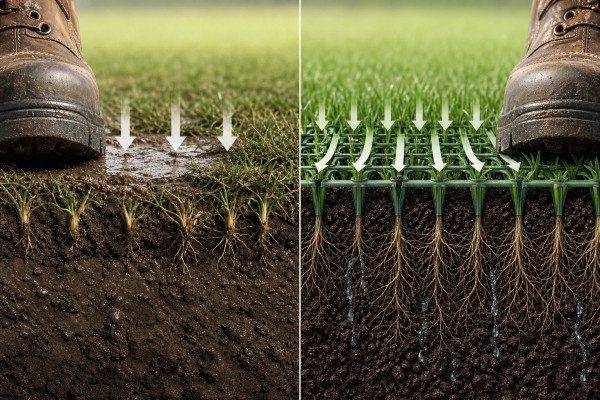
Pure natural grass exposes its crown and root system directly to trampling forces. Hybrid grass features a specialized open woven mesh bottom that absorbs physical impact. This synthetic armor distributes weight across the structural grid, ensuring natural grass roots remain uncrushed even under heavy municipal or commercial foot traffic.
In my years managing artificial grass exports, I see many contractors confuse a hybrid grass system with standard artificial turf. They are not the same. Standard artificial turf has a solid polyurethane or latex backing. An open woven hybrid turf—often called a grow-through turf—is fundamentally different. The backing is a highly permeable, open structural grid.
The "Armor" Mechanism Explained
When you specify pure natural grass for a public park or school campus, you rely solely on biology. When a pedestrian steps on it, their full body weight crushes the grass crown against the soil. Over time, the soil compacts, the roots suffocate, and the grass dies.
A hybrid system introduces a mechanical defense layer. The high tensile strength of the synthetic mesh creates a supportive canopy.
| Feature | Pure Natural Grass | Open Woven Hybrid Grass |
|---|---|---|
| Root Protection | None; roots take direct impact | High; mesh absorbs footfall weight |
| Soil Compaction | High risk under foot traffic | Low risk; grid distributes pressure |
| Base Structure | Natural soil only | Open woven synthetic grid + soil |
| Tensile Strength | Low (easily uprooted) | High (synthetic fibers anchor the system) |
Biological Growth Meets Synthetic Engineering
The natural grass seeds germinate in the soil below our open mesh. As the real grass grows, it pushes directly through the open woven grid. When people walk on the surface, their shoes hit the resilient synthetic fibers and the durable mesh, not the fragile natural grass crown. You get the biological benefits of living grass with the mechanical durability of synthetic engineering. For B2B contractors, this physical barrier translates to a massive reduction in landscape failure rates. While my factory controls the exact mesh size and tensile strength of this grid, I always advise buyers to consult local agronomy experts for their specific soil and seed selections.
What is the difference in project timelines for hybrid grass and natural grass?
Long project handovers hurt your bottom line. Waiting months for pure natural grass seeds to establish leaves construction sites looking barren and vulnerable to erosion. You need a solution that delivers immediate visual results for your clients.
The timeline difference between hybrid grass and natural grass comes down to immediate visual impact. Natural grass requires weeks or months of vulnerable growth before a project looks complete.2 A hybrid grass system provides an instant green landscape the moment it is unrolled, covering the soil while real grass grows through.
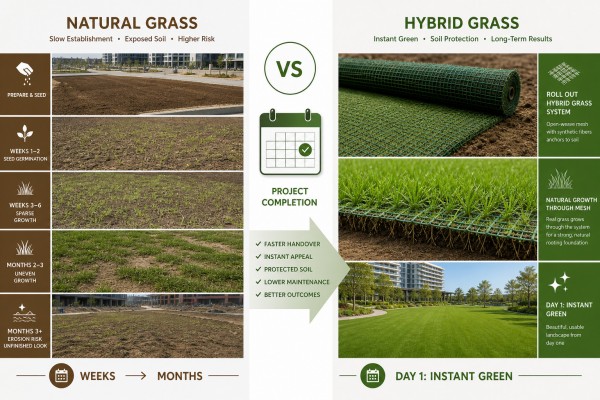
Time is money for municipal, landscape, and sports field contractors. The timeline for a pure natural grass project involves significant delays. You must fence off the area. You wait for germination. You hope that birds do not eat the seeds, and you worry that heavy rain might wash the topsoil away before the roots take firm hold.
Instant Green Handover
With an open woven hybrid grass system, the construction site turns green on day one. The synthetic fibers stand upright, providing a finished, pristine aesthetic immediately after installation. This instant green capability allows contractors to close out projects faster, remove unsightly construction fencing, and satisfy client expectations without the long biological wait.
Seed Protection Phase
During the critical early growth phase, the open woven hybrid turf acts as a protective blanket.
- Erosion Control: The mesh holds the soil in place during heavy rain.
- Seed Protection: It shields vulnerable grass seeds from birds and wind.
- Microclimate Creation: The synthetic fibers help retain slight surface moisture, aiding germination.
This dual-functionality—providing an instant visual finish while nurturing the natural grass below—is exactly why commercial landscapers upgrade to hybrid turf. You secure project approval quickly while ensuring the long-term biological success of the green belt.
How do weather and drainage compare for hybrid grass and natural grass?
Heavy rainfall quickly exposes the weakness of standard landscaping. Pure natural grass fields easily turn into unusable mud pits that require expensive remediation. You need a commercial surface that stays stable regardless of the weather forecast.
Weather and drainage represent a major difference between hybrid grass and natural grass. High-traffic natural grass compacts, creating poor drainage and muddy surfaces. The open woven bottom of hybrid grass ensures excellent water permeability, maintaining a stable, mud-free surface while allowing the soil to breathe naturally.
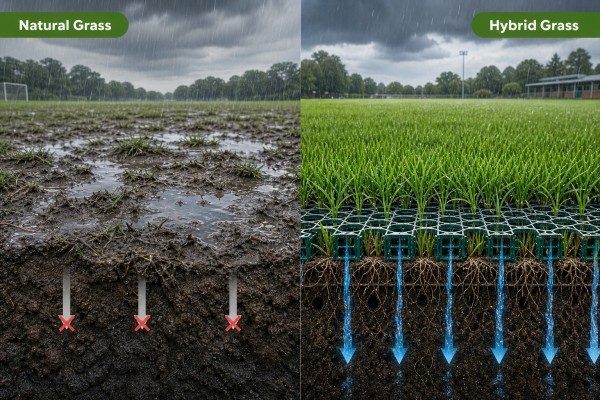
In commercial landscaping, a muddy public park, hotel courtyard, or school campus is a massive liability. Natural grass soils compact heavily under foot traffic, especially when wet. This compaction destroys the soil’s macro-pores. Water cannot drain through compacted dirt, which results in standing water and deep mud.
Preventing the Mud Pit Effect
Hybrid grass systems prevent this compaction entirely. Because the synthetic mesh absorbs the compressive forces of foot traffic, the soil underneath remains loose and aerated. The open woven bottom structure features an incredibly high drainage rate. Water passes directly through the grid into the uncompacted soil below.
Breathability and Recyclable Compliance
This breathability is not just good for rapid drainage; it is absolutely essential for the natural grass roots to survive.
| Weather Factor | Pure Natural Grass | Hybrid Grass System |
|---|---|---|
| Heavy Rain | Prone to flooding and mud | Rapid drainage through open mesh |
| Drought/Winter | Turns brown and barren | Remains green due to synthetic fibers |
| Soil Aeration | Decreases over time with traffic | Maintained by the protective grid |
Additionally, our hybrid synthetic turf uses environmentally friendly, recyclable materials. Government project suppliers and municipal contractors increasingly demand recyclable compliance for public works. The synthetic components withstand UV degradation and harsh weather. Even when the natural grass goes dormant and turns brown in the winter, the synthetic green fibers keep the landscape looking vibrant and well-kept.
What is the difference in maintenance costs between hybrid grass and natural grass?
Commercial maintenance budgets drain quickly when replacing dead grass. Repairing bald patches in high-traffic zones is an endless cycle of labor and material costs. A structural upgrade stops this financial bleed.
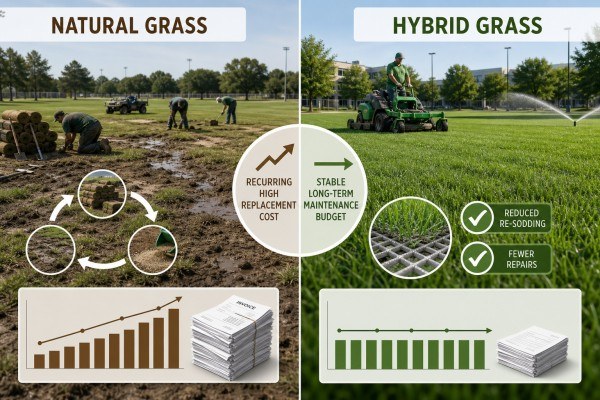
The maintenance difference between hybrid grass and natural grass lies in commercial replacement costs. While hybrid grass still requires botanical care like watering and mowing, it eliminates the expensive need to constantly replant, re-sod, and repair the bald patches that inevitably plague pure natural grass projects.
I need to be very clear with my B2B clients: hybrid grass is not 100% maintenance-free. If your project demands zero botanical maintenance, you should specify standard, closed-back artificial grass. Hybrid turf contains living, breathing natural grass. Therefore, you must water it, fertilize it, and manage its biological health.
The Botanical Reality
You will still need to mow a hybrid grass system. The synthetic fibers are manufactured at a specific pile height designed to sit slightly below the ideal mowing height of your natural grass. Because of this, your maintenance crews can use standard mowing equipment. They simply set the mower blades high enough to cut the growing natural grass without clipping the synthetic fibers.
Eliminating the Replanting Cycle
The true commercial ROI of a hybrid system comes from its permanent durability. In municipal green belts, roadside landscaping, or busy private estates, pure natural grass consistently fails near walkways, benches, and entrances. Landscapers spend thousands of dollars annually ripping up dead sod, loosening compacted soil, and replanting these bald zones.
An open woven hybrid turf acts as a permanent anchor. Even if the natural grass blades die back during an extreme drought, the synthetic fibers keep the area green and prevent soil erosion. Once the weather improves and you resume watering, the natural roots regenerate safely from beneath the protective mesh.3 By eliminating the endless cycle of re-sodding, commercial properties drastically lower their long-term maintenance budgets.
Frequently Asked Questions
Can I use standard mowers on hybrid grass?
Yes, you can use standard mowing equipment. The synthetic fibers of the hybrid grass system are manufactured at a specific height. You simply set your mower blades to cut the natural grass slightly above the synthetic fibers to avoid damaging the synthetic mesh.
Does hybrid grass drain like natural grass?
Hybrid grass often drains much better than high-traffic natural grass. Because the open woven mesh prevents soil compaction, water permeates freely through the structural grid and into the ground instead of pooling on the surface to create mud.
Do you supply the grass seeds with the hybrid turf?
No, we manufacture and export the synthetic open woven hybrid turf rolls. We highly recommend consulting a local agronomist or landscaping expert to select the best natural grass seeds and soil composition for your specific local climate and project requirements.
Conclusion
Understanding the difference between hybrid grass and natural grass allows you to make smarter, more profitable engineering decisions for your landscaping projects. While pure natural grass struggles with root compaction, mud, and bald spots, an open woven hybrid grass system provides instant green aesthetics and physical armor that protects roots from high-traffic trampling.
If you are a landscape contractor, importer, or project supplier looking to source highly durable, permeable grow-through turf, my factory can support you. At QH Grass, we specialize in B2B wholesale and full-container manufacturing (minimum order of 3,000 sqm per specification). Contact me, Alice Chen, at [email protected] or via WhatsApp at +86 185 7566 0746 to discuss your next commercial landscaping project.
-
"Foot traffic on turf primarily shaped the endophytic bacteriome of the soil …", https://pmc.ncbi.nlm.nih.gov/articles/PMC12014648/. Agronomic research demonstrates that mechanical wear from foot traffic directly damages plant tissue, while the resulting soil compaction restricts root growth and ultimately leads to turf decline. Evidence role: mechanism; source type: education. Supports: The physiological and structural damage caused to natural turfgrass by soil compaction and direct mechanical wear.. Scope note: The rate of turf destruction depends heavily on the specific grass species and soil type. ↩
-
"Healthy Lawns—Grass development: Seed germination rates – UC IPM", https://ipm.ucanr.edu/TOOLS/TURF/ESTABLISH/germin.html. Horticultural extension guidelines indicate that turfgrass grown from seed typically requires 4 to 8 weeks for initial establishment and several months to develop a mature, traffic-tolerant root system. Evidence role: general_support; source type: education. Supports: The standard germination and establishment timelines for commercial turfgrass from seed.. Scope note: Establishment timelines vary significantly based on climate, season, and grass species. ↩
-
"[PDF] Winter Desiccation Prevention and Recovery in Turfgrass", https://digitalcommons.unl.edu/cgi/viewcontent.cgi?article=1120&context=agronhortdiss. Botanical research on turfgrass physiology indicates that as long as the meristematic tissue within the grass crown is protected from mechanical destruction, the plant retains the capacity to regenerate shoots and roots following environmental stress. Evidence role: mechanism; source type: research. Supports: The biological importance of protecting the turfgrass crown for post-stress regeneration.. Scope note: Regeneration also requires adequate restoration of soil moisture and favorable temperature conditions. ↩