_画板-1.png)
You secured a massive landscape contract, but shipment delays now threaten the deadline. Panic sets in. Choosing the right turf partner prevents this nightmare and ensures project success.
Supplier choice dictates project profitability and reputation. The right partner ensures consistent quality through ISO standards, provides on-time delivery to avoid penalty testing, and offers transparent communication. This stability protects you from hidden costs like replacement labor and material failure.
I have seen many businesses fail because they focused only on the lowest price. The initial savings look good on paper. However, the real trouble starts when the containers arrive. Let us look at why this decision matters so much for your long-term growth.
Cheap quotes tempt every buyer. But when the turf fades in six months, your reputation crumbles. Hidden costs1 destroy profit margins faster than high material prices.
Hidden costs include expensive rework labor, penalties for project delays, and loss of future contracts due to reputational damage. Unreliable suppliers often cut corners on UV stabilizers or backing glue, causing early product failure that costs more to fix than the initial savings.
The Trap of Cutting Corners
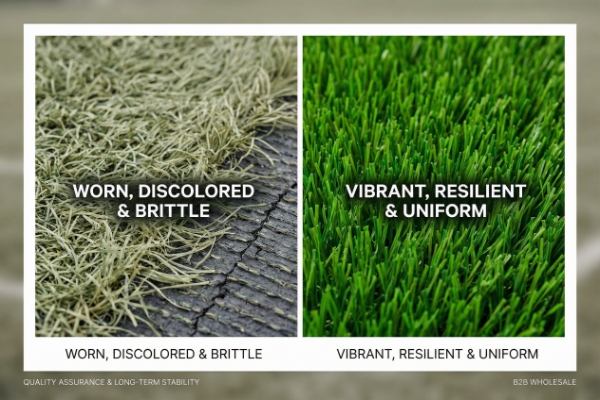
I often tell my clients that a supplier who cuts corners is actually worse than a fraudster. This might sound extreme, but let me explain. If you meet a fraudster, you might lose your deposit. That is painful, but it is a fixed loss. You know where you stand.
However, a supplier who cuts corners sends you a product that looks acceptable but lacks durability. They might reduce the amount of UV stabilizer in the yarn to save money. They might use cheap latex glue for the backing. You import this grass. You pay for sea freight. You pay import duties. You pay your installation team to lay it down at your customer’s site.
Six months later, the grass falls apart or fades to white. Now, you face a disaster. You must remove the old grass. You must dispose of it. You must buy new grass. You must install it again. The financial loss is four or five times the original cost of the goods.
Quality Management Systems2 Matter
Factories without a strong quality system rely on luck. I started in the technical department, so I know how production works. If there is no strict system, the worker might change the machine speed or temperature without recording it.
This leads to "batch inconsistency." Your first container is good. Your second container has stripes. This inconsistency kills large projects. You cannot finish a football field if the second half of the grass is a slightly different shade of green.
Here is a breakdown of the real costs when quality fails:
| Cost Category | Description | Impact on Your Business |
|---|---|---|
| Replacement Costs3 | Buying material twice. | Direct loss of capital. |
| Labor Costs | Installation, removal, re-installation. | Triples your labor expense. |
| Reputation Damage | Negative reviews and word of mouth. | Loss of future sales. |
| Legal Risks | Contract penalties for delays. | Potential lawsuits. |
You need a supplier who values their reputation as much as you value yours. High profits from cheap materials are temporary. The losses from a failed project stay with you for years.
What are the non-negotiable points when auditing turf suppliers?
You can not trust a website description alone. Flying to China is expensive, but blind trust is risky. How do you verify a factory without being there every day?
Non-negotiable audit points include current ISO 9001 certification4, verified RoHS or REACH safety reports5, and a documented quality control log. You must insist on pre-production sample approval and random final inspections before the container leaves the factory floor.
Verification of Certificates
When I verify a factory, I do not just look at the logo on their website. You must demand the actual documents. The first non-negotiable is the ISO 9001 Quality Management System certification. This proves the factory has a standard process for how they work. It means they do not just make things up as they go.
The next critical documents are safety tests like RoHS or REACH. These test for hazardous substances like heavy metals. In countries like the USA, Australia, and parts of Europe, safety is a huge concern. You cannot sell grass that contains lead. A supplier who lacks these reports is too risky for any serious market.
The Production Audit Process
Paperwork is only the start. You need to audit the physical product during production. Many buyers skip this, but you must not.
This starts with the "Golden Sample." Before you send the deposit, you verify a sample. I keep this sample in a sealed bag. When the mass production starts, the factory must match this sample exactly.
You must also ask for Quality Control Logs. A real factory keeps a record of every roll. They record the weight, the pile height, and the stitch rate. If they cannot show you these logs, they are not checking the quality.
Finally, perform Random Inspections. Do not let the factory choose which rolls to check. You or your agent pick rolls at random from the warehouse.
| Audit Step | Action Required | Why it is Necessary |
|---|---|---|
| Pre-Order | Verify REACH/RoHS and ISO 9001. | Ensures safety and process stability. |
| Production | Check QC Logs daily. | Ensures the machine settings did not change. |
| Pre-Shipment | Randomly inspect 10% of rolls. | Catches defects before they leave the port. |
I act as a gatekeeper for my clients. We check these parameters strictly. If a supplier hesitates to show you their production logs, that is a major red flag. Transparency is the foundation of trust in this industry.
Conclusion
Your supplier is your business partner. Avoid hidden costs by strictly auditing for ISO and safety standards. Choose stability over the lowest price to ensure long-term success.
-
Understanding hidden costs can help you make informed decisions and avoid costly mistakes in supplier selection. ↩
-
Exploring the role of quality management can enhance your supplier evaluation process and ensure better product consistency. ↩
-
Knowing replacement costs can help you assess the true financial impact of choosing the wrong supplier. ↩
-
Understanding ISO 9001 certification helps ensure suppliers maintain quality management standards, crucial for reliable partnerships. ↩
-
Exploring RoHS and REACH reports reveals essential safety standards for products, protecting consumers and ensuring compliance. ↩
_画板-1.png)