_画板-1.png)
Municipal contractors and landscape architects often struggle with a recurring nightmare: natural vegetation breaching their synthetic grass installations. You might wonder, will grass grow through artificial turf and ruin your expensive commercial project? The answer depends entirely on the backing technology you choose.
Yes, grass will grow through artificial turf. In traditional synthetic grass with solid PU or latex backings, weed and grass penetration damages the structural integrity and causes premature failure. However, in open-woven hybrid turf systems, natural grass is intentionally designed to grow through the mesh backing, creating a highly durable, ecologically friendly surface.
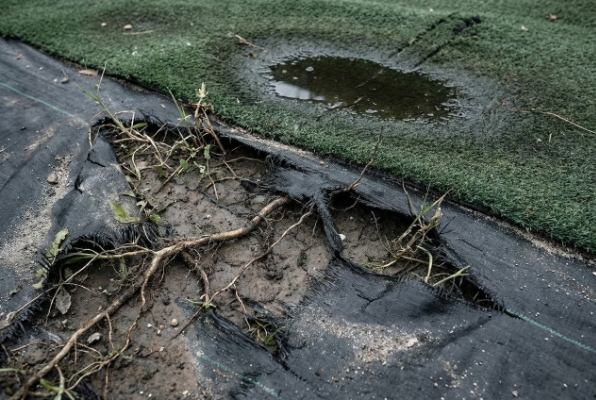
Bridging the gap from unwanted weed damage to intentional ecological design requires a complete shift in perspective. Let’s explore why traditional commercial turf fails when breached by nature, and how modern woven hybrid solutions turn this exact process into a major landscaping advantage.
Why does grass growing through artificial turf destroy traditional backings?
You invest heavily in commercial landscaping, expecting a durable, maintenance-free surface for your municipal project. Then, aggressive green shoots appear, cracking the foundation and severely shortening the product’s lifespan. Why does this structural failure happen?
When grass grows through artificial turf with traditional polyurethane (PU) or styrene-butadiene rubber (SBR) backings, the natural roots physically break apart the solid matrix1. This causes drainage holes to clog, backing materials to crack, and tuft lock to fail, ultimately destroying the synthetic grass.
When I review failed commercial installations with engineering companies, the culprit is rarely the synthetic yarn itself. The failure happens at the base. Traditional artificial grass uses a solid latex or PU coating to lock the tufted yarns in place. The manufacturer then punches small, spaced holes into this backing to allow for water drainage.
These drainage holes are the weak points. When wind-blown seeds take root, or aggressive native grasses push up from the sub-base, they seek the path of least resistance. They push through the drainage holes or physically fracture the rigid latex. Once the backing cracks, the yarn loses its tuft bind.2 The fibers shed, the surface becomes uneven, and the entire roll must be replaced.
Buyers in the commercial space must understand that traditional artificial grass is designed to suppress nature, not cooperate with it. If your project environment is highly prone to aggressive natural growth, forcing a solid-backed product into the area requires extensive, chemical weed barriers and heavy sub-base excavation.
To help procurement teams evaluate their options, I often use this basic structural comparison during factory consultations:
| Feature | Traditional SBR/PU Turf | Open-Woven Hybrid Turf |
|---|---|---|
| Backing Structure | Solid latex/PU with punched holes | Open grid, woven mesh structure |
| Natural Growth | Destructive (causes cracking and shedding) | Intentional (ecological coexistence) |
| Drainage System | Limited to specific punched holes | 100% permeable across the entire surface |
| Application Focus | Total weed prevention and isolation | Green landscaping & structural root protection |
How does open-woven hybrid turf let grass grow through artificial turf successfully?
Municipal projects often face strict ecological requirements and green-space quotas. Traditional artificial grass doesn’t meet these environmental standards, but pure natural grass fails rapidly under heavy pedestrian foot traffic.
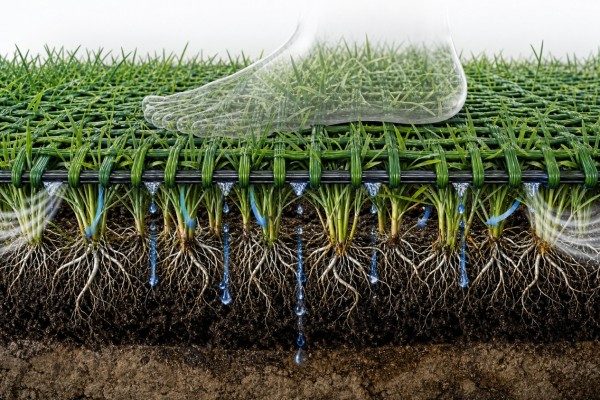
Open-woven hybrid turf solves this by featuring a highly permeable, mesh-like backing. It allows natural grass to grow through artificial turf seamlessly. The synthetic fibers protect the natural grass crowns from heavy wear, while the natural roots anchor the entire system deep into the soil.
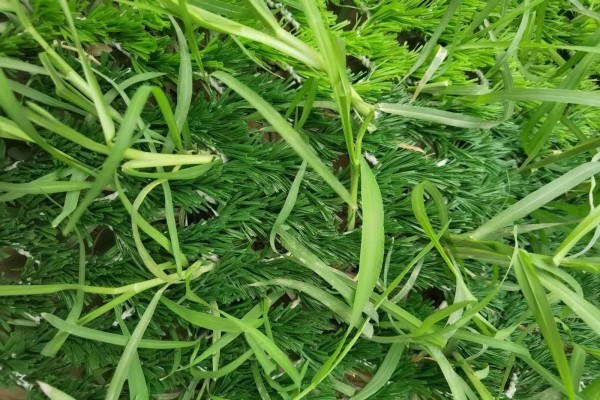
Instead of fighting nature, open-woven hybrid grass systems embrace it. During my consultations with landscape contractors, I emphasize that the magic lies in the manufacturing process. Instead of tufting yarn into a solid sheet and coating it in heavy rubber, hybrid turf utilizes a specialized weaving technique. The synthetic fibers are woven into an open grid pattern, leaving consistent, open spaces across the entire roll.
This open grid serves a dual purpose. First, it offers 100% water permeability. You do not have to worry about blocked drainage holes causing surface flooding in public parks or roadside green belts. Second, it acts as a physical framework for natural vegetation.
When you prepare a site, you sow natural grass seeds directly into the topsoil. You then lay the open-woven hybrid turf over the seeded area. As the seeds germinate, they naturally grow upward through the open spaces in the mesh. The synthetic yarns stand taller than the mesh base, acting as a protective cage. When pedestrians walk across the surface, their shoes compress the synthetic fibers, protecting the fragile growing crown of the natural grass from fatal crushing forces3.
Simultaneously, the natural grass roots grow downward, tangling with the woven backing and penetrating deep into the earth. This biological anchoring creates an incredibly stable surface, making it an excellent choice for slope stabilization, municipal embankments, and heavy-use public green areas. Furthermore, because these woven products often avoid heavy latex coatings, they utilize more environmentally friendly, recyclable materials, directly supporting green building initiatives.
What is the difference between open-woven and stitched hybrid grass?
Buyers frequently ask me for "hybrid turf" quotes without specifying the underlying technology. Misunderstanding the terminology in this industry can lead to drastically over-budget procurement or purchasing the wrong product entirely.
While both systems combine real and synthetic fibers, open-woven hybrid turf is a roll-based product laid over seeded soil, allowing grass to grow through the mesh. Stitched hybrid systems involve massive machines injecting synthetic fibers directly into an existing natural grass pitch, costing significantly more.
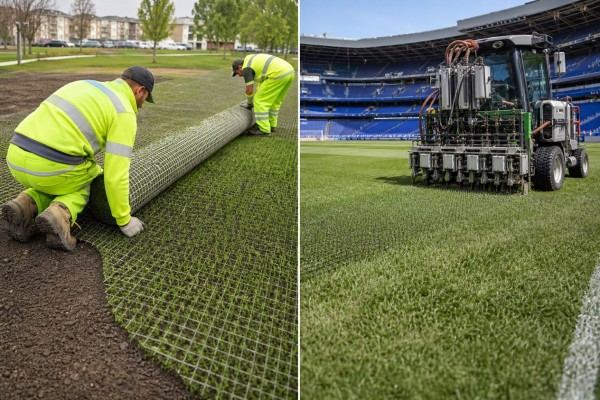
The term "hybrid" is heavily marketed, but it refers to vastly different manufacturing and installation realities. When a sourcing agent asks me for hybrid grass for a local school district or a municipal park, I immediately ask them to clarify their required installation method.
Here is how B2B buyers must differentiate the two primary systems:
- Stitched/Injected Hybrid Turf: This is the technology you see in professional stadiums. It is not manufactured in a factory and shipped in a container as a finished roll. Instead, contractors grow a massive natural grass field. Then, a multi-million-dollar machine drives over the field, injecting synthetic fibers deep into the soil every few millimeters. The costs are astronomical, and the process requires highly specialized, localized contracting crews.
- Open-Woven Hybrid Turf: This is the product we manufacture at the factory level. It is produced on weaving looms, rolled up, and shipped in standard 40HQ containers globally. Your local landscape contractors unroll it over prepared soil, secure it, and let the natural grass grow through the mesh. It is highly scalable, cost-effective, and perfect for commercial landscaping, standard sports fields, and municipal greening.
For wholesale importers and B2B distributors, open-woven hybrid turf is the viable commercial product. It allows you to order in bulk (our standard MOQ for custom specs is 3,000 sqm), ship via standard sea freight, and supply local construction companies with a product they can install using standard earth-moving and landscaping equipment.
Will grass grow through artificial turf instantly after installation?
Project managers often face tight handover deadlines for commercial builds. They want an instant green landscape but also require the long-term ecological benefits of natural root systems immediately.
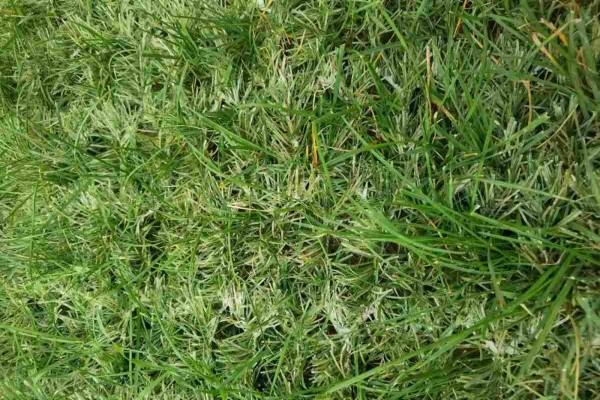
No, natural grass requires time to germinate and grow through the artificial turf backing. However, the synthetic fibers provide an immediate, visually green landscape on day one. The actual biological growth timeline depends entirely on local climate, soil conditions, and the specific seed type used.
Managing project expectations is a critical part of my job as a factory representative. I frequently remind engineering companies that while we manufacture the physical matrix, we cannot control nature. The factory guarantees the UV resistance of the synthetic yarn, the tensile strength of the woven backing, and the structural integrity of the roll. We do not guarantee biological growth speeds.
When evaluating a project’s feasibility, I always ask contractors specific qualification questions:
- What is your local climate and average rainfall?
- What specific grass seed species are you specifying for the region?
- What is the expected timeline before the area opens to heavy foot traffic?
The installation process itself offers massive benefits during the waiting period. When contractors lay open-woven turf over freshly seeded soil, the mesh backing and synthetic yarns act as an erosion control blanket. The turf prevents heavy rains from washing the expensive seeds away. It also deters birds from eating the seeds.
From day one of the installation, the site looks manicured, green, and finished due to the synthetic fibers. Over the following weeks or months—dictated by the local climate and the chosen seed species—the natural grass will germinate, push through the grid, and blend completely with the artificial fibers. This provides the aesthetic benefit of instant greening with the long-term resilience of a biologically anchored hybrid system.
How do contractors maintain grass growing through artificial turf?
A common fear among facility managers is that combining natural and synthetic grass will double their maintenance workload. They worry they will ruin the synthetic fibers while trying to care for the natural grass.
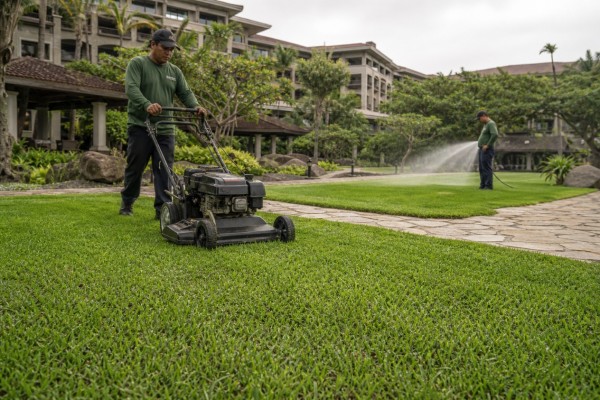
Maintaining grass growing through artificial turf requires standard natural grass care, such as watering and fertilizing. Standard rotary mowers can be used safely to trim the natural grass, provided the mower blades are set slightly higher than the synthetic fibers to avoid cutting the artificial matrix.
The maintenance reality of an open-woven hybrid system is highly efficient. Because the synthetic matrix protects the natural grass crown and prevents soil compaction to a degree, the natural grass actually suffers less stress. This means municipal crews spend less time patching bare spots, reseeding high-traffic areas, or dealing with deep mud ruts.
Watering requirements can also be optimized. The synthetic canopy provides slight shade to the soil level, reducing rapid moisture evaporation compared to a fully exposed natural field4. Fertilization happens exactly as it would for natural grass; the nutrients simply wash directly through the 100% permeable mesh into the root zone.
The most critical maintenance rule I stress to buyers involves mowing. You must instruct ground crews on the specific pile height of the synthetic turf installed. If the artificial yarn is 30mm tall, the mower blades must be set to 35mm or 40mm5. This ensures the mower only trims the natural grass blades that grow above the synthetic canopy, leaving the structural artificial fibers completely untouched and undamaged. Deep-tine aeration should be avoided or carefully calibrated, as plunging heavy metal spikes deep into the surface could tear the woven backing.
Frequently Asked Questions
Can I use a standard lawnmower on hybrid artificial turf?
Yes, standard rotary mowers work perfectly. You simply must adjust the cutting deck so the blades sit slightly higher than the pile height of the synthetic fibers. This trims the natural grass without damaging the artificial matrix.
Is open-woven hybrid grass environmentally friendly?
Yes. The open mesh design allows natural vegetation to thrive, promoting soil health and ecological coexistence. Furthermore, our open-woven designs use recyclable materials without the heavy, hard-to-recycle polyurethane or latex coatings found in traditional turf.
Do you need special equipment to install open-woven hybrid turf?
No. Unlike stitched hybrid systems that require specialized injection machinery, open-woven hybrid turf is installed much like standard artificial grass. Landscape contractors use typical earth-moving, seeding, and turf-laying tools.
How long does it take to manufacture a container of hybrid turf?
For a standard 1×40HQ container, our factory lead time is typically 15–20 days. For customized specifications (pile height, density, color), production takes 25–30 days, with each additional container adding about 10 extra days.
Conclusion
Understanding how and why grass grow through artificial turf is essential for modern commercial landscaping and municipal procurement. While traditional solid-backed synthetic grass will crack and fail when breached by natural roots, open-woven hybrid turf embraces nature. By utilizing a highly permeable mesh backing, this innovative product protects natural grass crowns, anchors deeply into the soil, and provides a durable, eco-friendly surface that looks green from day one.
-
"Polymer nanoparticles pass the plant interface – PMC – NIH", https://pmc.ncbi.nlm.nih.gov/articles/PMC9712430/. Botanical and materials science studies demonstrate that plant roots can exert significant radial pressure, capable of fracturing solid synthetic matrices and pavements over time. Evidence role: mechanism; source type: paper. Supports: The ability of plant roots to exert sufficient radial pressure to fracture solid synthetic matrices.. Scope note: Specific studies on polyurethane turf backings are limited, with most research focusing on asphalt, concrete, or general geosynthetics. ↩
-
"Synthetic Turf: History, Design, Maintenance, and Athlete Safety", https://pmc.ncbi.nlm.nih.gov/articles/PMC6299344/. Textile engineering analyses of synthetic turf confirm that the primary function of the secondary backing is to secure the tuft bind; cracking or degradation of this layer directly results in fiber shedding. Evidence role: mechanism; source type: research. Supports: The relationship between backing degradation and the loss of tuft bind in synthetic turf.. Scope note: Does not account for variations in tuft bind strength across different yarn types and manufacturing techniques. ↩
-
"A review on the limitations of natural fibres and natural fibre composites …", https://pmc.ncbi.nlm.nih.gov/articles/PMC9077356/. Agronomic research on hybrid turf systems demonstrates that synthetic fibers absorb mechanical stress, thereby protecting the natural grass crown and improving overall wear tolerance under heavy traffic. Evidence role: mechanism; source type: education. Supports: The mechanism by which synthetic fibers in hybrid turf systems protect the natural grass crown from mechanical wear.. Scope note: The degree of protection depends heavily on the density and height of the synthetic fibers relative to the natural grass. ↩
-
"Effects of woody plants on microclimate in a semiarid woodland", https://experts.arizona.edu/en/publications/effects-of-woody-plants-on-microclimate-in-a-semiarid-woodland-so/. Microclimate studies on hybrid turf systems suggest that the synthetic fiber canopy can reduce direct solar radiation on the soil surface, thereby lowering the rate of moisture evaporation compared to exposed natural grass. Evidence role: mechanism; source type: paper. Supports: The effect of a synthetic canopy on reducing soil moisture evaporation in hybrid turf systems.. Scope note: This effect may be offset by increased surface temperatures associated with synthetic materials in certain hot climates. ↩
-
"Synthetic Turfgrass and the Nine Principles of Florida-Friendly …", https://ask.ifas.ufl.edu/publication/EP612. Turfgrass management programs advise that mowing heights for hybrid turf systems must be strictly calibrated to remain above the synthetic pile height to prevent mechanical damage to the artificial matrix. Evidence role: expert_consensus; source type: education. Supports: Expert consensus on the required mowing heights for hybrid turf systems to avoid damaging synthetic fibers.. Scope note: Optimal mowing height also depends on the specific natural grass species being cultivated and seasonal growth patterns. ↩