_画板-1.png)
Do you notice your expensive artificial field wearing out faster than expected? This damage hurts your investment and player safety. The problem might be the shoes your players are wearing.
Yes, wearing the wrong soccer boots damages artificial turf significantly. Metal studs pierce the backing and break fibers. Using the correct AG, FG, or TF studs extends turf life, prevents bald patches, and ensures the safety of the players on your field.
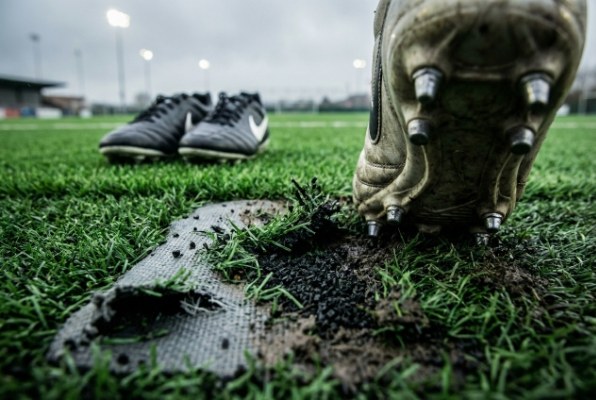
As an engineer at QH Grass, I have seen many fields ruined by bad shoe choices. It is painful to see a good product fail because of misuse. Let’s explore exactly why this happens and how you can fix it.
Why Is Artificial Football Turf So Popular and What Are the Common Usage Pain Points?
Artificial turf is everywhere now, but keeping it in good shape is hard. Are you struggling with unexpected damage on your sports fields?
Artificial turf is popular because it is durable and usable in all weather. However, users often face pain points like confusion over shoe selection, delayed repairs, and a lack of daily maintenance that accelerates aging and damage.
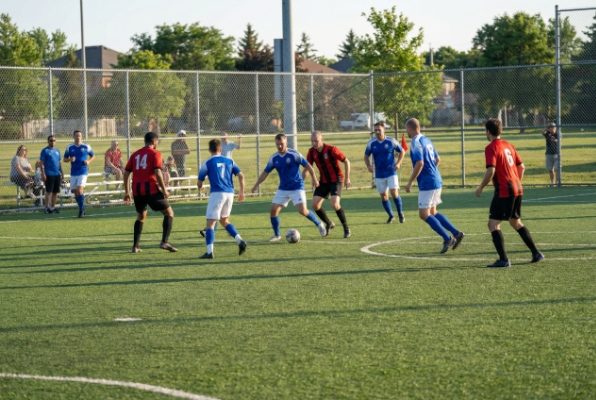
I talk to facility owners all the time. They love the low maintenance but hate the surprise repair bills. The statistics are clear. FIFA data shows that more than two-thirds of professional training grounds rely on this surface. Even three-quarters of school fields use it around the world. It is very popular. However, popularity brings problems.
I often see clients like Michael or David struggle with the same issues. The biggest pain point is confusion. Most players do not understand the technical difference between real grass and my products. They think they can wear anything. This leads to the indiscriminate use of metal studs. These players do not mean to cause harm, but they lack knowledge.
Another major issue is delayed action. A field manager might see a small tear. They think it is not a big deal. They wait. In a few weeks, that small tear becomes a "bald patch." The green fibers disappear. The black rubber flies out. This creates a safety hazard.
Finally, there is maintenance neglect. People think "artificial" means "no work." This is wrong. If you do not clean it, dirt grinds the fibers down. It ages the field too fast.
| Pain Point | Cause | Result |
|---|---|---|
| Shoe Confusion | Players lack knowledge of stud types. | Severe damage from metal studs. |
| Delayed Repair | Ignoring minor tears. | "Bald patches" and large holes. |
| Poor Maintenance | Believing turf cleans itself. | Accelerated aging and fiber wear. |
How Do Different Types of Soccer Studs Specifically Impact the Lifespan of Artificial Turf?
You might think all soccer cleats are the same. This mistake causes over 60% of the fiber breakage on synthetic fields.
Metal studs1 are the "number one killer" of artificial turf. They pierce the backing and destroy fibers quickly. In contrast, improper stud shapes create friction that pulls fibers out, causing bald patches and ruining the shock absorption layer.
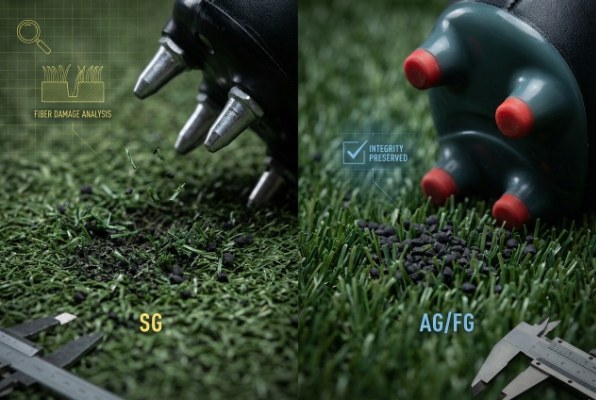
When I worked in the technical department of the designated workshop, I studied damage patterns closely. The results were shocking. Metal studs (often called SG or Soft Ground studs) are designed for muddy, natural soil. They need to dig deep. But on artificial turf, there is no deep soil. There is a backing cloth and a hard base.
When a player wears metal studs on my turf, two bad things happen. First, the sharp metal acts like a knife. It cuts the polyethylene fibers. This increases the fiber breakage rate by more than 60%. You will see green fuzz all over the field after a game. That is your investment dying.
Second, and more dangerous, is the piercing effect. The studs poke holes in the latex backing. This backing holds the grass in place. If you puncture it, water gets underneath. It ruins the glue. It damages the shock absorption layer. The turf starts to peel off the ground.
Therefore, 99% of suppliers, including us at QH Grass, explicitly prohibit these shoes. It is not just a suggestion. It is a rule to save your money.
The Impact Breakdown
- Fiber Cutting: Metal studs slice the grass blades during sharp turns.
- Backing Puncture: Long studs act like needles, destroying the structural integrity.
- Infill Displacement: They kick out too much rubber, making the field uneven.
| Stud Material | Impact on Fibers | Impact on Backing | Recommendation |
|---|---|---|---|
| Metal (SG)2 | Cuts fibers deeply (High Damage) | Pierces backing (Critical Damage) | BANNED |
| Hard Plastic (FG)3 | Moderate wear | Minimal impact if studs are short | Acceptable |
| Rubber/Composite (AG)4 | Low wear | Safe | Highly Recommended |
How Can You Precisely Select the Best Soccer Shoes for Artificial Sports Turf?
Choosing the right gear is confusing for many players. Do you want to know which shoes protect your knees and your field?
For artificial turf, you must choose AG (Artificial Ground), TF (Turf), or FG (Firm Ground) boots. These distribute weight evenly. AG shoes are best because they have more studs, which reduces pressure on the surface and prevents heavy wear.
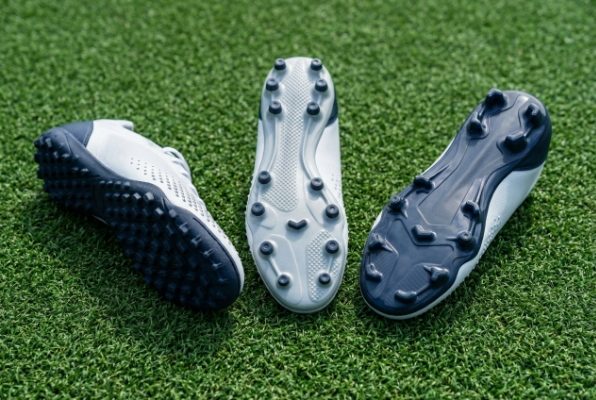
As a sales executive, I help customers grow their business. A big part of that is education. You need to tell your players exactly what to buy. You cannot just say "soccer shoes." You need to be specific.
The Best Choice: AG (Artificial Ground)
These are built for our industry. Search for "AG soccer boots" online. They are made of durable composite materials. They have more studs than normal shoes. Why does this matter? More studs mean the player’s weight is spread out. There is less pressure on any single point of the turf. This reduces wear.
The Alternative: TF (Turf)
These have tiny rubber bumps. They are great for thinner, older turf or playground surfaces. They are very safe for children.
Special Situations
We must also think critically about weather and age.
- Wet Weather: If it rains, the plastic gets slippery. You should choose AG studs with special anti-slip patterns. This helps with drainage and safety.
- Long-term Training: If you train every day, use AG studs with durable materials. This reduces the friction heat that melts the grass tips.
- Children: Safety is the priority. For kids, I recommend TF shoes or shoes with soft toe caps. This prevents injury if they kick the ground.
| Shoe Type | Best Surface | Pros | Cons |
|---|---|---|---|
| AG (Artificial Ground) | Standard Artificial Turf | Best grip, low turf wear, durable. | Not good for real mud. |
| TF (Turf) | Short Pile / Old Turf | Maximum safety, no stud pressure. | Less grip on long, wet grass. |
| FG (Firm Ground) | High-Quality Long Turf | Easy to find in stores. | Can wear down turf faster than AG. |
How Should You Handle Damage Repair and Daily Maintenance for Artificial Soccer Turf?
Even with the right shoes, damage can happen over time. Do you know how to fix a tear before it destroys the whole field?
You must address damage immediately. For minor loose fibers, trim and glue them. For moderate tears, patch the area with matching turf and seam tape. For severe base damage, contact professional teams to replace the substrate and avoid secondary issues.
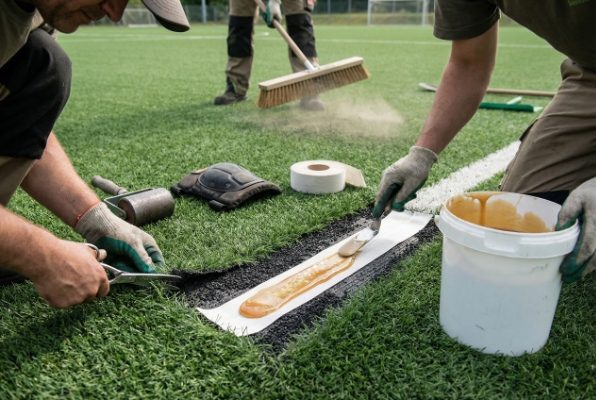
I advise my clients to be proactive. Do not wait. Damage grows like a disease. Here is my practical guide on how to fix issues based on their severity.
1. Minor Damage (Loose Fibers)
Sometimes you see fibers sticking up or coming loose.
- Action: Trim the broken fibers so the surface is flat.
- Repair: Apply specific artificial turf adhesive to the root.
- Cure: Press it down firmly. Let it dry for 24 hours. Do not let anyone walk on it.
2. Moderate Damage (Tears and Holes)
This is when you see a gap in the green carpet.
- Preparation: Cut the damaged area into a clean shape (like a square). Do not leave jagged edges.
- Replacement: Find a matching piece of turf. (I always tell clients to keep leftover scraps from installation!).
- Installation: Put seaming tape under the hole. Apply glue. Place the new piece in.
- Detailing: Stitch the edges if possible. Press it heavy.
- Cure: This needs 48 hours before you add the sand or rubber infill back in.
3. Severe Damage (Base Layer Cracking)
If the ground underneath is uneven or the main fabric is ripped open widely.
- Critical Thinking: Do not try to fix this yourself. You might make the drainage worse.
- Action: Contact a professional maintenance team. They might need to replace the substrate.
| Damage Level | Solution | Curing Time | Skill Level Needed |
|---|---|---|---|
| Slight | Trim and Glue | 24 Hours | Basic |
| Moderate | Patch and Seam | 48 Hours | Intermediate |
| Severe | Base Replacement | Varies | Professional Only |
Conclusion
Wearing the wrong shoes destroys artificial turf and hurts your wallet. You must ban metal studs and ensure prompt repairs. This keeps your field profitable and safe for years.
-
Understanding the impact of metal studs can help you protect your turf investment and choose the right footwear. ↩
-
Explore this resource to understand why Metal (SG) studs are banned on artificial turf and how they damage the field. ↩
-
Explore this link to understand how Hard Plastic (FG) studs can enhance turf longevity and player safety. ↩
-
Explore the benefits of AG studs to enhance your playing experience and protect your turf. ↩
_画板-1.png)